










O’Rourke’s enjoyable documentary travels to the tourist hot spot of Cinque Terre, on Italy’s northwestern coast
Dir: Gar O’Rourke. Ireland/Switzerland. 2026. 82mins
For Irish filmmaker Gar O’Rourke’s follow-up to his well-received 2025 documentary Sanatorium, he trades the spartan aesthetic of a Soviet-era health resort in Ukraine for the warmer climes of Italy’s stunning Cinque Terre. This collection of five picturesque villages perched on the country’s northwestern coast has around 4,000 permanent residents but, during the summer season, swells with an average of 4.5 million visitors. While O’Rourke’s gentle exploration of the cultural and environmental costs of unchecked tourism is not as nuanced or incisive as his previous film, it’s still immensely watchable and thought-provoking.
O’Rourke has a knack for finding the interesting characters and the intriguing stories
Premiering in Tribeca – where it won a special jury mention for cinematographer Lukas Gut – before playing Galway Film Fleadh, The Siege Of Paradise should travel to further festivals. Like Sanatorium, it could well secure a local theatrical release, and the presence of Swiss co-producers Dynamic Frame (the film has no Italian funding) could see it land a theatrical deal there. The global popularity of Cinque Terre – particularly with US visitors – may help its onward journey.
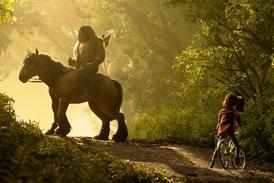
That award-winning cinematography is undoubtedly the star of the show, as O’Rourke and Swiss DoP Gut capture the breathtaking beauty of the villages of Cinque Terre – Corniglia, Manarola, Monterosso, Riomaggiore and Vernazza – in wide, sun-drenched overhead panoramas or agile shots that wind around the car-free cobbled streets. Every frame is artfully composed, taking in the stunning coastline, the lush mountain vineyards and the brightly coloured houses clinging precariously to the rugged landscape. It’s no surprise that millions of people are driven to discover it for themselves.
Tourism has become the bedrock of Cinque Terre’s economy, central to the lives of locals like cantankerous restaurant owner Carmelo, who lives a comfortable life but is unhappy about the amount he has to work – and the fact his teenage daughter is less than impressed with the idea of taking over the place. That’s a problem here; with an ageing, dwindling population, local customs and traditional ways of life – fishing, winemaking – are being lost. Personable vintner Bartalo, who tends the mountainous vineyard that has been in his family for generations, is more sanguine; he is not blind to the ravages of tourism, but also appreciates the fiscal opportunities for vineyard tours and summer wine sales.
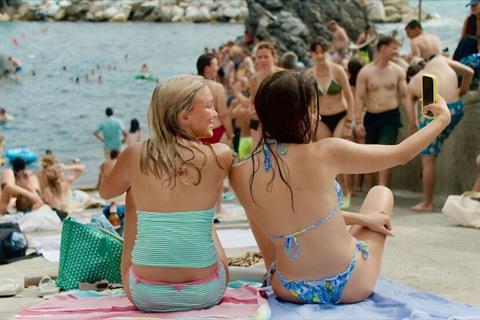
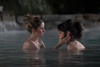
While Cineque Terre was named a Unesco World Heritage Site in 1997, most of the visitors here are more interested in capturing the perfect snap for Instagram, often lining up at popular spots, than learning about its culture and history. Social media has fuelled the area’s popularity – even though influencers like American Grace and her friend Isabel are so preoccupied with making content that they are unable to simply revel in the experience of the moment. O’Rourke spends a lot of time with Grace, with sympathetic editing from John Murphy highlighting the absurdity of her work – she swims with a camera in hand, does multiple takes to camera with a bucket of Aperol Spritz – while slowly revealing that her glossy traveller’s life may not be as charmed as it appears; a neat metaphor, perhaps, for everyday life in Cinque Terre itself.
As with Sanatorium, O’Rourke has a knack for finding the interesting characters and the intriguing stories, and uses this handful of locals and visitors to create a narrative throughline. Another key character is Riomaggiore’s mayor, Fabrizia Pecunia, who is constantly advocating for increased legislative powers to help limit the impact of tourism. Cinematography and editing are also visually articulate; close-ups of overflowing bins, endless souvenir shops, Airbnb lock boxes and tourists swarming like locusts around the coastline make their own point. Denis Kilty’s European-flavoured soundtrack humorously draws on Western and military motifs to underscore the idea of tourism as an invasion of sorts, the camera regularly returning to the heaving boats and trains that deliver a fresh influx of visitors each day.
In this area, as in so many, unchecked tourism is a double-edged sword – Cinque Terre both suffers from and depends almost entirely on it. O’Rourke works hard to maintain an ethical balance, but the film’s determination not to pick a side does dilute some of its impact. A more detailed look at, for example, the area’s strained infrastructure and its migrant-fuelled service economy may have added some depth. Yet there’s also an argument a less personal, more didactic approach would have proved alienating; The Siege Of Paradise persuasively presents the facts about this delicate ecosystem and invites viewers to draw their own conclusions.
Production companies: Venom
International sales: MetFilm Sales
Producers: Andrew Freeman, Jessie Hayden, Ken Wardrop
Cinematography: Lukas Gut
Editing: John Murphy
Music: Denis Kilty




No comments yet