







Dir. Ervin Han, Raúl García. Singapore/Spain/Italy. 2026. 114mins
When an enterprising Spanish journalist tracks down a veteran virtuoso violinist and asks to hear the story of her cherished instrument, the result is an epic, multi-decade-spanning tale of love and loss, musical creation and the destruction of war. This year’s Annecy Cristal winner The Violinist tells of talented young musician Fei and orphaned violin prodigy Kai, who form a bond in childhood that goes beyond the music that they play together. Peopleing its fictional story with real hisorical figures, including resistance fighter Lim Bo Seng, this handsome, unapologetically old-fashioned and extremely sincere animated blend of melodrama and wartime thriller unfolds against the tumultuous backdrop of 20th century Singaporean history.
Unapologetically old-fashioned and extremely sincere blend of melodrama and wartime thriller
The film marks the first collaboration between Singaporean director Ervin Han, whose previous work includes the 2018 anthology picture Timescapes, and Annie-nominated Spanish filmmaker Raúl García, who has worked as an animator on several Disney pictures and directed the 2013 Edgar Allan Poe anthology Extraordinary Tales. The Violinist occupies a tricky-to-position middle ground for an animated feature: a little too mature in its themes and deliberate in its pacing to connect with family audiences, it is also perhaps too traditional in its approach to lure in the lucrative YA market. Still, the Annecy Cristal win is likely to boost the film’s profile and this, together with the richly textured musical component of the filmmaking might put the film on the radar of distributors and programmers looking for prestige pictures that may appeal to older demographics.
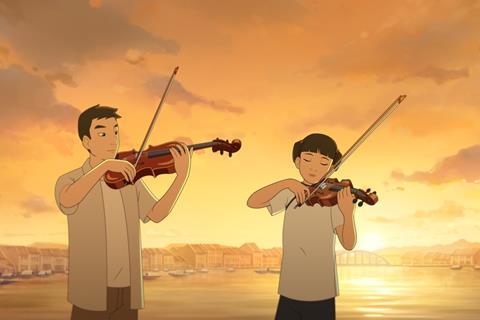
There’s a rewarding depth of detail to the film’s good-looking, traditional, predominantly 2D animation. In the film’s prelude, a moped race through the near-contemporary city of Singapore captures the space-age wow factor of the architecture. But it’s in the flashbacks to the city in the early 1930s, as Fei recounts her story, that the exceptional level of research undertaken by the filmmakers becomes clear.
In Fei’s well-appointed upper-middle-class home, every shelf is crammed with period-specific treasures and tiny details. It speaks of a comfortable, supportive and privileged existence, one in which Fei’s talent is nurtured and nourished with one-to-one sessions with a private violin tutor. Kai has no such safety net. A street-kid with no family, he is taken in by Fei’s family maid, Ying Jie. While helping out with the mop-wrangling and kitchen chores he listens to Fei practice, and his fascination for music is sparked; his unusual talent for the violin is identified shortly afterwards.
The children grow into inseparable teenagers who are never happier than when they are playing music together. When Japan launches its 1941 Malayan campaign, as part of the second Sino-Japan War, the pair are wrenched apart. Kai joins his benefactor, the businessman-turned-Singapore freedom fighter Lim Bo Seng, working as a spy in the Malaysian city of Ipoh. Fei struggles to survive in much-reduced circumstances after the Japanese requisition her family home. She takes in a pair of orphans and, thanks to music-loving Japanese officer Takeshi Inoue, finds work in an orchestra. Through the years of separation that follow, music keeps alive the memory of the spiritual, creative and romantic connection between Fei and Kai.
Music, not surprisingly, is central to the storytelling. (The picture also picked up the SACEM Award for Best Original Soundtrack in a Feature Film at Annecy). Classical works by Tchaikovsky, Paganini, Mendelssohn and others set the temperature for this epic tale. But most impressive is a new composition – an unfinished Sonata that Kai starts writing before the war and which Fei eventually performs many decades later. It’s a skin-tinglingly lovely piece of music. While the film might not have much that’s new to say about life during war and the unifying power of music, it’s a classy, well-made piece of animation
Production company: Robot Playground Media, TV On Producciones, Altri Occhi
International sales: France TV Distribution teo.jacquemin@francetv.fr
Producers: Ervin Han, Paloma Mora, Cristiano Bortone, Raul Garcia
Screenplay: Ervin Han, Jordan K. See
Artistic direction: Ru Wei Ong
Animation: Wendy Li
Editing: Elaine Chan
Music: Ricky Ho, Isabel Latorre
Main cast: Kheng Hua Tan, Kazuya Tanabe, Adrian Pang, Ayden Sng, Fang Rong