












Six Japanese filmmakers took part in an intensive week at Toronto Film School, the first cohort in a new partnership to bring global skills to the Japanese production industry
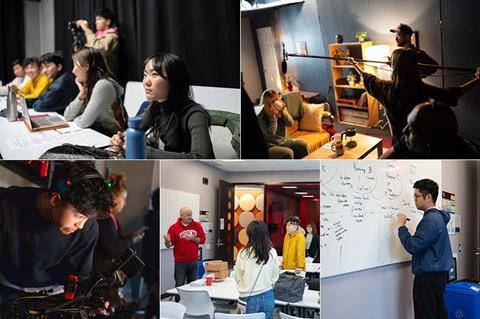
The first Global Filmmakers Lab: Japan took place right after September’s Toronto International Film Festival, and saw six Japanese filmmakers spend the week workshopping a script before casting, scheduling, shooting and cutting it into a finished short.
In partnership with Toronto Film School (TFS), the lab was delivered under Film Nexus-SEED, a programme organised by the Agency for Cultural Affairs, Japan Arts Council and Japan’s Visual Industry Promotion Organization (VIPO). Film Nexus-SEED is part of the Japan Creator Support Fund, which was established through supplementary funds from the Agency for Cultural Affairs and is administered by Japan Arts Council.
For TFS president Andrew Barnsley, a Primetime Emmy and Golden Globe-winning producer whose credits include Schitt’s Creek, the lab is a practical application of a tenet he holds dear. “There’s a real responsibility that goes along with being a film school — how do you make sure that transition from film school to the real world is as seamless as possible?” he says. “That’s been the fundamental mission of what TFS has been doing.”
VIPO came to the school with a simple brief. “They wanted to identify a small cohort of emerging, above-the-line talent, young filmmakers with one or two meaningful credits, so it’s about upskilling rather than training from ground zero,” says Barnsley. “They’re on a trajectory to have a meaningful impact in the industry.”
The six-day lab is the kind of programme that contributes to a sustainable global production ecosystem, he continues. “I’ve seen pain points where there’s labour shortages. I’ve seen pain points where your trained workforce wasn’t as trained as you’d like them to be. Film schools need to be delivering skilled labour who are going out and doing the work.”
The programme was structured as a full production cycle that “shines a light on the protocols, the conventions and the workflows of North American film and television production”, says Barnsley. Three of the six participants are already working outside Japan: Keito Ono, who travels between New York and Tokyo; Megu Maruyama, who is studying in London; and Akane Fukuhara, who is attending Université Paris 1 Panthéon-Sorbonne.
Meeting demand
For VIPO, the lab is part of a broader strategy to build a domestic cohort of crew and creatives who can work on the international productions increasingly choosing to shoot in Japan. The organisation points to a rise in inbound filming activity in the country that cannot always be met because of the shortage of local talent equipped to support them.
Naturally aligning with this goal is participant Naoya Ogasawara, who is specifically interested in cinematography and gaining international production skills.
“Our goal for this lab, and the programme as a whole, is to serve as a catalyst for developing such professionals,” says a VIPO spokesperson. “By developing a global perspective and foundational skills that thrive in a cross-cultural environment, we hope this programme serves as a strong stepping stone and a gateway to their future endeavours, such as participating in international co-productions.”
The throughline for such a global perspective is simple, says Barnsley: “Language and culture aren’t the barriers they used to be. Quality content will cross borders, will cross language.”
He adds that changes to Canada’s federal immigration policy had made it more difficult for TFS to train global talent. “It really stung,” says Barnsley. “We’ve travelled the world and seen the impact TFS alumni have had in their own industries. We want to contribute to jurisdictions that are developing their film industries, and we didn’t have the same ability to do that.”
In trying to decipher how to continue his mission when policy was getting in the way, Barnsley decided to go straight to the source: film commissions. After speaking to film commissioners from all over the world, he felt that with Japan, “immediately they were connecting the dots. Our instructors, programme directors and leadership team came together. This was our first time doing anything like this with an outside organisation, and we’re very excited about it.”
Barnsley found working with VIPO to be an easy and natural process. “This has been a great opportunity for TFS to get our feet wet with a partner who is supportive, who sees what we’re doing and who’s investing in their cultural industries too.”
TFS Training Programme Participants

Akane Fukuhara
Currently pursuing a master’s degree in filmmaking at Université Paris 1 Panthéon-Sorbonne, Fukuhara has worked in video production and international co-production. She is interested in fiction, documentary and international sales and distribution. She aims to develop her own filmmaking practice and explore new forms of cinematic expression across different cultures.
Noboru Kawasaki
Kawasaki is a philosophy student at the University of Tsukuba and a filmmaker. He has directed several shorts and a medium-length film. He is particularly interested in screenwriting and mise en scène, especially in directing actors.
Shin Kimura
Kimura is a director and screenwriter based in Japan. He graduated from Tokyo University of the Arts, where he studied under Kiyoshi Kurosawa and Nobuhiro Suwa. His short film Maaji (And Then How He Told The Horse Mackerel) screened at Osaka Asian Film Festival in 2025.
Megu Maruyama
Maruyama studied political science and economics at Waseda University and worked at broadcaster NHK as a news and documentary director for five years. Currently completing a master’s in filmmaking (producing) at Goldsmiths, University of London, her short Dear Tooth Fairy was nominated for best micro film at Little Flix London Film Festival. She is now developing international and cross-cultural film projects.
Naoya Ogasawara
Ogasawara is a fourth-year film student at Nihon University College of Art, specialising in cinematography. He has been a music lover since a young age, with rhythm and emotion inspiring his approach to visual storytelling. Through this overseas film programme, Ogasawara is seeking to deepen his filmmaking skills and discover new ways to express stories through images.
Keito Ono
Ono is a screenwriter, director and producer based in New York and Tokyo. An MFA candidate at Columbia University School of the Arts, his short films have been screened and awarded at major international festivals. Ono explores human emotion through cinema while collaborating with corporations to develop next-generation frameworks for the film industry.