












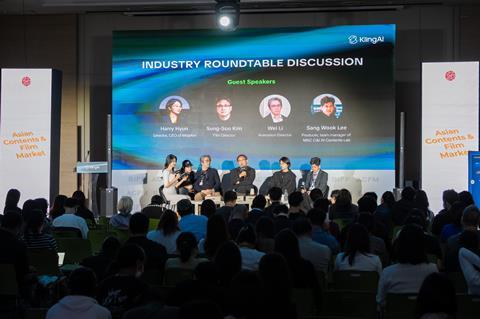
Four leading filmmakers and producers assembled in Busan to discuss the creative potential of artificial intelligence through real production cases spanning short films, animation, and live-action/AI hybrid workflows that have been developed using the latest 4.0 iteration of Kling AI.
Kling AI, the generative artificial intelligence service, hosted the special industry panel as part of the InnoAsia section of the Asian Contents & Market (ACFM) in Busan on October 11.
First up was Sung-Soo Kim, the film director behind Korean blockbuster hits including 12.12: The Day, who explained how he began using AI to complement VFX work before he came to realise that Kling provided a “powerful alternative,” helping him to see “possibilities previously not possible”.
“The question moved from ‘How cheap can we make a film?’ to how AI can fundamentally change how films are made,” said Kim. “Using Kling technology, I was able to create something very close to what I had in mind far quicker. This was something that used to require two years but now requires two days.”
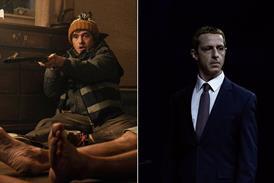
As Kim presented a trailer for his Franz Kafka-inspired short film Worm Train, developed using Kling, he marvelled at how AI can “redo” scenes without the budgetary constraints typical of live-action reshoots. Realising Kling 4.0 could render scenes he once struggled with convinced Kim that AI will not “destroy” the film industry like he once thought.
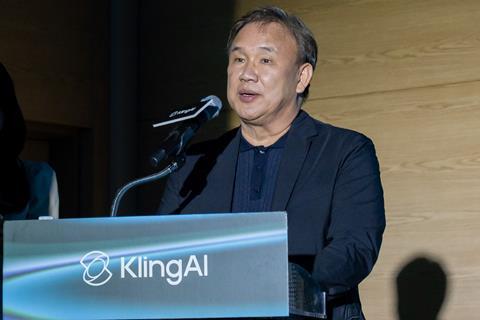
“My experience with this project got me thinking that traditional filmmaking will never come back to me. I’ll never go back to that,” said Kim. “Being able to see my imagination come to life this way has really changed me. In the future, we will never need to say ‘AI movie’ just as we don’t call films a ‘colour movie.’”
Joining him was animation director Wei Li who has more than 20 years of experience in the industry with credits that include acclaimed feature Big Fish & Begonia. Li introduced the Kling-developed Born Of The Tide, a 105-minute AI-animated feature about China’s boat-dwelling Tanka community, by explaining that AI is another creative tool in the same vein as paper or ink.
“Think of the time and costs it would have required to make Born Of The Tide using traditional tools,” said Li. “AI has brought a lot of surprises to me. By optimising traditional methods with AI, it can actually bring us more choices.”
“But whatever direction we need to take is decided by directors,” he added. “We don’t need to be worried about the rise of AI or the possibility of it replacing us. The impact of it on our industry should never be exaggerated. As filmmakers, it’s more about how we can best do the storytelling.”
Finding the humans behind AI content
Sang Wook Lee, leader of the AI Contents Lab at MBC C&I, also joined to discuss how he explores new storytelling horizons by actively embedding AI technology into professional production pipelines. The AI drama and film producer used his short-form series, Rendering Love, as an example.
Produced by MBC C&I and Barunson E&A, it combines live-action scenes filmed traditionally with AI generated characters to tell the story of a virtual K-Pop idol group.
“I believe AI content is about finding the humans behind the AI content,” said Lee, who uses Kling AI tools to train directors at his lab in order to foster new talent. “If even one or two individuals lag on the learning curve, overall quality can suffer.”
Harry Hyun, founder, CEO, and director of AI production company MooAm, rounded out the panel, bringing her experience as the visionary director of Netflix Korea’s hit film Crypto Man.
For Hyun, AI production is not fundamentally different from a traditional shoot. “The only difference is efficiency.” Experts in filmmaking are vital to ensure that the power of AI is implemented effectively.
As such, her directing team includes an “AI coordinator” that checks with AI artists for continuity to avoid the “cookie-cutter” approach that users less versed in the technology are at risk of producing. “If you don’t have experienced filmmakers on set, everything can end up looking the same.”
Contact: Ivy Yu