










“He was really an outsider. That was what was so good about him,” said director Stephen Frears, summing up what made Jeremy Thomas, the Oscar-winning British producer who died aged 77 last Friday, such a special figure within UK and international film culture.
“I can only tell you he was, in his own way, very subversive.”
Tributes to Thomas have poured in over the last few days from every sector of the industry: from filmmakers, distributors, fellow producers, sales agents, festival directors and even from the House of Lords. They’ve all emphasised his kindness, humour and his maverick spirit.
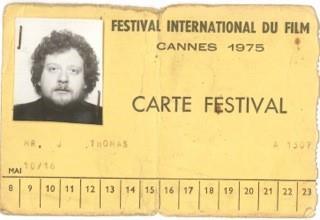
Some have talked about his passion for Grand Prix racing and Ducati motorbikes and the speed at which he drove. “He was a complete petrolhead,” said one. Others have reminisced about his dinners at the Carlton Hotel in Cannes where stars and other producers came to pay tribute.
Cannes Film Festival delegate general Thierry Fremaux was among those who shared memories: “Jeremy was a giant, and such a wonderful man. And an extraordinary friend. He was also a model of modesty – someone who kept on working and remained deeply loyal to his authors. I remember him arriving in Cannes by car from London; it was his tradition. He also came to the Lumière Festival in Lyon every year, saying, ‘Because we must remember our friends.’ So, we will remember him.”
Life and career
Thomas was born in 1949, the son of Ralph Thomas, director of The Doctor In The House comedies, and nephew of Gerald Thomas, the director behind the Carry On movies. The Rank Organisation’s leading male star of the era, Dirk Bogarde, was a close family friend. He met Judy Garland and could remember as a child going on the backlot at Pinewood Studios to watch Kenneth More star in A Night To Remember (1958), about the sinking of the Titanic.
In later years, Thomas would passionately defend the comedies his father and uncle made, calling them “a part of English heritage as much as Charlie Chaplin or Ken Loach or Powell and Pressburger,” and yet he himself produced very different movies like The Great Rock And Roll Swindle, Crash,Bad Timing and Merry Christmas, Mr Lawrence.
“He had this extraordinary childhood and he then became arguably the most subversive, maverick producer we have ever had. That is Jeremy’s legacy. Jeremy was absolutely the most rock and roll producer I have ever met in my life,” commented Adrian Wootton, CEO of British Film Commission.
“We all worshipped him. That’s really true,” said producer, academic and author Colin MacCabe. “He managed to do what every independent producer wants to do. He managed to function without having to deal with the mess of English filmmaking. He just went elsewhere. He was someone with a completely global vision in terms of production.
“It is not true that he never made a bad film but he made an astonishing number of good ones and he never made an uninteresting film,” added MacCabe. “Even the ones that didn’t succeed completely were ten times more interesting than the majority of the British film output.”
Thomas began his career in the British film industry by taking a job in a film lab – it was the easiest way to get his union card. He became an editor, working with, among others, Ken Loach and Karel Reisz. He ended up at production company Goodtimes Enterprises with Sandy Lieberson and David Puttnam.
“I was a massive admirer of Jeremy for over 50 years, from the moment he came to work as an editor at Goodtimes Enterprises to the day, two months ago, when he hosted a memorable 90th birthday celebration for Sandy Lieberson. In my view, amongst his entire generation of filmmakers he remained the most deeply in love with cinema,” Puttnam commented. “Every aspect of the industry fascinated him; his knowledge, understanding and commitment to filmmaking and filmmakers was absolute.”
Thomas set up production company Recorded Picture Company in the early 1970s. His first feature as producer was Mad Dog Morgan (1976), directed by Philippe Mora and shot in Australia. He went on to produce Polish director Jerzy Skolimowski’s British-made psycho drama The Shout (1978), adapted from a Robert Graves story and which famously opens with a cricket match in a lunatic asylum. The film won the Grand Prix in Cannes.
An important early mentor was veteran UK producer and sales executive Terry Glinwood who versed him in the art of pre-selling movies and whom he later called “the greatest sales and marketing mind I worked with”.
Crew members relished working with him, including longtime collaborators like production manager Joyce Herlihy and cinematographer Mike Molloy, as did actors and directors.
“It speaks to the person that so many filmmakers worked with him many times,” said his colleague and close friend Chris Auty, now director at London Film School. “What was fascinating with Jeremy was that the people who worked with him once always wanted to work with him again.”
“All his work was built around friendship, this was his intuitive choice,” agreed Israeli director Amos Gitai, who did films ranging from Promised Land (2004) to Shaken (2024) with Thomas and called him “a friend and an inspiration”.
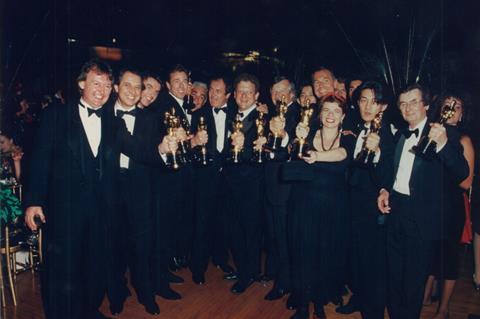
For most of his career, he had “Jeremy Thomas Presents” at the start of his movies – a credit few other producers ever achieved. He also made films in every genre conceivable. In only a few years in the early 1980s, he racked up such impressive credits as Bad Timing and Eureka with Nicolas Roeg and Merry Christmas, Mr Lawrence with Nagisa Oshima, and he ended that decade with the first of many epics with Bernardo Bertolucci, The Last Emperor (1987), which saw him winning the best picture Oscar when still in his 30s. (It was Bertolucci who famously characterised Thomas as “a hustler in the fur of a teddy bear.”)
There were also many edgier films with directors like Roeg, Oshima and David Cronenberg, including the latter’s 1991 adaptation of Naked Lunch. He also worked with emerging British filmmakers including Jonathan Glazer, David Mackenzie and Ben Wheatley.
More than a producer
Thomas was much more than a producer. He was involved in distribution and exhibition and co-founded sales company HanWay Films in 1998 with Peter Watson and Stephan Mallman. Alongside Auty and Chris Blackwell, he was one of the partners in Oasis, an independent arthouse distribution and exhibition outfit which bought such cinemas as The Gate Notting Hill, the Cameo in Edinburgh and the Ritzy in Brixton.
Between 1992 and 1997, Thomas was chair of the British Film Institute. “Yes, he was a maverick but I think that was born of love and complete involvement in all aspects of film. He was a huge supporter of the archive, very keen to explain what it did and why it was important,” commented Labour Party life peer Wilf Stevenson, who was director off the BFI during this period.
During his stint at the BFI, Thomas lobbied hard for the Imax cinema near London’s Waterloo station.
“In the public sphere, the BFI Imax will remain a permanent memorial to his tenacity and extraordinary powers of persuasion,” Puttnam said of how Thomas pushed for the opening of what is now considered one of the most successful premium screen venues in the UK, which sold more than 100,000 tickets to Christopher Nolan’s The Odyssey this summer.
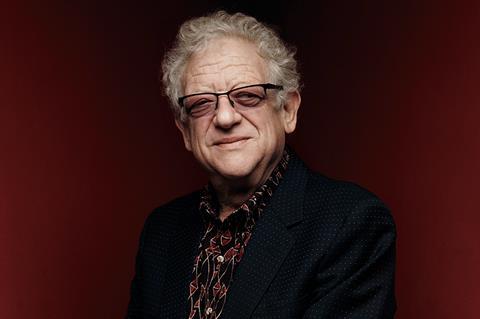
Thomas remained an active producer till the very end of his life, and was still dictating letters from his bed in the days leading up to his death. There were certain projects that he couldn’t get off the ground, among them Frears’ Jonathan Coe adaptation Wilder & Me, scripted by Christopher Hampton.
“He did try right to the end but it got nowhere. I guess nobody has heard of Billy Wilder now. It seems very, very shocking,” Frears commented. “Suddenly on [the Billy Wilder film], the people who normally gave him money wouldn’t. I think he was rather distressed by that.”
Nonetheless, he still has new projects in the pipeline. Werner Herzog’s Bucking Fastard recently premiered in Venice’s Competition, Takashi Miike’s Bad Lieutenant: Tokyo receives its world premiere at the Toronto International Film Festival and Becoming Capa, which he produced alongside Andrea Cornwell and Chris Curling, is in post-production.
“I feel incredibly fortunate to have been working with Jeremy over the last couple of years on Becoming Capa. Even entering his office in Notting Hill and sitting among the hand-notated scripts from his legendary canon of work was exciting. We’ve all lost a one-of-a-kind producer: a swashbuckling defender of the arts who inspired so many of my generation,” Cornwell commented.
Auty recounted an “extraordinary” session that Thomas did with LFS students as recently as July: “He knew he was dying but did it anyway. It was a remarkable masterclass in how to behave – how to behave with actors and directors; how to guard your own counsel, etc. He was unbelievably brave. That is why all those filmmakers loved him so much.”
Several collaborators talked of his decency and hospitality. “He was a wonderful man and got better as he got older, more generous and bountiful,” said Frears.
Some feel that Thomas remained undervalued in the UK. “His peers absolutely knew that he was the king, and he knew that they knew that. But they were very stingy in handing out the honours to him. When you think of all those theatrical knights, he didn’t get the public honours that he would absolutely have deserved,” said MacCabe.
For MacCabe and many others, Thomas is the most significant British producer since the legendary Ealing Studios boss, Michael Balcon.
“I think Balcon would be the only comparison. They were very different films but Balcon made the films he wanted to make,” MacCabe stated. “Every film Jeremy made, he wanted to make. He wasn’t making any film for some imaginary audience. He was making it for himself. That’s an incredible record over 50 years.”
Heather Stewart, former creative director of the British Film Institute, agreed that Thomas stands alongside Balcon as a giant of British cinema.
“Kindness is often a virtue that is overlooked today, certainly by young people. You appreciate cleverness and quickness and other things but kindness mustn’t be underrated – and Jeremy was kind,” said Stewart.




1 Readers' comment