


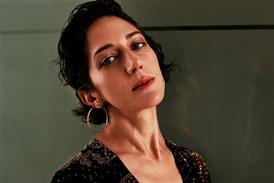
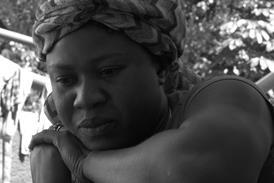




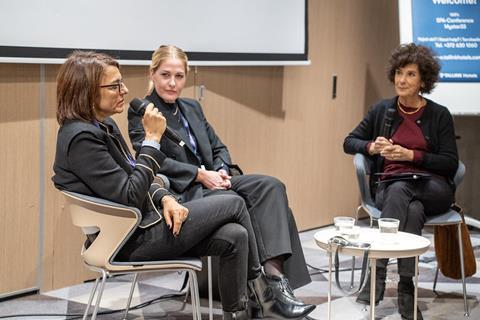
German casting director Nina Haun revealed the challenges of casting Pawel Pawlikowski’s Fatherland, for which she has been nominated for an EFA, during a Black Nights Star Discovery Campus talk in Tallinn, joined by Swedish casting director Pauline Hansson.
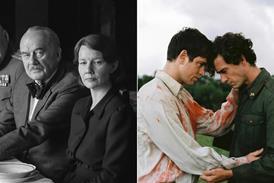
Haun revealed that when working on a period drama like Fatherland, one of the biggest issues can be when actors have had cosmetic surgery. “If somebody has Botox or fillers, that’s not usual in 1949 so I have to ask the agent very politely ‘do you think for six months she cannot use Botox?”
Another challenge was finding the right fit for the role of mayor of Frankfurt, who was “a very big, tall bald man,” said Haun, Actors therefore had to be a certain size and ready to shave their heads if needed.
Haun previously cast Sandra Hüller in Maren Ade’s Toni Erdmann, which became Hüller’s breakthrough performance. Haun refused to take full credit for Hüller’s meteoric subsequent career, pointing instead to Ade’s script and direction and the star’s own skills. “It [being cast] is like being invited to a party, and then you have to behave well at that party. It takes so many things that must come together.”
Collaborating with Swedish casting director Pauline Hansson on Ruben Östlund’s 2022 Triangle Of Sadness, Haun explained the director’s approach to casting was “totally different” from what she was used to. ”The actors didn’t learn a scene by heart but instead studied the personality of the person they should play. This was new to me. I learned a lot during this process.”
Hansson, who also cast Ostlund’s 2017 film The Square, spoke about the advantages of working with a filmmaker like him who co-owns Swedish production company, Platform Produktion. “He can decide where to put the money and the time. For him, the casting process is very long and important. It takes a year, and it is very open,” she stated. “Ruben loves casting. Everyone needs to audition also. It doesn’t matter if it is a huge celebrity in the US. His process is to pitch the whole movie to everyone. He is listening, looking you in the eye and tries what is working and what is not.”
Describing the relationship between a casting director and director as sometimes being “like a marriage”, Hansson explained, “at the beginning it can be really tricky – and after a couple of productions, you really know what she or he will like, and then it goes way faster”.
On some of the most audacious director requests, she recalled her response to one demand from a director to “Get Me Zendaya!” as being: ”You have to have your film financed first.’
She also revealed that when it comes to putting forward acting talent, it’s important to work strategically. “For some directors, it is really important they are the ones saying who’s best, so I usually put my number one [choice] as number three,” Hansson admitted. “Usually it works.”
Both Hansson and Haun offered practical tips on how actors should present themselves in auditions. One was to make sure they were visible on the main casting platforms such as e-Talenta, Filmmakers and Spotlight. Another was to put the script first and not to think immediately about what they will be paid.
“What is also important is that actors should take some kind of risks when they come to auditions because we really love to see what they add. Actors should know we don’t share everything with the directors or the producers or the people from the networks because we always want to present the actors as best we can,” Haun added.
While the two casting directors have regular collaborators, they remain open to working with newcomers, sometimes ‘pro bono’.
“Sometimes you have to protect them from too powerful actors who are taking over,” Haun warned. “Also, as they are new to the business, we tell them you can fight for your ideas. We can help them to connect with agencies who might not respond if they are a student from a film academy. We can help open doors.”






No comments yet