














”It began life 10 years ago as a children’s film,” says Fatih Akin of his 13th feature film Ghost Song. The idea for the story of two friends, one is a ghost, the other alive, originated with the director’s son. As he grew up, so did the narrative evolve.
“The film’s main characters became progressively older, going from 10 years old 10 years ago, to 15 five years ago, and now they are 20,” says Akin. ”Naturally, they changed a lot for us to have a love story between a girl with an Arabic background and a boy who is German-Turkish, like my children.”
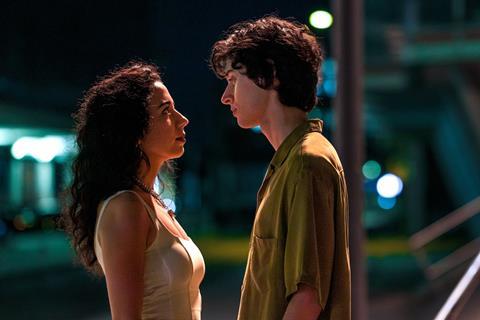
Ghost Song stars Syrian-born newcomer Mariam Dawoud in her acting debut and German-Turkish actor Eren M. Güvercin, known for his roles in the series Mozart/Mozart and Euphorie, as star-crossed lovers Farasha and Faris, pursuing a love story between the worlds of the living and the departed.
The look of the film was also influenced by the love Akin’s children had for watching anime and reading manga. The filmmaker cites the romantic fantasy films of Makoto Shinkai, Weathering With You and Your Name, as well as Naoko Yamada’s psychological drama A Silent Voice as ”great inspirations”.
Ghost Song reunites Akin’s production company Bombero International with Warner Bros Film Productions Germany, Berlin-based Rialto Film and sales company Beta Cinema, the team with whom he made his previous film Aurumn.
It also marks Akin’s second collaboration with screenwriter Ruth Toma, following the 2002 film Solino.
The film made its world premiere earlier this month at the San Sebastian International Film Festival in Spain, screening in black and white. The version that will screen in Hamburg will be in colour.
The notion of two versions occurred to Akin after six months in the edit suite.
“The material came from the lab for us to start on the colour grading but it was frustrating to see what was in the pregrading,” he recalls. “At some point, I started not trusting the images. We took out the colour so that I wouldn’t be distracted during the editing process and destroy the value of the image.”
As he continued working, he became so used to the black-and-white that he wanted both versions available.
“After all, anime may be in colour, but manga are in black-and-white,” he suggests.






No comments yet