














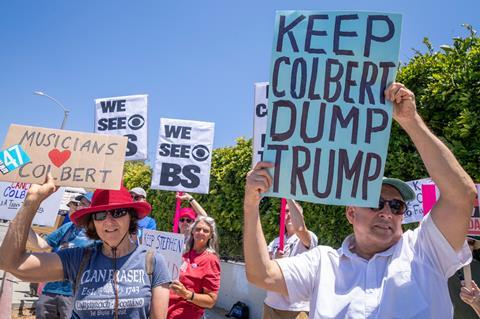
Last month, Stephen Colbert became — in the words of one of his final guests Bruce Springsteen — “the first guy in America who’s lost his show because we’ve got a president who can’t take a joke”. As if to prove his point, Donald Trump posted on social media that Colbert was a “total jerk” with “no talent, no ratings, no life”, concluding: “Thank goodness he’s finally gone!”
CBS’s decision to draw the curtain on The Late Show after 33 years — the last 12 of them with Colbert at the helm — has been interpreted as the death knell for US late-night, for CBS itself, and for free speech on mainstream US television.
It is a ripple effect of Trump’s efforts to silence his critics that includes his calls for Disney-owned ABC to take another late-night host, Jimmy Kimmel, off air and granting the Federal Communications Commission (FCC) power to lift late-night talk shows’ exemption from the ‘equal time’ rule, which requires certain shows to give the same airtime to rival candidates competing for office.
More significantly, The Late Show’s axing is seen by some as inextricably linked to the $16m paid by CBS owner Paramount to the president only weeks prior to settle a lawsuit over an interview on news show 60 Minutes — which Colbert had called a “big fat bribe”.
The expected closure in the third quarter of 2026 of Paramount Skydance’s $111bn deal to buy Warner Bros Discovery (WBD), which will put David Ellison, son of Trump ally Larry Ellison, at the top of a media empire with a 23.6% share of US studios, has only exacerbated fears of interference.
Further complicating matters, and firing up the conspiracy theorists, is that in 2023, CBS had been ready to hand Colbert — an outspoken critic of Trump — a five-year extension of the show before backtracking with a reduced three-year offer. By the time it wielded the axe, CBS said the show was losing the network $40m a year and was not open to negotiating ways to make it more cheaply. Colbert, for his part, said that $40m included the $16m ploughed into the lawsuit.
Filling Colbert’s slot is Comics Unleashed, with creator Byron Allen paying CBS $15m a year for the privilege in a so-called ‘time buy’ — he gets a licence to broadcast in the slot and seek profit through selling advertising inventory himself. This effectively leaves CBS up by $55m.
Colbert’s predecessor David Letterman bluntly called CBS “weasels” for calling time on The Late Show, claiming the decision was made to appease Ellison’s Skydance as it took over Paramount last year. Colbert himself has acknowledged the oddities of the situation, telling The New York Times in April that he understands scepticism about CBS’s claim that it axed the show for financial reasons. “I… completely understand why people would say (a) that doesn’t make sense and (b) that seems fishy to me, because the network did it to themselves by bending the knee to the Trump administration over a… completely frivolous lawsuit. It’s possible that two things can be true,” he said. “But less than two years before they called to say, ‘It’s over,’ they were very eager for me to be signed for a long time. So, something changed.”
The Late Show’s demise has also revealed the faultlines between old and new media in the US, with the show — and late-night in general — held up by an old guard sentimental for the days when commercial networks ruled the roost.
In an essay for The New York Times, writer Bill Carter, a long-term chronicler of late-night TV, proclaimed that “CBS is assenting to its own diminishment”. He concluded: “The biggest loss is to core American values, such as the right to speak freely, even in brutally mocking terms, about those in power.”
Freedom of speech
In 2026, commercial networks like CBS, with their need to keep advertisers on side and the egos of media moguls and presidents in check, are far from the only place where satirists can sharpen their knives.
“Where’s the gain in interfering with freedom of speech when you can speak freely on YouTube or on podcasts, unless one’s going to shut down the internet, which obviously has happened in certain countries, but fortunately not North America yet?” asks UK producer and agent Jon Thoday, who executive produces HBO’s Last Week Tonight With John Oliver through his company Avalon.
Away from the prying eyes of the FCC, Oliver has spent years poking fun at a succession of political figures — and HBO’s ‘business daddy’ owners (currently WBD and soon to be Paramount) — with little pushback, and Thoday hopes that can continue. “It’s a stated position of Paramount that they stand for freedom of speech and they are creator-led as a studio. One has to take on face value what they’re saying.” Indeed, South Park creators Trey Parker and Matt Stone signed a new marquee deal with Skydance despite their constant and savage takedowns of Trump and other MAGA figures.
Yet the prospect of WBD-owned CNN coming into the Paramount Skydance orbit is raising fears for the future of broadcast independence, particularly in news. The Freedom of the Press Foundation, comprising more than 200 journalists and academics, is not convinced by Ellison’s vow to maintain editorial independence. It warned there will be “improper political meddling” at the channel, in the manner of last year’s signing of “Trump-aligned columnist” Bari Weiss as CBS News editor‑in-chief.
Former CNN anchor Jim Acosta is among those alleging the proposed Paramount Skydance/WBD tie-up is a “political arrangement to circumvent constitutional safeguards, with severe consequences for American democracy”. To them, Ellison’s words ring hollow as, back in December, reports suggested he was talking to the White House about axing some of Trump’s most hated CNN hosts, buoyed by Ellison Sr bankrolling a chunk of the Warner Bros deal.
Another desired outcome for Paramount is to leverage the HBO brand to boost its own Paramount+ service by pairing it with HBO Max. Despite the wealth of competition flooding the market, HBO is still seen as the ultimate prestige brand and one that, Harry Potter and Game Of Thrones aside, is uncharacteristically strong in creating new shows that are not beholden to legacy IP.
That is one of the reasons why it was so attractive to Netflix before it pulled out of the takeover race. But size aside, the combined Paramount Skydance and Warner Bros will carry an estimated $79bn of debt that could hinder investment and prove hard to shake off without large-scale cost-cutting. As one industry observer puts it: “I’m not convinced that one basket case buying another basket case doesn’t lead to another basket case.”
It is a changing of the guard then, and not necessarily for the better. Netflix will be smarting that it missed out on expanding its wares through acquiring some of Warner Bros’ premium IP but might yet have the last laugh if the two big beasts struggle to make their alliance work.
Streaming live
As for late-night, it’s not dead — it’s just become unaffordable for CBS and is now moving out of its control. For streamers like Netflix, argues Thoday, a high-volume live chat show would partly alleviate the stress of dropping high-cost dramas that do not gain immediate traction.
Moreover, he attests: “People want to see somebody actually speak, and have questions asked of them, rather than reading about them through AI. I think the broadcast part is a bit broken. I can envisage a time when there’ll be a talk show on YouTube globally — you can reach 3 billion homes, no-one’s going to interfere, and there’s no one advertiser that matters so much.”
In April, Colbert quietly launched a YouTube channel as a possible future outlet. It has added only one video in its first month, attracting 1 million views, and its 273,000 subscribers are dwarfed by The Late Show channel’s 10.8 million. Small for now, but a huge potential for uncensored mischief.





No comments yet