

















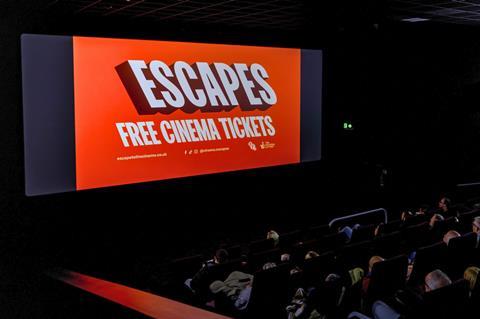
In a challenging climate for independent film at the UK box office, the British Film Institute (BFI) has taken a radical step to spur engagement with disconnected audiences: giving out free cinema tickets, year-round, on a mass scale.
The Escapes programme was launched in 2024, backed by $3.6m (£2.7m) of BFI National Lottery funding through March 2026, with marketing agency elevenfiftyfive running the campaign. It has now been extended to 2029, with a further $4m (£3m) in funding.
“It’s about trying to find new audiences, introduce them to cinemas and leave them there,” says David Kapur, elevenfiftyfive co-founder.

Around 10 films are screened for free each year, mostly on Monday or Tuesday evenings, with a total of 224 venues taking part to date across the initiative.
Cinemas are not required to show every film in the programme, which has largely featured UK independent titles including Curzon’s Kneecap, True Brit’s Giant and MetFilm’s Lollipop, along with a few international films such as A24’s Eternity and MetFilm’s Savages, and repertory titles including Bullet Boy.
Uptake has been positive at 72%, with 220,000 tickets claimed out of 306,000 available. But has the bold initiative succeeded in its aim of attracting lapsed audiences into theatres and then, crucially, paying to watch more films?
“As far as getting people through the door and watching and engaging with films, it does that,” says Callum Pawlett Howell, manager at London’s Genesis Cinema, who reports its Escapes screenings achieve between 50%-80% capacity. “However, it’s tough to tell if people are then coming back and buying tickets.”
BFI stats suggest positive inroads are being made. An audience survey of 1,503 people conducted in July 2025 found 58% returned to their Escapes cinema and paid to see a non-Escapes screening; 41% have been to the cinema more regularly since their first Escapes screening; 52% had been back to watch independent films; and 52% brought people with them who had not previously visited that cinema before.
From the launch in 2024 to the present day, surveys conducted after each event revealed 52% of attendees were new or lapsed (had not attended in over a year) audiences for that independent cinema, and 72% of audiences were not familiar with the film they watched prior to booking their Escapes ticket.
Potential audiences from postcodes or demographics deemed disengaged are targeted through digital advertising, largely across Meta platforms, and through campaigns with influencers relevant to the themes of the film and local press.
Ben Luxford, BFI director of UK-wide audiences, says the key priorities are to engage 25 to 45-year-olds. “They are underrepresented in independent cinema audiences,” says Luxford. “A big learning of ours has been to do more family films, because that’s a big reason why they aren’t there. They’re busy looking after kids.”
Engaging Black and global majority audiences outside London is another priority. All screenings play with open caption subtitles to be as inclusive as possible. Luxford cautions, however, “We don’t want to just cultivate a community for Escapes. It’s for the broadest possible public benefit.”
He adds that Escapes audiences have been “broad” and over-indexed on disabled and LGBTQ+ communities. Studiocanal’s I Swear has had the best uptake to date.

Isobel Harrop, assistant programmer for young audiences at Sheffield’s Showroom, notes the “demand” for family films prompted the cinema to upgrade Vertigo Releasing’s A Sloth Lane to a bigger screen. On the flip side, the over-subscription model operated for Escapes means that at a recent re-release showing of Amelie, some Showroom Escape ticketholders had to be turned away.
Cinemas and distributors are paid a one-off fee, which is not reported to Comscore as part of the film’s box-office takings.
BFI declined to comment on specific fees, but Screen understands that for a larger independent cinema with more screens and less risk, it equates to around £100 per screening.
Drawing crowds
While not a big earner for cinemas, it makes financial sense on a typically quiet Monday or Tuesday night slot, although it is hard to measure any potential loss of paying customers for the film. At Genesis, Pawlett Howell notes there were more people at a single Escapes screening of Kazoo Films’ German animation Grand Prix Of Europe than the entirety of the rest of the film’s run.
Independent cinemas also benefit from receiving access to new eyeballs for digital marketing, such as newsletters, with 47,000 Escapes attendees allowing their data to be onboarded to cinema databases.
One concern has been that the Escapes programme signals that independent cinema is not worth paying for.
“A film distributor never likes giving away films for free,” says one UK distributor who has taken part in the scheme and preferred to remain anonymous. “It’s a tough decision to make, but they renumerate you. When it comes to small films, it’s hard to say no to that.
“[The BFI’s] view about additionality and new audiences – that remains to be seen a little bit. If you’ve got a small film that plays like gangbusters, then it’s an interesting avenue to go down. If you can generate pre-release word of mouth while also bringing in income, those are good things.”
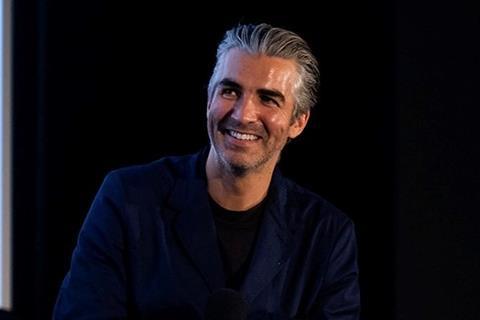
Luxford contests the belief that giving away films for free is devaluing.
“One of the things that kickstarted Escapes was looking at data and studies we’ve been doing to work out what was going on in the market post-Covid,” he says.
“The biggest barrier to people going to the cinema is always perceived to be cost. The best way to see a film is still perceived to be the cinema… If it exposes people to independent film, that’s creating a value even though it’s free.”
Elevenfiftyfive will be recruiting for an external industry steering group to help develop the scheme and is open to a sponsor joining the project.
“It brings people in and breaks that threshold anxiety,” says Harrop. “It seems like something worth nurturing, with so little effort to us [cinemas].”
“It’s more about accessibility than value,” says Pawlett Howell. “You don’t go to the Tate Modern and think an Andy Warhol is worthless because you’ve seen it for free.”




No comments yet