










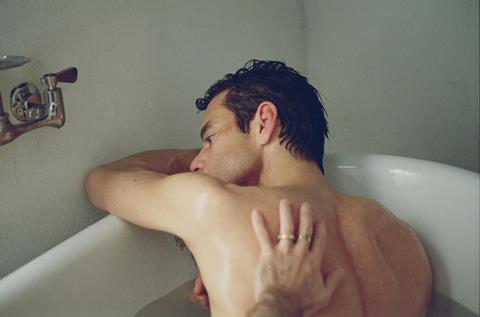
US filmmaker Ira Sachs is back in Cannes Competition with his new feature, The Man I Love, following his previous appearance competing for the Palme d’Or in 2019 with Frankie. The film is set in downtown New York in the 1980s and follows an actor, Jimmy George, played by Rami Malek, as he takes on what might be his last great role.
Mk2 Films handle world sales on The Man I Love, which is produced by US production outfit Big Creek Projects in association with France’s SBS.
What are your memories of New York in the 1980s at the time of the AIDS crisis and when you, as a young man, were working as an assistant to director Norman Rene on Longtime Companion?
Well, I guess the whole film is the answer to that question. It contained all the extremity of youth - pleasure, excitement and discovery. In particular, in the East Village and in downtown New York in this period, there was the galvanising energy of a community. At the same time, there was extraordinary darkness and fear. Those things merged to create a truly unique time and experience.
Is Jimmy George based on anyone you knew?
He is a collection of histories embodied by Rami Malek. I was going down a rabbit hole of discovery specifically around an actor named Ron Vawter who worked with the Wooster Group. There was the comedian Frank Maya who was performing at Caroline’s Comedy Club at the end of his life, and [drag queen] Ethyl Eichelberger who was performing at the Theatre Of The Ridiculous. The list goes on and on and includes people I knew who were not famous and who inspired myself and my co-writer, Mauricio Zacharias, who was also young and gay and living in America [when] we were becoming ourselves.
What part does music play in the film?
A lot of memories were rooted in the experiences of dancing and listening. It’s this thing that happens when you are young and certain songs you play on repeat on the stereo. They become merged with your emotion and memory of that time. The film includes music as wide as ‘How Are Things In Glocca Morra’ from Finian’s Rainbow to ‘The Man I Love’ by Gershwin, but also the Talking Heads and club music from Bohannon who was big in downtown New York places like Paradise Garage and The Loft back in the day.
Is this on a bigger canvas than your previous films?
Yes, to the extent that I had more money than I have had recently. I am grateful there is a company called Big Creek run by Scott McGehee and David Siegel who are comrades of mine. We were at Deauville and Sundance as filmmakers 25 years ago. Without them, the film wouldn’t have happened. I was also very lucky to meet Said Ben Said [of SBS] and for him to discover my films around 10 years ago. This is our third film together after Passages and Frankie; without Said, I wouldn’t still have a career.
Hadn’t you done pretty well before that?
The bottom dropped out of American independent cinema at around the time I partnered with Said, so there were other resources outside of America that were significant. It came right at a moment when sustaining [a career] seemed nearly impossible.
Much has been written about New York and the AIDS crisis of the 1980s. Which of the books that chronicled that time inspired you?
Paul Monette wrote Borrowed Time, a memoir about his lover’s experience with AIDS and their relationship. It’s extraordinary, the most detailed record I’ve ever found. It was the singular most important firsthand reference for Maurice and I in the writing of the script. And Andrew Holleran’s books, since that period, from the high of Dancer From The Dance to everything after, which contains the grief that came with the hurricane of AIDs.
Do you see a rise in homophobia in US society that is making it harder for gay filmmakers to tell their stories?
It’s also about the changing nature of cinema and the industry, which has become global. So local experience, including gay experience, gets washed out. That’s why I feel grateful I’m still able to make films. I am making a film about experimental theatre in New York City and it’s about a lot of things that are very personal to me. That is harder than it was 20 years ago within the American independent sphere.
Did Rami Malek’s performance as Freddie Mercury inspire you to cast him?
For me it was the naturalism of his performance in show after show in Mr Robot. He’s the kind of actor I like to work with because I feel there is something very raw and simple underneath, and he also has a magnetism. I believe in star quality – certain people can make the smallest gesture have meaning.
You list National Velvet as one of your favourite films. What do you like about it so much - Elizabeth Taylor, Mickey Rooney, the horses?
Something I strive for in this film, which connects to National Velvet, is a purity of emotion and not to be shy about feeling. That film makes me weep and Elizabeth Taylor is for me the greatest actor in American cinema. In films like National Velvet and Suddenly Last Summer, Elizabeth Taylor, like Rami Malek, understands and manages to convey something transcendent in the everyday.
Is The Man I Love a weepie?
This is a film about life: what am I going to do with the life and time that remain? How much can I pack into that? How much beauty, how much pleasure, how much cinema, how much music, how much colour, how much light? That was the intention – to make a film bursting with life.






No comments yet