














Swedish filmmaker John Skoog’s fiction feature debut Redoubt is screening as part of the international film competition at this month’s Geneva International Film Festival (GIFF).
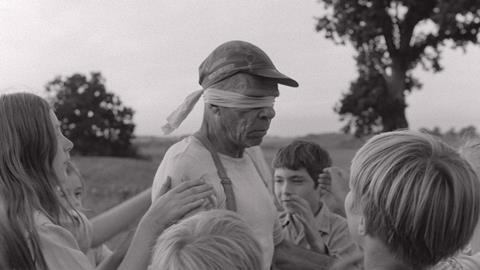
French actor Denis Lavant, best known for his iconic role in Leos Carax’s Holy Motors, stars as a Swedish farm worker during the Cold War. He turns his isolated house into a fortress against the threat of Soviet invasion, for himself and nearby villagers. The film is based on the true story of Karl-Göran Persson.
Skoog, a visual artist and documentary maker, for whom Redoubt is his first narrative feature, grew up near where Persson had lived in southern Sweden - he died in 1975. As a child, Skoog’s parents would take him and his brother to see the shelter, and the filmmaker grew up fascinated by Persson. He has previously used the story and the shelter for video installations in Germany and Austria.
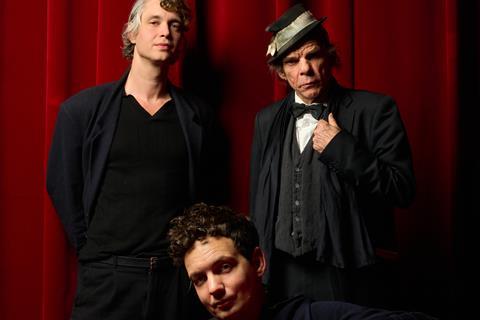
But when he told producer Erik Hemmendorf at Plattform Production he wanted to make a fiction feature about Persson, one immediate problem had to be solved: Skoog could not think of a Swedish actor to play him.
Redoubt is a Sweden-Finland-Denmark-Poland co-production between Sweden’s Plattform Production producers Hemmendorf and Caroline Drab with Film i Skåne (Sweden), Sveriges Television (Sweden), BCD Film (Sweden), Bufo (Finland), Lemming Film (the Netherlands), Paloma Productions (Denmark) and Madants (Poland). France’s Coproduction Office is handling international sales.
Co-written by Skoog and Kettil Kasang, the film was shot entirely on location in southern Sweden for eight weeks; six in the summer, two in the winter.
Skoog talks to Screen in Geneva about casting a French man to play a Swede, taking out his crew for drinks and why shooting in black and white was to emphasise the texture and the physicality of the film.
What is it about Karl-Göran Persson that has inspired you to make a film about him?
I’ve known about this story my whole life. His story is a story of the human condition. The more I have thought about him, the more legendary he has become. Erik [Hemmendorf] and I agreed there’s a film there. We both thought his story talks to our times.
Why did you cast Denis Lavant, a French actor, in the role of this very Swedish man?
I said, half-jokingly to Erik, that maybe Denis Levant could play him. Erik said it would be fun to watch [Lavant] build the house and took my idea seriously, which made me think casting Denis was a good idea.
There was no script, just an idea. I emailed Denis directly, explaining my background and why I’m interested in this film and this character, sending him pictures of the real house and sharing my research. He said, ‘Please write this film for me and let my agent know that this is something I’m interested in’. Together with my friend Kettil Kasang, we wrote the script with Denis in mind.
What was the most challenging part of the shoot?
Where we built the big house [where Lavant’s character lives and constructs throughout the film], there was no real road, it was in the middle of a field. When it rained, it was harder to get there with all the gear; things had to be carried. It was like a physically demanding shoot for everyone.
I’ve made films before, but not on this scale. As the director, you have to be positive and keep everyone feeling that they’re working on something that is really special. I met everyone who was going to be on the shoot before we started, had a coffee, a beer with everyone to make sure that when the shoot began, the team was excited to embark on this adventure.
Although the film does not have much dialogue, the little Levant does have is very powerful. Did he learn to speak in Swedish phonetically?
At first, we thought maybe it should be a completely silent part but that seemed uninteresting. One of the first times we met Denis in Paris, he had tested learning lines from the Swedish government guideline pamphlet [about what to do in the case of invasion] that had been distributed at the time. His rhythm was amazing. We decided to go for it and write more for him.
Why did you decide to film in black and white?
There were a few reasons. One is to emphasise the anachronistic timeframe of it. It’s not clear if it’s 1955 or 1965 or 1975, but it is clear that it is between the Second World War and the fall of the Berlin Wall.
Another reason is we knew we wanted the film to be a textural and physical film. Black and white is good to emphasise these textures, the physicality of the world and also the physicality Denis brings to the role.
It has been such a meaningful story for you as an artist. What do you hope film audiences now take from watching Redoubt?
The experience of watching a film that has a physical effect on your body is something I like very much when I’m watching films in the cinema. I hope the viewer enjoys a physical experience watching this film and Denis’ performance.
We thought a lot when writing about the role of the outsider in a society and what that does to the community. What happens when someone decides to live their life like they want, instead of following a kind of ploughed path?
The film does not give answers because they lie within the audience.






No comments yet