












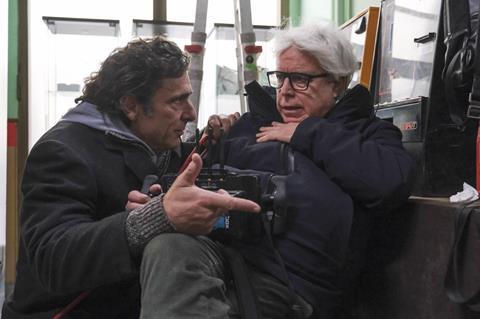
“I wasn’t interested in reconstructing Buenos Aires exactly,” says Marco Bechis about Back To Buenos Aires. “I thought, ’We’re in South America and audiences anywhere in the world will understand that.’” That approach explains the Italian-Chilean filmmaker’s decision to film his latest feature in Porto Alegre in southern Brazil. “Perhaps people from Buenos Aires will say a particular street is somewhere else,” he adds with a chuckle.
The Italy-Brazil co-production, which premiered in competition at Venice Film Festival, follows Mariano Guerra (Adriano Giannini), an Italian survivor of Argentina’s military dictatorship who returns in 2008 to testify against his torturers. Bechis, himself a survivor of the regime, is presenting the film at São Paulo International Film Festival, known as Mostra de São Paulo, where he is receiving the Humanity Award.
Produced by Italy’s Fandango, 39Films and Karta Film, with Rai Cinema and Brazil’s 34 Filmes, the film shot over four weeks in Porto Alegre, with additional 18 days in Turin from November 2025 to January 2026. Post-production was completed entirely in Italy.
34 Filmes’s Patrick de Jongh says it made financial sense to shoot the film in Brazil. The production received €700,000 through Brazilian National Film Agency Ancine’s Audiovisual Sector Fund (FSA) international co-production programme, under its regional quota. The award accounted for around 25% of the total budget of approximately €2.8m. Italian backers included the culture ministry and Piemonte Film TV Fund.
“Accessing the Ancine/FSA public funds was crucial to making the co-production viable and securing the approximately 25% Brazilian stake,” de Jongh says. He adds that shooting in Argentina would have presented substantial costs associated with cross-border transfers, while the Brazilian contribution could be invested in local professionals and infrastructure.
Porto Alegre also offered a convincing architectural match. Bechis sought a mixture of colonial-era buildings and modern streets rather than an exact street-by-street replica of the Argentine capital. “I like discovering what I need in reality and taking it,” he says. One semi-abandoned building used for the survivors’ accommodation, with yellow walls, glass doors and unusual bathrooms, seemed a ready-made set. “I make films as though they were prototypes,” Bechis says. “Prototypes need unique pieces.”
Regional benefits
The region had other benefits, de Jongh says. “Being close to the southern border, Porto Alegre offered a highly skilled local crew and a wide pool of fluent Spanish-speaking Brazilian actors.”
With the exception of cinematographer Fabrizio La Palombara, his assistant and a small group of Italian and Argentine actors, the crew working in Brazil was local, meeting the co-production’s domestic participation requirements. Brazilian actress Paula Cohen, who plays the judge, shot her courtroom scenes in Turin.

Bechis had previously worked in southern Brazil on Birdwatchers (2008). On this occasion, however, he faced the added challenge of a crew of mostly unfamiliar faces and a production moving between two continents and seasons. The filmmaker says the Brazilian team worked intensively, allowing him to achieve a great deal on a limited budget. He also deliberately shot the opening scenes in Turin last, once he knew precisely what material the film still needed.
As for his cast, Giannini initially appeared unavailable but, when his schedule cleared, the pair developed an almost “symbiotic” understanding. Their collaboration relied less on technical instructions than an intimate exchange grounded in Bechis’s experiences. “While we were shooting, I often became emotional, not necessarily because the scene was emotional, but because I saw myself again in the situation the character was experiencing,” the director says.
That closeness did not make the film autobiographical, he insists. Its starting point was instead the final chapter of his 2021 memoir The Solitude Of The Subversive, concerning his return to Argentina to testify. “We’re living in an era of survivors,” he says, citing torture endured by migrants in Libya and the war in Palestine. But becoming a witness requires courts capable of holding perpetrators accountable, sometimes even heads of state, he says.
Bechis now hopes to make another feature next year, preferably with a simpler, smaller production. “As you advance in your career and experience, the budget should go down,” he says. “Instead, the opposite happens.” Whatever he chooses, he adds, it will not be a fourth film about Argentina’s disappeared: “For now, that chapter is closed.”





No comments yet