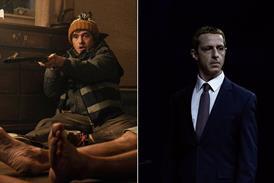
Rodney Hicks and Geoffrey Rush lead the Japanese auteur’s Venice Competition drama

Dir/scr: Shinya Tsukamoto. Japan/USA/Thailand/Vietnam. 2026. 116mins.
Shinya Tsukamoto, the creator of 1989 cult hit Tetsuo: The Iron Man, returns with a sometimes viscerally powerful, but often muddled take on Vietnam veteran Allen Nelson’s non-fiction book Mr. Nelson, Did You Kill People?. The traumatised Nelson is played in middle and old age by stage veteran Rodney Hicks, who starred in the first Broadway production of Rent, and by relative newcomer Mark Merphy as a young man. Geoffrey Rush appears as Nelson’s grizzled therapist, whose primary innovation is to repeatedly ask him “why did you kill people?” until he gets a better answer than “I was following orders.”
There appear to be two movies fighting for supremacy here
Premiering in Venice Competition, Mr Nelson, Did You Kill People? faces a challenging onward journey. The enduring cult status of Tetsuo could draw some attention, as could the presence of Rush in a minor role, but the film’s horrifying depiction of real-life brutalities could make it a tough sell commercially.
Tsukamoto writes, shoots, edits and directs here – an approach that has resulted in some propulsive conflict sequences, but may also have made it difficult to step back and address the project’s bigger-picture shortcomings. The film is strangely choppy: we’re dropped into certain timeframes and introduced to characters without much preamble, while at other moments inelegant expository dialogue has people baldly stating facts for the benefit of the audience. Indeed, the film’s most impactful moments are largely dialogue-free: vivid scenes of slaughter in Vietnamese villages speak for themselves, while a couple of extended wordless encounters in Nelson’s later career as an anti-war activist and public speaker see Tsukamoto’s camera gracefully tracking a crowd’s individual reactions.
Allen Nelson arrives onscreen at a peculiar moment in cinema’s history of moral reckoning with war. While Vietnam classics like Apocalypse Now and Full Metal Jacket act as correctives to official US narratives of heroic liberating forces fighting on the right side of history, soldiers as individuals tend to be depicted as swept up in forces bigger than themselves. They can either go along with the madness enthusiastically or reluctantly, but mainstream cinema has often framed their culpability differently from that of, say, German soldiers during the Second World War, where “following orders” is rarely considered a sufficient excuse for having committed war crimes.
Here, though, Nelson is shown actively participating in the slaughter of women, children and unarmed men, and torching villages. He does, occasionally and seemingly at random, refrain from killing – he encounters a young woman in active labour whom he admits he would normally have shot, but instead delivers her baby.
The film is not, however, a simple mea culpa. It is invested in whether Nelson can recover and forgive himself, or accept the forgiveness of others. His sweaty, sleepless nights, plagued by vivid nightmares, are given more narrative weight than the pain of a group of unnamed Vietnamese men finding the corpses of their families stacked neatly outside their homes - a technique to distract them so waiting US forces can shoot them in the back. Elsewhere, a moment in which Nelson is embraced by compassionate young schoolkids after one child poses the titular question plays out like a sentimental would-be Oscar contender’s cathartic crowning sequence. Within the previous hour, we’ve seen children of a similar age in Vietnam clinging, weeping, to blood-spattered pieces of their parents, which Nelson and his platoon have piled together to count the bodies and prove they are winning the war. Yes, Mr. Nelson killed people. Sleepless nights seem a minimal consequence.
It’s unclear if the film believes Nelson deserves the chance to ask for forgiveness for his participation in such atrocities because he has since written honestly about them, or because he had qualms at the time. It’s made clear that many men who fought in Vietnam only did so due to limited options and/or difficult childhoods, but does that balance the scales against the horrors that took place?
There appear to be two movies fighting for supremacy here. One is an old-fashioned war-is-hell film, which holds space for individual soldier trauma on the basis that they didn’t have much personal choice. The other is a tougher vision of a man-made hell on earth which breached more or less every tenet of international humanitarian law, and was actively participated in by ordinary men who committed extraordinary crimes. The two positions co-exist uneasily. Reconciling them would require a clear-eyed command of the story’s raw materials that is not in evidence here.
Production company: Kinoshita Group, Kino Films, Cross Media International
International sales: masumi-handa@kinofilms.jp
Producers: Yumiko Takebe, Christopher Frey, Philippa Frey and Ken Ochiai
Executive producer: Naoya Kinoshita
Cinematography: Shinya Tsukamoto
Production design: Takashi Sasaki
Editing: Shinya Tsukamoto
Music: ermhoi
Sound: Masaya Kitada, Eiji Mori
Main cast: Rodney Hicks, Geoffrey Rush, Tatyana Ali, Mark Merphy, Lily Franky