











’Manta Ray’ director Phuttiphong Aroonpheng turns his attention to marginalised S’gaw community in ambitious third feature
Dir/scr: Phuttiphong Aroonpheng. Thailand/Singapore/France/Netherlands. 2026. 118mins
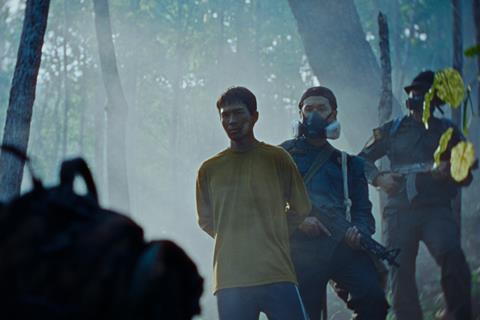
A mysterious, poisonous smoke starts appearing in the forests of western Thailand in The Burning Giants, the third feature from Manta Ray director Phuttiphong Aroonpheng. The strict government actions meant to contain any potentially lethal damage make life practically impossible for the S’gaw minority, who live in the forest and are forcibly removed from their homes. This ambitious work is part quasi-realist pandemic tale and part meditation on Thai history, society and culture.
A fascinating corrective to any nationalistic idea of monoculture
The Burning Giants premieres in Venice Horizons, where Manta Ray won best film in 2018. While his latest work may not not fully cohere for Western audiences, it should nonetheless appeal to festivals and perhaps find a niche arthouse release.
The first 80 or so minutes of the two-hour film tell a relatively straightforward story that involves a 30-something man (Awat Ratanapintha) of S’gaw White Karen heritage, who has secretly remained behind in his native habitat after authorities have forcibly removed everyone from the forests to the city. The exact source and nature of the smoke, and the infectious burn-marks it provokes, are not clear to either the government or the audience. We do see a police chief (Teerawat Mulvilai) quickly waste away from the effects of the disease, making the government’s decision to step in credible.
Indeed, in the early going, our protagonist is hunted down by a kind of virus police force that includes Pak (Pakapol Srirongmuang), a young man who is kind-hearted even if his job involves capturing people who shouldn’t be anywhere near potentially dangerous areas. His sweet nature comes to the fore in his interactions with his shy girlfriend, Aepoh (Phunthida Phairuangkij). Things get knotty when Aepoh introduces Pak to her sister, Aeva (Waywiree Ittianunkul), whose husband is mysteriously absent. It doesn’t take long for the various strands to come together, though Aroonpheng does have one shocking twist up his sleeve for those not directly familiar with the real-life 2014 case that inspired Ratanapintha’s character.
The Burning Giants’ first two-thirds feel relatively straightforward both in terms of storytelling and Aroonpheng’s approach to realism. Besides the exact nature of the smoke and virus – which are clearly invented but lead to many sights and procedures familiar from the Covid era – things feel mostly authentic. The same can’t be said for the film’s final third, in which khon (traditional Thai theatrical dance) and some of the protagonists from the Ramakien, the Thai version of the ancient Sancrit poem Ramayana, make their entrance.
For Western audiences not familiar with these foundational Asian epics, the parallels Aroonpheng wants to draw between the first and second parts are not immediately obvious, though neither are they impenetrable. It’s because the director is more interested in the underdog characters than the heroes – and even questions who gets to be called a hero in the first place – that lines get blurred in ways that are unexpected and may initially be confounding.
We see the mythical characters move through physical spaces very much like our own, including a dilapidated, smoke-filled cinema that seems to have sprung up in the middle of the forest (production designers Sarawut Karwnamyen and Wan Ping Looi clearly had a ball). This makes the final section feel stylistically different from the first, which takes place in a reality very much like our own. Whether the blend is successful will depend on each viewer’s openness to having the established rules of the film radically changed more than halfway through (if this were a film by Aroonpheng’s compatriot Apichatpong Weerasethakul, you’d expect a title card to be wedged between the two distinct parts of the story).
As in Manta Ray, which was interested in the predominantly Muslim Rohingya minority, Aroonpheng here again takes a pluralistic view of society. In his world, society includes marginalised groups and here he raises them literally to the same plane as the country’s foundational epic, offering a fascinating if somewhat opaque corrective to any nationalistic idea of monoculture.
Production companies: Diversion, 13 Little Pictures, Nord-Ouest Films, Sluizer Film Productions
International sales: Lucky Number, sales@luckynumber.fr
Producers: Mai Meksawan, Bee Thiam Tan, Ola Byszuk, Anouk Sluizer
Cinematography: Emo Weemhoff
Production design: Sarawut Karwnamyen, Wan Ping Looi
Editing: Daniel Hui
Music: Christine Ott, Mathieu Gabry
Main cast: Awat Ratanapintha, Pakapol Srirongmuang, Waywiree Ittianunkul, Thanatwut Rodpai, Phunthida Phairuangkij