



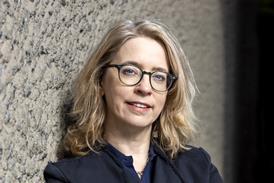



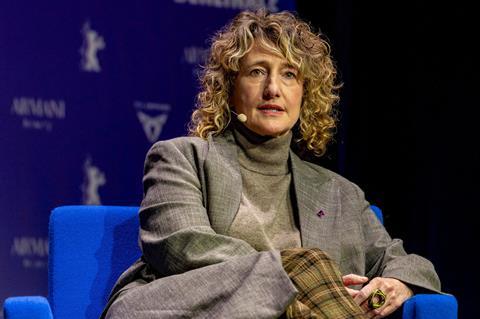
The Berlin Film Festival and festival director Tricia Tuttle have issued statements in response to the issue of political commentary from festival guests.
They follow the response to comments made by Competition jury president Wim Wenders, who made a distinction between films and politics, including the withdrawal of author Arundhati Roy from the festival.
Scroll down to read Tricia Tuttle’s full statement
“As we enter the first 48 hours of this year’s Festival, a media storm has swept over the Berlinale,” reads the festival statement.
“We feel it is important to speak out – in defence of our filmmakers, and especially our jury and jury president. Some of what is currently circulating takes remarks from press conferences detached not only out of context of the full conversations but also from the lifetime of work and values these artists represent.”
The festival then linked to a statement from Tuttle, in which she said, “Artists are free to exercise their right of free speech in whatever way they choose. Artists should not be expected to comment on all broader debates about a festival’s previous or current practices over which they have no control.
“Nor should they be expected to speak on every political issue raised to them unless they want to.”
The full statement is below.
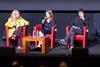
Jury members were asked to comment on the festival’s stance on the conflict in Gaza at a press conference on Thursday. German director Wenders said films and filmmakers “are the opposite of politics”, while Polish producer Ewa Puszczynska described the question as “a little bit unfair”, adding that “it’s about empathy, about trying to understand”.
Indian author Roy cancelled her planned visit to the festival in response to the comments, due to what she described on social media as “unconscionable statements made by members of the jury”.
Several high-profile guests have since been asked questions on political topics, often with limited connection to the film for which they are attending the festival. Among them have been US actor Neil Patrick Harris, at the press conference for George Jaques’ Sunny Dancer; and UK star Rupert Grint, promoting Hanna Bergholm’s Nightborn.
Earlier on Saturday, Charli XCX, attending the festival for Aidan Zamiri’s The Moment, in which she stars and has also produced, praised the Berlinale as somewhere that “doesn’t shy away from political films”.
The Berlinale runs until Sunday, February 22.
Tricia Tuttle’s statement
There are many different kinds of art, and many different ways of being political. Individual approaches vary greatly.
People have called for free speech at the Berlinale. Free speech is happening at the Berlinale. But increasingly, filmmakers are expected to answer any question put to them. They are criticised if they do not answer. They are criticised if they answer and we do not like what they say. They are criticised if they cannot compress complex thoughts into a brief sound bite when a microphone is placed in front of them when they thought they were speaking about something else.
It is hard to see the Berlinale and so many hundreds of filmmakers and people who work on this festival distilled into something we do not always recognise in the online and media discourse. Over the next ten days at the Berlinale, filmmakers are speaking constantly. They are speaking through their work. They are speaking about their work. They are speaking, at times, about geopolitics that may or may not be related to their films. It is a large, complex festival. A festival that people value in so many different ways and for so many reasons.
There are 278 films in this year’s programme. They carry many perspectives. There are films about genocide, about sexual violence in war, about corruption, about patriarchal violence, about colonialism or abusive state power. There are filmmakers here who have faced violence and genocide in their lives, who may face prison, exile, and even death for the work they have made or the positions they have taken. They come to Berlin and share their work with courage. This is happening now. Are we amplifying those voices enough?
There are also filmmakers who come to the Berlinale with different political aims: to ask how we can talk about art as art, and how we can keep cinemas alive so that independent films still have a place to be seen and discussed. In a media environment dominated by crisis, there is less oxygen left for serious conversation about film or culture at all, unless it can be folded as well into a news agenda.
Some films express a politics with a small “p”: they examine power in daily life, who and what is seen or unseen, included or excluded. Others engage with Politics with a capital “P”: governments, state policy, institutions of power and justice. This is a choice. Speaking to power happens in visible ways, and sometimes in quieter personal ones. Across the history of the Berlinale, many artists have made human rights central to their work. Others have made films which we see as quietly radical political acts which focus on small, fragile moments of care, beauty, love, or on people who are invisible to most of us, people who are alone. They help us make connections to our shared humanity through their movies. And in a broken world, this is precious.
What links so many of these filmmakers at the Berlinale is a deep respect for human dignity. We do not believe there is a filmmaker screening in this festival who is indifferent to what is happening in this world, who does not take the rights, the lives and the immense suffering of people in Gaza and the West Bank, in the Democratic Republic of the Congo, in Sudan, in Iran, in Ukraine, in Minneapolis, and in a terrifying number of places, seriously.
Artists are free to exercise their right of free speech in whatever way they choose. Artists should not be expected to comment on all broader debates about a festival’s previous or current practices over which they have no control. Nor should they be expected to speak on every political issue raised to them unless they want to.
We continue to do this work because we love cinema but we also hope and believe watching films can change things even if that is the glacial shift of changing people, one heart or mind at a time.
We thank our team, guests, juries, our filmmakers, and the many others engaged with the Berlinale for cool heads in hot times.


No comments yet