













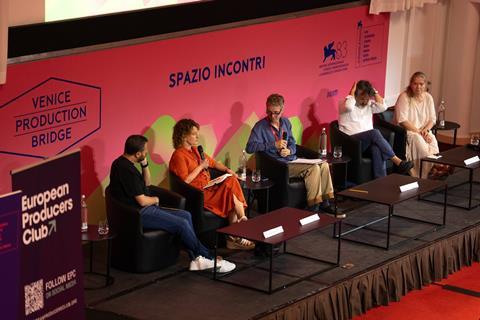
A lack of recognition for producers and a misunderstanding of the creative role they play in the film industry is a “systemic” issue that needs addressing by festivals, awards ceremonies, critics and film journalists, according to panellists at a Venice Production Bridge panel.
Titled ‘Recognising the Creative Contribution of Producers’, the panel marked the one-year anniversary of the European Producers Club launching a campaign at Venice film festival to recognise producers as creative authors of a film or series — not only as financiers and logistical organizers.
Among its recommendations, it called for lead producers to be named in official festival materials and at awards ceremonies, to be invited to festivals and to take part in juries.
Carlo Cresto-Dina, producer at Italy’s Tempesta, said the campaign is about “understanding, recognising, and then protecting the function” of a producer.
“Even within our industry, journalists and critics, perhaps even festival directors, very few people really know what the producer does.”
He said the confusion is in part due to the proliferation of roles with producer in the title, including executive producer, assistant producer, co-producer, line producer to social producer.
Cresto-Dina defined a producer as “someone who originates, manages, and is part of a complex collective creative process,” calling them “activators and custodians of biodiversity in our industry.”
He added: “In order to survive, the original producer must constantly seek the new - discover new talent, the new stories, and take risks.”
He said that many festivals had responded “extremely positively” to the EPC campaign, citing the Berlinale, Toronto and Venice. A few exceptions remain, he added: “I won’t mention who they are, but there is a big festival that they hold in the French Riviera that still in its catalogues lists everybody down to the sound mixer. We love that because it’s a celebration of collective work, which is what this is all about. But there is one name missing - the producer. They mention the production company.”
Clear guidelines
Berlinale director Tricia Tuttle said she welcomed the EPC campaign and the clear guidelines it proposes. “It’s really clear. It’s not overly complex…I think they are very strategic recommendations…you are definitely pushing on an open door for me personally.”
She underlined that the campaign was trying to change “a system of thinking” in the industry, where the term director is widely synonymous with that of a filmmaker.
“A filmmaker is the collective group for us, the collective group of people who make a film together. A director is a role, a producer is a role, and a sound editor is a role. They’re all important.”
Tuttle noted that the Berlinale has had producers as jury presidents, such as Jeremy Thomas and James Schamus, and has given major awards to producers.
But she recognised that change takes time, citing the industry and press focus on auteur theory. “Collectively, for 100 years, we’ve built up brands around directors because it helps to sell to an audience. It’s a proposition that producers and festivals make to an audience.”
Romanian producer and European Film Academy (EFA) chair Ada Solomon also said the concept of auteur cinema was partly to blame. “In school, at least in my country, the mindset is that Mrs or Mr Director - you are god, you are the creator. Somehow this was fuelled by film critics and programmers over time.”
She recognised that producers have to work on how they present themselves in press materials to the media, pointing out that there are often up to 10 producers listed for a film. But in reality there are only one or a maximum of two “masterminds” that are actually full producers, she said.
Solomon noted that EFA has a significant number of producers as members and on its board, and has a special award devoted to producers each year – the Eurimages International Co-Production Award. This year it was presented to producers Maren Ade, Jonas Dornbach and Janine Jackowski of Germany’s Komplizen Film.
“It’s a beautiful tribute to a really very special producer every year, taking the stage, having the momentum, being recognised, being praised for all the things that they have contributed to the development of the diversity of European cinema,” said Solomon.
Ahmed Shawky, president of FIPRESCI, the federation of film critics, agreed that the issue was something that “needed to be fixed at the foundation”, with the code distributed to writers and critics to help better educate them about the role of the creative producer.
He flagged the challenges facing many journalists and critics in acknowledging producers in articles, namely a lack of clear press information and space limitations. “Your media allows you a specific number of words, and you don’t need to waste 100 words of your 400-word piece to just mention the names of the producers.” It would be helpful, he said, if the “one or two” lead producers could be flagged from the outset.
Tuttle said festivals also had huge challenges getting hold of production credits. “We spend an extraordinary amount of time, money, and human resources in trying to extract the right credits from some films that are world premiering with us. Sales agents tell me the same thing. Sometimes they don’t have the information they need when the film has already been selected.”
“Navigating the very sensitive fights that are being had within the production itself about who gets which credit…is a real barrier to some of these recommendations. If there could also be a process of education that all of this happens very early in the process, then that would save a lot of time and money that could be spent elsewhere with festivals, and it would probably help with clarity with journalists as well.”





No comments yet