








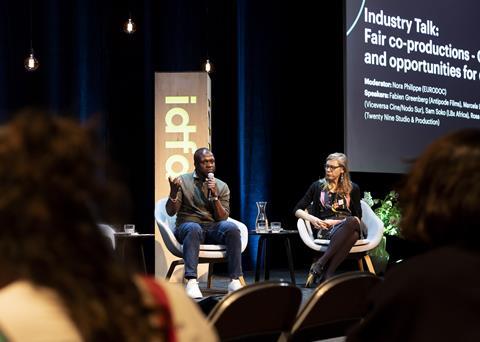
Some uncomfortable topics have come under the spotlight during a panel discussion at the International Documentary Festival Amsterdam (IDFA) called ‘Fair Coproductions - Obstacles and Opportunities for Equity’ this week.
Concepts of fairness and inclusion, as well as cultural authenticity and extractivism, were discussed within the framework of a conversation about how and where the revenues flow when filmmakers from the Global South work with European producers.
“Sometimes, it can go wrong,” said IDFA festival director Isabel Arrate Fernandez frankly in her introduction. “Maybe that’s because people don’t share or speak out [about] what their expectations are when they get on board a project. ‘Fair’ is a word that comes up so often.”
Directors from the Global South who work with European producers can often feel short-changed by a lack of budget transparency, said Sam Soko, director and producer at Kenyan production company LBx Africa.
One “red flag” immediately identified by Soko was when Kenyan directors made films produced by European companies, with no Kenyan producer.
“If you’re a filmmaker from Kenya in 2025, [the filmmaker] needs to have a collaborator in Kenya,” he insisted. “That whole idea where it’s a French producer with just the Kenyan director, and so that 90% of the money goes back to Europe, that kind of sounds familiar.”
Another question was how to assess the relative contributions of the various co-producers. “Sometimes, you have a very nice contract but the daily conversation is different,” said Colombian producer Marcela Lizcano, from production outfit Viceversa Cine. Lizcano recently participated in a think tank in Durban that explored how Latin American filmmakers can collaborate with African and other partners, also from the Global South, even when formal coproduction treaties are not in place.
Non-financial contributions
Lizcano emphasised the importance of finding a good way to measure “non-financial” contributions made by partners in a production.
“A lot of people [from Latin America] and from Africa say, ‘I put [in] the story, the music, the colour, the sound, the characters, everything, and also the symbolic knowledge of a community’, and then somebody else who puts in more money owns everything,” she said.
She called for filmmakers to “unlearn” bad old habits, to rethink the way coproductions are put together.
Chairing the panel, head of the Eurodoc organisation Nora Philippe raised the “ontological” question of how an entity like a river can also have its own legal rights within a film coproduction framework.
“How can we give the authority and rights of a person to what the Western world will call an object?” she asked. “The same thing is happening right now in the film sector, of rivers or lakes or the environment becoming a legal entity that has part of the IP and is a coproducer. It is extremely interesting.”
Beyond the panel, Iraqi producer-director Zahraa Ghandour, whose debut feature Flana is screening in international competition following its premiere at TIFF, told Screen about her experience negotiating with a potential European partner.
“Several young people [in Iraq] have beautiful films. They get so excited an European producer is coming aboard, but then they actually lose their films,” she observed.
“The second year I was on the project [Flana], I started working with a [European] producer,” Ghandour continued. “After a few months she sent me the contract. I was shocked. I couldn’t really understand it. It was very difficult language, but basically, [the] bottom line was that I was just a fixer, working on the ground for her. And it was my film, my story. I am the one working on the ground every day with the team in Baghdad. I was like, no, I am not going to sign this.”
“I was a bit hurt that someone could treat me that way,” Ghandour said.




No comments yet