








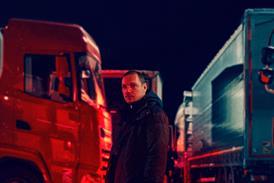

The Cannes Competition title follows real-life opportunist Henri Marre as he seeks to make a mark in 1940s France
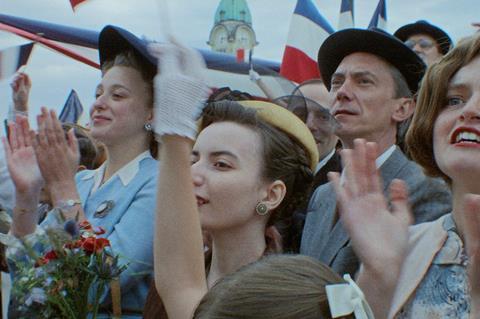
Dir-scr. Emmanuel Marre. Belgium/France. 2026. 157mins
September 1940. For many in France, the country’s swift defeat at the hands of the Germans and the establishment of the authoritarian Nazi-appeasing Vichy regime is nothing short of a national tragedy. But for 49-year-old Henri Marre (Swann Arlaud), it’s an opportunity. Hauling a stack of his self-published manifestos, titled ’Notre Salut’ (’Our Salvation’), he arrives alone in Vichy to offer his services to the new France. His talents and his lack of moral qualms are swiftly recognised. There’s much to admire in Emmanuel Marre’s ambitious second fiction: the lighting choices are thrillingly unexpected; the performances are superb across the board. But whether there’s enough there to justify the running time is another question.
Distinctive voice and boldly unconventional choices
It’s a personal work for Marre, whose previous films include 2021 Cannes Critics Week feature Zero Fucks Given, co-directed with Julie Lecoustre, and short Castle To Castle, which took home two prizes from Locarno in 2018. The framework that provides a structure for A Man Of His Time is a series of real-life letters between Henri and his semi-estranged wife, Paulette (Sandrine Blancke) – the director’s great-grandparents – and the film tells an inglorious chapter of their wartime story.
Marre does not let his ancestors off lightly. With its unsensational, dispassionate account of what Henri is prepared to do in the name of efficiency and self-preservation, the film touches on the same ‘banality of evil’ themes as Jonathan Glazer’s Zone Of Interest. And while this picture might not match Glazer’s for its intellectual rigor and formal control, Marre’s distinctive voice and boldly unconventional choices make this, at times, a genuinely exciting piece of work. The film has deals in place in France and Belgium; the main stumbling block for distributors elsewhere is likely to be the marathon running time and the occasional pacing issues. A further trim might serve to shift the focus onto the picture’s considerable strengths.
Of those strengths, Arlaud is one of the most notable. The lithe beauty and empathy he brought to his performance in Anatomy Of A Fall has been toned down; instead, he conveys a sly, weasel-like quality. Henri lurks on the sidelines when we first meet him, hard eyes and sharp teeth poised to attack any opportunity that might present itself. His desperation at a champagne reception for Vichy hotshots is palpable and off-putting, clinging to him like the smell of cheap cigarettes. The revellers instinctively give him a wide berth.
Marre emphasises Henri’s discomfort by the way he lights these scenes, with hard, glaring full-face spotlights that make the shot feel more like an interrogation than a cocktail party. At times, in the looming shadows and the sense that something untoward has been interrupted, there’s a hint of Weegee’s 1930s crime scene flash photography.
Equally bold as a device is the use of anachronistic music. It’s an approach recently seen in everything from Marie Antoinette to Corsage and Marty Supreme, but Marre takes it one step further. Rather than simply inserting tracks onto the score, he weaves them diegetically into the picture, having his Vichy clique members dancing to ’70s and ’80s electropop (’Popcorn’ by Hot Butter is a particularly memorable moment). It’s an irreverent flourish that provides a welcome contrast to some of the more airless scenes in which Henri and his colleagues sit through endless meetings about workplace efficiency and procurement processes.
But then the interminable dullness of Henri’s administrative duties is rather the point – he wrangles with a request to provide fuel and trucks to facilitate the transport of Jewish women and children with the same long-suffering resignation that he might show for a mix-up in a paperclip order. There’s a striking early scene in which Vichy officials debate how best to describe their relationship with the Nazis. Some favour “co-operation”, others opt for “collaboration”. In the case of Henri, a few other words come to mind – none of them flattering.
Production companies: Michigan Films, Kidam
International sales: Charades sales@charades.eu
Producers: Alexandre Perrier, François Pierre Clavel, Sébastien Andres, Alice Lemaire
Cinematography: Olivier Boonjing
Production design: Anna Falguères
Editing: Nicolas Rumpl
Main cast: Swann Arlaud, Sandrine Blancke, Mathieu Perotto, Harpo Guit, Mathilde Abd-El-Kader, Jean-Baptiste Marre