








Chosen as Tajikistan’s official Oscar submission, Shahram Mokri’s feature now plays Red Sea Competition
Dir: Shahram Mokri. Tajikistan/UAE. 2025. 139mins
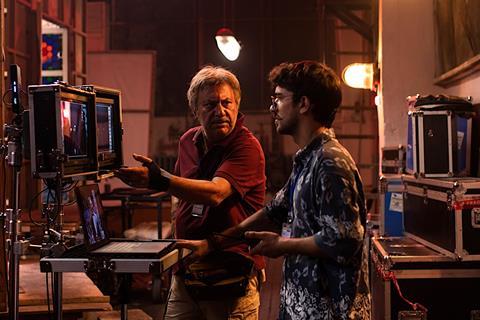
Everyone is everywhere not quite all at once in Iranian director Shahram Mokri audacious time-loop story, which is set mostly on the sound stages and backlots of a ramshackle Tajiki film studio. For much of its stretched running time, Black Rabbit, White Rabbit is an engaging meta-cinematic ride that twists the stories of three anxious, questing people around the McGuffin of an antique revolver.
More intriguing, original and clever than it is dramatically satisfying
Spiraling around this centrifugal point in narrowing circles, Mokri’s wildly ambitious, wryly comic puzzle film is ultimately more intriguing, original and clever than it is dramatically satisfying. But that’s more than enough to tempt cineastes in search of energising world cinema. At its best, Black Rabbit, White Rabbit is The Player meets Otto e mezzo transplanted to Central Asia. At its most impenetrable, it is always stubbornly watchable.
Selected as Tajikistan’s official Oscar selection, Black Rabbit, White Rabbit now plays Red Sea competition on the latest stop of a festival tour that began with a Busan premiere (and Vision Asia award win) and stops at London, Chicago and Singapore. This, combined with the sheer chutzpah of a deeply cine-literate film which flirts knowingly with genres from sci-fi to horror, may tempt arthouse distributors looking for offbeat, audience-challenging titles.
An opening caption quotes playwright Anton Chekhov’s famous dictum that if you’re going to hang a gun on a wall in a drama, it’s because you and the audience know it will be used. As in his 2013 film Fish And Cat, Mokri enacts a cinematic relay race, passing the point of view from one character to another, wrong-footing the audience with timeslips that turn the narrative into a kind of cinematic Möbus strip.
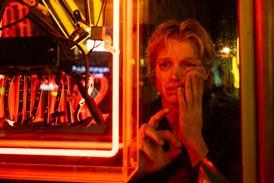
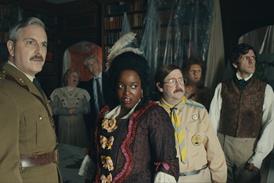
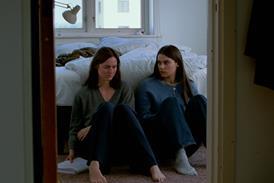
Consisting of a prologue, four chapters and an epilogue, the film follows three main storylines after kicking off with opening shock that it would be unfair to reveal. The first follows a woman, Sara (Hasti Mohammai), who is swathed in bandages following a car crash that seems to have given her strange powers. Filmed in a single take, this opening section is later revealed to be one of two features that are being shot on different lots of the same studio. The other is the remake of Hezar Dastan, an epic Iranian birth-of-a-nation TV drama series that became a national obsession in the early years of the Islamic Republic.
Babak Karimi, a veteran actor perhaps best known for his role in Asghar Farhadi’s A Separation, plays Babak, a hassled prop and weapons master who is desperately trying to find the film’s director – also, naturally, Black Rabbit, White Rabbit’s director – to deliver a gun to be used in the remake’s climactic assassination scene. He keeps crossing paths with an aspiring actress (Kibriyo Dilyobova) who is desperate for a role in Mokri’s movie – though when she auditions for Babak in the burqa she would need to wear for the part, her performance skills turn out to be of the old-fashioned stage magician variety. The rabbits she pulls out of a top hat are among several bunnies that populate the film; others, full-sized, land firmly in Donnie Darko territory.
Co-scripted by the director with his regular writing partner Nasim Ahmadpour, Black Rabbit, White Rabbit carries echoes of a work by Iranian experimental dramatist Nassim Soleimanpour. Soleimanpour 2010 play White Rabbit, Red Rabbit – designed to be performed each time by a different actor who has never read the script until they open it onstage – has become a breakout global phenomenon that is still playing off-Broadway and in London’s West End. Soleimanpour’s audience-participation drama deals with issues of censorship, coercion and control in more open ways than Mokri’s film; though perhaps Iranian and Tajiki audiences will be better placed to penetrate its dense layers of metaphor and allusion.
Superficially a thriller about a weapon master’s increasingly desperate attempts to avoid a tragedy, the film mentions only in passing the real-world death in 2021 of cinematographer Halyna Hutchins on the set of the film Rust. Accompanied by Peyman Yazdanian’s often contrapuntally jaunty score – which sounds at times as if played by a group of drunken musicians in a distant room – Black Rabbit, White Rabbit is a funny-sad human comedy that uses its film-within-a-film structure to entertain its audience while drawing a deterministic noose around characters who can’t seem to escape history’s cycles.
Salvation lies, perhaps, in a world beyond our rational perception – one figured here by supernatural elements that include the glowing force field that surrounds the bruised and abused Sara, or the props in a studio storeroom that, in one of several moments of mad brilliance, suddenly begin talking to each other.
Production companies: Karnameh Dubai Co
International sales: DreamLab Films
Producer: Negar Eskandarfar
Screenplay: Nasim Ahmadpour, Shahram Mokri
Cinematography: Morteza Gheidi
Production design: Amir Esbati
Editing: Shahram Mokri
Music: Peyman Yazdanian
Main cast: Babak Karimi, Hasti Mohammai, Kibriyo Dilyobova, Bezhan Davlyatov