










Ahmed Hassouna’s Venice out of competition title has been selected as Palestine’s official Oscar submission
Dir: Ahmed Hassouna. Palestine/France. 2026. 69mins
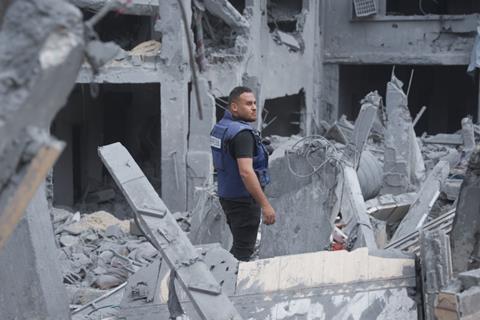
A Palestinian journalist tries to document what is happening in Gaza while enduring the same struggles as his subjects. Citizen Osama is, of course, a harrowing watch, as Osama Al-Ashi, a photographer-turned-war journalist, slaloms between bombings and other perils whilst celebrating the birth of his son and then trying to find milk and nappies in a war zone. The film premieres out of competition in Venice, and that it has been selected as Palestine’s official Oscar entry should help raise its profile.
Underlines the incredible resilience of the Palestinian people
Palestinian director Ahmed Hassouna previously directed 2019 non-fiction feature Istrupya and participated in the 2024 anthology work From Ground Zero, which featured 22 local directors telling stories from Gaza, while Al-Ashi worked on Gaza: Doctors Under Attack, which won a BAFTA for Best Current Affairs Program earlier this year. Al-Ashi also provides a voiceover for the film, which opens with a shot of him filming the rubble of a recent air raid in Gaza.
From there, the film follows Al-Ashi during his work as a war journalist and at home as a first-time father. Director/cinematographer Hassouni’s intent is clearly to highlight how the local journalists documenting the war also suffer from the problems they are recording. But the fact that the film is created from Hassouni filming Al-Ashi’s camera adds a invisible meta-layer, creating a persistent and completely unexamined tension that can contaminate the work’s supposed realism; even though this second layer remains carefully hidden.
Citizen Osama is at its best when at its most straightforward, showing on-the-ground imagery of the reality faced by citizens of Gaza. Ironically, this is when it is at its least cinematic and least intellectually probing, when there is little in the way of filters of editorialising. Of course, these kind of intellectual question marks do not take anything away from the gravity of what is being portrayed on screen. Over a period of about a year, from the birth of Al-Ashi’s son to the boy’s first birthday, both Hassouna and Al-Ashi lay bare the catastrophic devastation inflicted on Gaza’s people, infrastructure and fabric of daily life.
If Hassouni is conspicuous by his absence on screen, both as a director and working with editor Denis Le Paven, he does a solid job of constructing a portrait of both the private and professional sides of Al-Ashi while also giving an overarching sense of the scale of the conflict raging around him. We see constant airstrikes, bombings, tanks in the streets and severe food and fuel shortages that test the limits of human desperation. Amidst the countless wounded and dead on-screen are fellow journalists who seem to have been targeted directly by drones.
All this underlines, without a shadow of a doubt, the enormous bravery of people like Al-Ashi (and Hassouna) to document these atrocities, as well as the incredible resilience of the Palestinian people in the face of utter destruction. Long lines of people evacuating their homes and coming back during ceasefires, only to be expelled again a few weeks later, chill to the bone.
Technically, the film mixes regular and phone-captured footage, so the aspect ratio changes occasionally between shots. The pared-back score, which includes a lot of droning menace, is byRasmus Steen, who was also involved, in a behind-the-scenes capacity, in the recent Best Documentary Oscar winner No Man’s Land, another harrowing non-fiction work about Palestine.
Production companies: Coorigines Production, Masharawi Fund for Films & Filmmakers, Filcam For Media Production
International sales: The Party, acquisitions@thepartysales.com
Producers: Laura Nikolov, Rashid Masharawi, Ahmed Hassouna
Cinematography: Ahmed Hassouna
Editing: Denis Le Paven
Music: Rasmus Steen