










Wollner’s follow-up to ‘The Trouble With Being Born’ bows in Cannes Un Certain Regard

Dir: Sandra Wollner. Austria/Germany. 2026. 121mins
A Berlin-based family comprising teenage Jessie (Carla Hüttermann), her mother Ella (Birgit Minichmayr) and sister Melli (Lotte Shirin Keiling) are about to go on holiday in Tenerife when Jessie sneaks out for a night of partying with her boyfriend Lux (Tristan Lopez) which ends in tragedy. Sandra Wollner’s lyrical gut-punch of a film doesn’t ease its audience gradually into its world: Wollner immerses us in the family’s day-to-day life before swiftly upending it within the first 15 minutes.
An exceptionally well-calibrated study of an untimely death and its aftermath
After taking drugs in a park and climbing a tower block to watch the sunrise from the roof, Jessie plunges to her death; Wollner and cinematographer Gregory Oke stage this accident with an extraordinary command of cinematic space and perspective. Wollner avoids a sentimental aestheticisation of an avoidable disaster, while also giving a sense of melancholic grace to Jessie’s final moments. Everytime has a significant theme (loss of a child) in common with Wollner’s last film, The Trouble With Being Born, but unlike that controversial film, which also incorporated incest and paedophilia, this is unlikely to present the same kind of challenges for distributors and publicists.
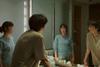
Life after Jessie dies can never truly be the same for Ella and Melli, and yet in many ways it is. It has to be: the daily routine is all they have. At the same time, it is like they have slipped into another dimension, where minor occurrences acquire a freighted sense of significance. At one point, Ella stands in a car park as a small drone hovers directly in front of her face. The image of a bird keeping company with a character in mourning is a familiar cinematic trope – perhaps a drone is simply the contemporary equivalent. But it’s eerie, and made no less so, when we discover the reason, which is connected to Jessie’s boyfriend Lux. Ella eyes him with a complex mixture of emotions: compassion, suspicion and anger all seem to be in the mix.
Ella is a plum role for veteran stage and screen actor Minichmayr, who will also be very familiar to arthouse cinema audiences for her prolific screen career in films by the likes of Michael Haneke, Jessica Hausner and Maren Ade. The challenge in portraying Ella is conveying that although she appears to be stoically carrying on, much of this is an attempt to keep life functioning for her younger daughter – it’s a performance within a performance of everyday survival.
The revelation here is Shirin Keiling as young Melli, who gives a lived-in, utterly believable performance as a youngster old enough in some ways to comprehend what has happened, while still being far too young to understand nuances such as her mother’s ambiguous attitude to Lux. In particular, Shirin Keiling really comes into her own in the final act, which is where the film stops being merely an exceptionally well-calibrated study of an untimely death and its aftermath, and becomes something richer and more unsettling.
It would be easy to reach for the term ‘magical realism’ in describing the film’s climax, but the precise internal logic of Wollner’s film elevates it above so much of what is meant by that term. Here, the impossible appears to occur, but with a grounded psychological precision that more than earns the break with reality and means that the film’s carefully established realism is deepened – reaching almost unbearable levels of emotional resonance, rather than undermined.
Production company: Panama Film, The Barricades
International sales: Charades, Carole Baraton, sales@charades.eu / Sena Cilingiroglu sena@charades.eu
Producer: Lixi Frank, Viktoria Stolpe, David Bohun
Cinematography: Gregory Oke
Production design: Julia Libiseller & Gerald Freimuth
Editing: Hannes Bruun
Music: David Schweighart
Sound: Johannes Schmelzer-Ziringer
Cast: Brigit Minichmayr, Tristan Lopez, Lotte Shirin Keiling, Carla Huttermann