









Gibney’s exhaustive documentary plays Venice ahead of berths in Toronto and London
Dir: Alex Gibney. US. 2026. 225mins
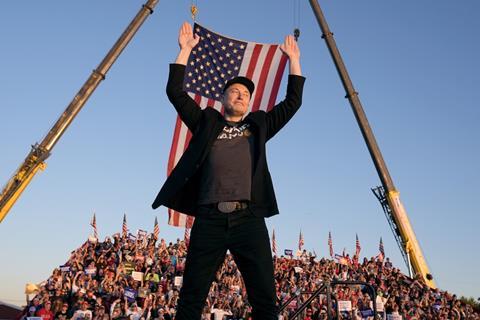
How did Elon Musk become the richest and, arguably, most powerful person on the planet? Alex Gibney’s four-hour documentary compellingly presents several theories, many of which speak to humanity’s worst tendencies including ego, greed, arrogance and the masses’ willingness to be conned by a self-proclaimed messiah. As with many of Gibney’s films, Musk can be too slickly assembled, but it lays out a persuasive case that the controversial businessman has become increasingly more dangerous as his influence grows, threatening the very species he professes to want to save.
Can be too slickly assembled, but it lays out a persuasive case
Premiering in Venice out of competition, the documentary should find a receptive audience among progressives looking to be enraged anew by Musk’s questionable professional conduct and capricious personal life. Gibney’s track record of taking on corrupt figures, such as in Mea Maxima Culpa and The Armstrong Lie, will be further enticement for viewers to watch a film about such a divisive figure. Musk will travel the festival circuit, including berths in Toronto and London, before opening in US theatres on October 16.
Gibney recounts the billionaire’s most noteworthy moments, starting with his early days as a dot-com star of the late 1990s, eventually founding the aerospace company SpaceX and taking control of the electric-vehicle giant Tesla. (As Musk clarifies, he did not found Tesla as he likes people to believe.) Featuring extensive conversations with ex-wives, former business partners, journalists and Musk’s father Errol, the documentary works around Musk’s refusal to talk to Gibney by drawing from archival interviews, creating an animation of Musk and incorporating AI tools to simulate him ‘speaking’ to the filmmaker.
Utilising trendy new technology feels fitting for a film focused on someone on the cutting edge of innovation. To that end, Gibney also integrates colourful graphics that mimic video games — an art form Musk adores — to illustrate the man’s ballooning fortune and budding political ambitions. Understandably, a documentary this dense with information needs some visual pizzazz, but these effects frequently come across as glib rather than gripping.
Far more effective is the film’s methodical rundown of its subject’s worrying behaviour and attitudes. Musk reminds viewers that, not long ago, Musk seemed like an eccentric but conscientious entrepreneur who warned of AI’s destructive potential and advocated for the environment. But those positive traits soon proved illusory. Editor and co-writer Michael J. Palmer moves the story along at a steady clip, emphasising Musk’s ingrained habit of overinflating his contributions and selling himself as a tech savant. Much like previous Silicon Valley folk hero Steve Jobs, Musk understood the importance of playing the part of a visionary, attracting a cult of personality along the way.
Disturbingly, as Musk became a celebrity thanks to the success of SpaceX and Tesla, his unquenchable desire to be adored and protect his obscene wealth drove him to control how the world perceived him. JP Doherty, who was instrumental in Twitter’s engineering and reliability operations, bitterly recounts Musk’s acquisition of the social-media site, gutting its protective guardrails in the name of ’defending’ free speech, even after it was increasingly apparent that he merely wanted a massive platform on which to be worshipped by his millions of loyal supporters. Musk would adopt a similarly reckless strategy when, in 2025, he oversaw the White House’s DOGE program, cutting thousands of jobs that helped the world’s most vulnerable, in order to ensure that government watchdogs investigating his companies’ dubious practices would be neutralised.
Gibney’s talking heads paint Musk as a cult-like figure lacking empathy and insisting that he knows better than everyone else. His first wife, author Justine Musk, confesses that she felt more like an employee than a spouse, and she is particularly moving while decrying her ex-husband’s transphobic comments about their trans daughter Vivian, whom he refuses to acknowledge. We hear stories of Musk’s extreme pronatalist views, having children with several women because he believes the world needs to be populated with his superior genes. And as Musk’s reported drug addiction begins to consume him, so do his flagrant far-right commentaries — he constantly disparages the ’woke mind virus’ — which aligned him with Donald Trump’s retrograde political agenda. Similar to the current US president, Musk is revealed to be a toxic narcissist — an impression strengthened by Musk’s abusive father, who instilled in his son a pitiless winner-take-all outlook on life.
Myriad biographies, exposes and news specials have been made about Musk, so Gibney’s film may not be especially illuminating for knowledgeable viewers. But Musk’s sheer heft and catalogue of damning details serves as a handy primer on why so many fear having someone as vindictive and maladjusted be so powerful. (As just one example, after previously condemning AI, Musk has now embraced it, viewing the unregulated technology as a financial windfall.) In one clip, Musk claims to be an optimist, but anyone watching this documentary will feel deep despair about the future.
Production company: Jigsaw Productions
International sales: Black Bear, info@blackbearpictures.com
Producers: Zhang Xin, Joey Marra, Nick Shumaker, Jessica Grimshaw, Dana O’Keefe, Ronan Farrow, Lawrence Wright, Jessie Deeter, Erin Edeiken, Alex Gibney
Screenplay: Alex Gibney & Michael J. Palmer
Cinematography: Benjamin Bloodwell
Editing: Michael J. Palmer
Music: Daniel Pemberton