












Ken Watanabe also stars in Minamoto’s adaptation of Sayako Nagai’s prizewinning novel
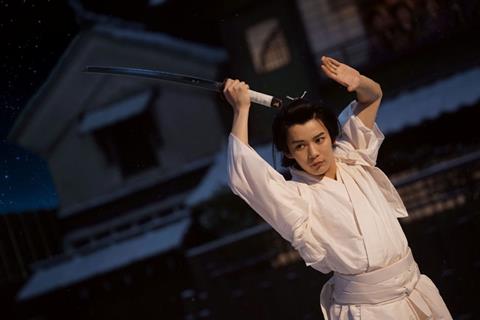
Dir: Takashi Minamoto. Japan. 2026. 118mins
A winter night in Edo, 1810, is the backdrop for a duel between a local thug and a young samurai noble; a duel that is much more than just a sword fight and has more twists and turns than an average Agatha Christie mystery. Effortlessly jumping from Columbo-style detective tale to heavy drama and all points in between, Takashi Minamoto’s Samurai Vengeance is a stealthy delight with the potential to sneak up on viewers expecting a rote jidaigeki film and surprise with something considerably more thoughtful – and entertaining.
Minamoto has a keen sense of when to dial up the emotion and the humour
Journeyman director Minamoto has been down this road before, specifically with The Last Revenge in 2011, which pivoted on the Meiji era’s quest to outlaw samurai revenge killings. That film flew under the radar, as did Samurai Vengeance when it was released at home in Japan in February. Now making its international premiere at New York Asian Festival, it is toplined by veteran Tasuku Emoto in a charming turn as a bumbling PI and features an impactful supporting performance by Ken Watanabe. That should help Samurai Vengeance find receptive international audiences and distributors who responded to Lee Sang-il’s lush Kokuho and Junichi Yasuda’s low-budget hit A Samurai in Time – even though Vengeance bears little resemblance to either of those films narratively or thematically.
Vengeance – as something that is performative and as a tradition that can be honoured, altered or ignored – is the idea at the heart of Samurai Vengeance, based on 2023 Yamamoto Shugoro and Naoki prize-winning novel by Sayako Nagai. In 1810 Edo, the Kobiki-cho’s Monte-za Theatre is just completing a performance of Kanadehon Chushingura, best known as the story of the 47 Ronin, the quintessential Japanese revenge saga.
As the crowds stream onto the street they become witnesses to a young woman being harassed by local thug, Sakubei the Gambler (Kazuki Kitamura), the scourge of the area. As it happens, the young woman is actually teenage boy Kikunosuke Ino (Kento Nagao), who claims Sakubei killed his father. He’s here to avenge the death and save his family from banishment, and the crowd is with him. Kikunosuke beheads Sakubei in a fight that gets everyone’s attention, including former samurai and playwright Kinji Shinoda (Watanabe), who shines the theatre’s spotlights on the fighters. Then just like that, Kikunosuke disappears.
Eighteen months later, another ronin from Kikunosuke’s fiefdom, Soichiro Kase (Emoto, Shin Kamen Rider), shows up at the theatre and starts asking uncomfortable questions about that night. Kase quickly discovers not everything is what it seems, and everyone has something to hide.
That is just the tip of Samurai Vengeance’s very large narrative iceberg, which slowly but steadily reveals itself as Kase bumbles his way through his investigation. Eventually a complete picture emerges: of Edo-period corruption, duty, honour and rigid rules that underpin identity; as well as the eternal role of theatre (or art) as haven for outsiders. It’s all tucked inside a hodgepodge of pulp detective mystery, heist romp, comedy and drama that could prove a tonal clash, but doesn’t. Minamoto, who also adapted the novel for the screen, has a firm grasp on the material, and a keen sense of when to dial up the emotion and the humour.
The cast is the film’s strongest element, despite solid production design by Takashi Yoshida, cinematography by Yoshito Asakura and costuming by Mitsuru Otsuka (FX’s Shogun). Emoto leads the charge with his willfully silly Kase, whose cluelessness is a ruse. He masters the slow burn, and mines the script for more than a few laugh-out-loud moments. Similarly Kitamura is clearly enjoying the histrionics of the overtly villainous Sakubei, and Nagao’s relatively innocent Kikunosuke is the film’s emotional anchor. Minamoto surrounds him with a colourful cast of characters that make the most of the time they have: theatre barker Ippachi (Koji Seto); retired onnagata (Kazuya Takahashi); swordmaster Sagara (Kenichi Takitoh); and Kyuzo the Tight-lipped (Bokuzo Masana), the theatre’s carpenter.
Samurai Vengeance is ultimately about subverting the very concept of public, bloody revenge, and about accepting change and finding one’s place in the world – no matter how hard that may be. It also subverts the mystery genre by never concealing the fact there’s more at play than meets the eye, making it less a whodunit and more about the hows and whys.
Production company: Amuse Creative Studio
International sales: Toei Company Ltd international@toei.co.jp
Producers: Junpei Horiguchi, Gen Nakazawa, Yasushi Suto, Miki Watanabe
Screenwriter: Takashi Minamoto, based on the novel by Sayako Nagai
Cinematography: Yoshito Asakura
Production design: Takashi Yoshida
Editing: Keiji Koizumi
Music: Umitaro Abe
Main cast: Tasuku Emoto, Ken Watanabe, Kento Nagao, Kazuki Kitamura, Koji Seto, Kenichi Takitoh, Kazuya Takahashi