











Emma Boccanfuso’s feature length debut world premieres at Visions du Reel
Dir: Emma Boccanfuso. Switzerland/France. 2026. 94mins
Chapéu Mangueira is a small Rio favela community perched on a vertiginous hillside, barely a five minute walk from Brazil’s famous Copacabana beach – but the tourist hotspot remains deliberately unseen throughout director Emma Boccanfuso’s intimate documentary of a place and its people. Boccanfuso’s attention is given entirely to a geographically precarious community that gives the impression of being one extreme weather event away from crumbling away. No less precarious is the residents’ psychological sense of security, with shootings by both gangsters and police a daily reality.
Poised yet offbeat formality
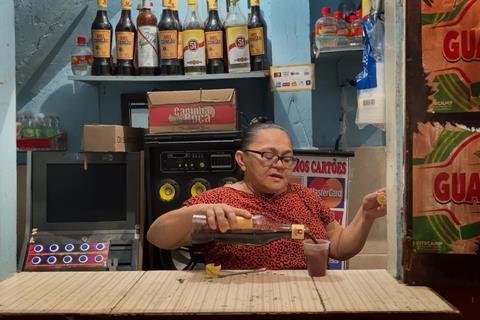
Boccanfuso, who divides her time between France and Brazil, previously co-directed the 2020 short Café, Verre D’Eau, and has now created a modest and thoughtful feature length debut. World premiering in Vision du Reel’s international competition, Saudades Eternas narrows its focus to one particular home, ruled over by Sueli – a hard-working Brazilian matriarch attempting to keep body and soul together under trying circumstances. Sueli is not the irrepressibly sassy older lady beloved of Hollywood, nor is she a cliched wise elder dispensing strict discipline and philosophical insight alongside nourishing home cooking. It is possible that the film would have longer commercial legs if she were; more mainstream character studies have a better chance of breaking out beyond the independent documentary festival circuit.
Instead, Sueli is depicted as a real woman of the type not often elevated to lead character status in either fiction or documentary. She is loosely responsible for connecting a network of biologically or socially related people of varying ages – Rogério, Jaqueline, Wendel, Marina, Rafael, Juan, and Thays, to name but a few – adding up to something of a family. Despite their numbers, there is a palpable sense of absence, with various men dead or missing due to not wanting to be responsible for their children. (The film’s title is a Portuguese idiomatic equivalent of ‘rest in peace’.) The result is a domestic portrait that blends universally familiar aspects with culturally specific features.
Boccanfuso creates an aesthetic which aims to make a virtue of the shoot’s restrictions. She’s evidently working with a single camera and favours static compositions, often with part of the scenario occluded by clutter or household items. Close-ups are rare, with a solo midshot her favoured set-up for an interview, though the interviews are not formally staged – more often, the filmmaker is conversing with a household member as they complete some chore. She is also adept at playing with our sense of dimensions; for instance staging a shot vertically, looking down through a trapdoor and ladder, not as part of a kinetic series of shots moving through a space, but as a position in which to set up camp and linger, observing an interaction.
This sense of poised yet offbeat formality has more in common with a filmmaker like Ozu than the images suggested by the film’s marketing, which employs zesty turns of phrase such as ’a blazing hymn to life […] flamboyant, volcanic, tender’ to conjure a certain narrative of favela life. What is most interesting about Saudades Eternas itself is how staunchly it resists that tone of voice to arrive in a more mediated space of reckoning with the difficulties faced by its protagonists.
The film hits hardest in its depiction of childhood – both in the ways that this formative period of life is affected by the proximity to violence and, paradoxically, the ways in which it remains the same, despite the circumstances. To the children depicted here, there is a certain unreality about the prospect that they themselves could be shot. They might understand that a relative or community member has recently been killed, but a temporary prohibition on playing in the yard during a period of increased risk registers as an adult-imposed bore. As with children everywhere, the kids here find it hard to comprehend the everyday dangers of their world as anything more than a fairly arbitrary set of restrictions; your heart breaks for them.
Production company: Macalube Films, Close Up Films
International sales: Close Up Films info@closeupfilms.ch
Producer: Anne-Catherine Witt, Flavia Zanon
Screenplay: Emma Boccanfuso, Quentin Faucheux-Thurion
Cinematography: Emma Boccanfuso
Editing: Clara Chapus