












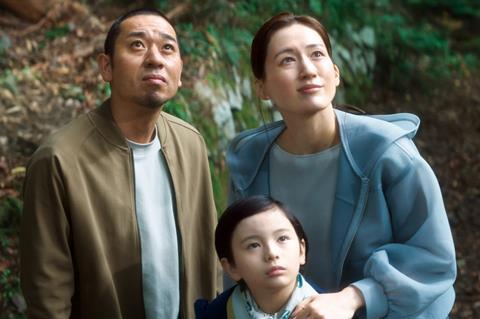
The Cannes Competition title stars Haruka Ayase and Daigo as grieving parents
Dir/scr: Hirokazu Koreeda. Japan. 2026. 126mins
“It’s a Roomba” says sceptical father Kensuke (Daigo) when a new domestic appliance enters his home. But this one doesn’t hoover. It’s a humanoid robot, formed in the image of the son Kensuke and his wife Otone (Haruka Ayase) lost two years previously. It’s been supplied by a company called ReBirth, which provides walking, talking humanoid surrogates for grieving people. In Cannes Competition for the eighth time in 25 years, Japanese auteur Hirokazu Koreeda resists the pull of AI doom-mongering to table a thoughtful, poignant, sometimes funny and whimsical reflection on the future of humankind’s coexistence with intelligent machines.
A penchant for saccharine touches undercuts the authority of the film’s philosophical musings
Sheep In The Box is arguably not sci-fi at all, certainly not in the FX-laden dystopian mould set by other emotional android forays like Spielberg’s A. I. Artificial Intelligence. But its grounded real-world credentials are compromised by a not entirely earned vein of sentimentality, and by the script’s inability to fully digest an otsumami spread of bite-sized themes. Yet it’s not difficult to see why Neon took rights for the US, UK and Australia in late 2025: though scattershot in the telling, this is a film of undeniable heart and charm that should perform well with international arthouse audiences.
Koreeda has set the film in a very near future Japan that looks remarkably like today, one in which AI has not progressed far beyond its current status as an enabler of human desires, illusions and weaknesses. Sure, delivery drones are now widespread, kids are accompanied to school by traffic warden robots, and fridges tell you when you’ve had enough beers for one day, but everything else is recognizably in a here and now that is gently tweaked by an insistent recourse to bright, flattening sunlight on faces and surfaces.
Otone is an architect who still relies on analogue tools like the scale models she patiently makes for her clients, while her down-to-earth husband Kensuke is a master carpenter, attuned to the properties of different woods and the way they continue to live even when the tree has become timber. He’s also a very human human, who slurps his food and slouches along in setta sandals that swish lazily on tarmac.
Casting earthy Japanese comedian Daigo as Kensuke alongside the willowy, ethereal Ayase (previously used by the director in 2015’s Our Little Sister) works to establish their odd-couple dynamic and set up the dramatic tension of their seven-year-old son’s reappearance into their lives two years on from the unspecified ‘accident’ that took him away. Otone is febrile with emotion, Kensuke distrustful. She sees the boy they lost, he sees a machine with a GPS tracker that doesn’t eat or drink, mustn’t get wet and is automatically put into sleep mode if it strays more than 30 metres from its ‘owners’.
We know from the get-go that the couples’ initial reactions to this curious, smart, loveable replica of their lost son – played affectingly by cute newcomer Rimu Kuwaki – will change and chicane. It’s difficult to keep a reborn son a secret, and when Otone’s blowsy, judgemental mother drops in unexpectedly, or when Kensuke’s work colleagues try to figure out how they should behave around this eerie spitting-image android, the film’s aching untenability floats to the surface.
Yet the film also enacts the messiness that, according to Otone, makes us human (“I want to struggle with difficulties, I don’t want quick solutions”, she says to her robot ‘son’ at one point). Back in his usual writer-director mode after entrusting the screenplay of his last feature, 2023’s Monster, to Yuji Sakamoto, Koreeda interleaves a story about a group of feral, independent ReBirth child-humanoids into what is essentially a story about two adults trying to face the fact that it’s time to let go. It’s a bold move, but it’s one that makes better thematic than emotional sense.
Sheep In The Box takes its title from an illustration in Antoine de Saint-Exupery’s children’s classic The Little Prince that pays homage to the power of the imagination. Boxes like the modernist house Otone and Kensuke live in, or the one that she is designing for a pair of crass but enthusiastic clients, are contrasted here with a more organic approach to architecture; one inspired by trees and the mycorrhizal networks that connect them underground. There’s plenty of food for thought here, but the script’s penchant for saccharine touches – one aided and abetted by a lilting string-led soundtrack that turns to treacle a little too often – undercuts the authority of the film’s philosophical musings.
Production companies: Fuji Television Network, GAGA Corporation, TOHO CO Ltd, AOI Pro. Inc.
International sales: GAGA Corporation intlsales@gaga.co.jp
Producers: Kaoru Matsukazi, Megumi Banse
Cinematography: Ryuto Kondo
Production design: Takuya Okada
Editing: Hirokazu Koreeda
Music: Yuta Bandoh
Main cast: Ayase Haruka, Daigo, Kuwaki Rumi, Rimu Kuwaki