Tonia Mishiali’s second feature makes its debut in Karlovy Vary’s Crystal Globe copetition

The Lion At My Back

Source: Karlovy Vary film festival

The Lion At My Back

Dir. Tonia Mishiali. Cyprus/Luxembourg/Greece. 2026. 106mins

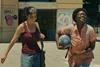
It is hard to pinpoint the exact moment in which the relationship between teenage Senegalese asylum seeker Mariama (Sokhna Diallo) and Cypriot recovering drug addict Stella (Elena Kallinikou) shifts from something cold and convenient into something warmer and more nurturing. But thanks to two empathetic performances, this ad-hoc mother-daughter relationship feels fleshed out and persuasive, even when the story doesn’t always seem as grounded in reality as the characters inhabiting it.

The story doesn’t always seem as grounded in reality as the characters inhabiting it

The sophomore feature from Tonia Mishiali The Lion At My Back is the second part of a proposed trilogy of films linked, presumably, by the common theme of women on the periphery – the kind of people who it’s easy to overlook. This Cyprus-set drama turns a lens onto two women who find a kinship with each other as they struggle to make a life at the margins of society. Family, the film suggests, is not just about shared blood. Sometimes, it’s just a case of caring when you don’t have to.

The Lion At My Back follows Mishiali’s 2018 debut Pause to Karlovy Vary, graduating to the main competition. Pause screened in the festival’s East of West strand, and went on to enjoy a healthy festival run, winning the Fipresci prize at Thessaloniki. While the market for migrant stories is rather oversaturated, meaning that the film might struggle to gain traction theatrically, The Lion At My Back should achieve similar festival exposure to that of Mishiali’s debut. Events with a specifically female or political focus will be the picture’s natural home.

The film opens with a celebration. A hand shakes slightly as it lights the candles on the birthday cake. The hand belongs to Stella, and its unsteadiness is perhaps the legacy of the addition and self-destructive impulses that she is trying to escape. The cake belongs to Mariama; it’s her 18th birthday, but the joy is bittersweet. Formerly a resident at a centre for child migrants, she is now an adult and must fend for herself. Her meagre possessions crammed into plastic carrier bags, she loiters at the gate of the migrant centre, unsure of what to do. It’s the only safe place she knows, so when she fails to find a bed for the night, it makes sense to break back into the grounds of the facility and sleep rough by the walls of the building that was, until recently, her home.

Elsewhere, Stella hides in the undergrowth at night, hoping to catch a glimpse of the daughter who was taken from her when her addiction became her priority over her parenting. She has a lawyer and is hoping to regain custody, but the first step towards this is to take a drug test – which Stella knows she will fail. What throws Stella and Mariama together initially is mutual expediency. Mariama needs a place to stay; Stella needs a clean urine sample. What connects them, however, is something deeper – both have an aching absence in their lives that, temporarily at least, is filled by the unexpected bond that forms between them.

For much of the film, Mishiali favours an unvarnished, social realist approach. The camera fidgets restlessly, attuned more to Stella’s wariness than to Mariama’s openness and innocence. Both women have suffered. Stella now meets the world with hostility and suspicion (the subdued, low-lit murky gloom of her cramped apartment feels like an extension of her character). But somehow, despite a forced marriage as a child and a perilous journey as a refugee, Mariama has a spirit which is as pure as it is positive. The scenes which best capture her personality are shared moments of calm on an empty beach, with a wide, clear, hopeful horizon.

There’s a shift, towards the end, away from the gritty authenticity towards a more heightened, heady sense of menace. Stella is offered a substantial amount of money to return to a former employer, for one night. Her place of work is a BDSM punishment dungeon; lit in brazen magenta, surrounded by a disorientating maze and populated by monstrous men, it feels hallucinatory and surreal. It’s a change in tone and approach that jars slightly, but it delivers a message: for vulnerable women like Stella and Mariama, sisterhood and mutual support offers a way forward when life is full of bad men and dead ends.

Production company: Bark Like A Cat Films

International sales: The Yellow Affair steven@yellowaffair.com

Producer: Tonia Mishiali

Screenplay: Tonia Mishiali, Dianne Jones, Simona Nobile

Cinematography: Manu Tilinski

Production design: Christy Polydorou, Yiorgis Yiannou

Editing: Emilios Avraam

Music: Fredrika Stahl

Main cast: Sokhna Diallo, Elena Kallinikou, Prokopis Agathokleous, Herodotos Miltiadous, Marina Mandri, Paris Erotokritou