






Star Valeria Bruni Tedeschi impresses in this stylish but increasingly repetitive Faustian horror
Dir: Paolo Strippoli. Italy/France/Belgium. 2026. 115 mins
We’re all familiar with fairy tales, or Faustian legends, in which a supernatural being acts as a kind of existential loan shark, promising present relief or riches in return for some devastating yet distant future payback. The motif is weaponised in Italian art-horror specialist Paolo Strippoli’s most mainstream film to date, which sees him play Venice’s main competition just a year after The Holy Boy played out of competition at the festival. There, as in his 2022 feature Piove (It’s Raining), Strippoli used the horror genre to illuminate fractures in families and communities. In The Spiral, the Puglian director continues in the same vein; intriguingly at first, but to diminishing returns.
A dark family tale that gradually loses its grip
In Italy, where it is due to be released by 01 Distribution on 8 October, The Spiral (titled L’Estranea – ‘the female stranger’ – on home ground) will leverage its cast of familiar local faces to attract a crossover crowd, and has a few other cards to play that could attract further buyers in territories beyond the ones to which it has already sold. It’s a self-consciously stylish number stuffed full of flashy crane shots, extreme shallow focus and woozy wide-angle shots, with a jarring, moody colour palette and some catchy needle drops. Even the predictability of its cyclical fairytale structure could turn out to be a positive for attracting audiences.
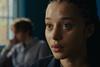
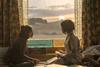
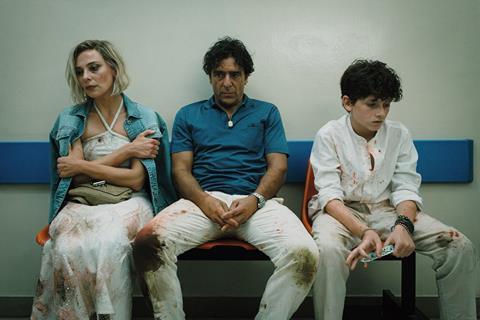
‘It was a dark and stormy night’ is a suspense cliché with abiding potency, and Strippoli and his co-writer Salvatore De Chirico embrace it fully – without apparent irony – in the framing device, set in Rome on a night of lashing rain, when a stressed and bedraggled woman, Anna (Jasmine Trinca), pays an unannounced visit to her adult daughter Alice (Romana Maggiora Vergano), to unburden herself of a terrible secret. As she reveals – early enough for it not to be a spoiler – a strange woman lies behind the family’s nose-dive from wealth and happiness to rack and ruin. As the rain outside turns into a flood, the mother’s febrile story is punctuated by flashbacks that detail the way a hasty pact with some kind of devil turned into an unstoppable ‘spiral’.
The first of those flashbacks take us back around 20 years to the good times of the rich, superficial Colonna family. Anna is married to Walter (Adriano Giannini), a successful businessman with a taste for open shirts and medallions. She’s thrilled because Alice, seen here at primary-school age (and played by Gabriella Telegrafo), has just been cast in a TV commercial. Walter is excited because Tobia, Alice’s brother (Alessandro Carbonara), is a promising young football talent. Their bland new-build neoclassical house with its huge lawn and pool is in Bari, Puglia, but it could be just about anywhere.
At her birthday party, in a sequence with a Sorrentino feel set to 1998 pop hit ‘Narcotic’, the young Alice suffers a life-threatening accident. It’s while at the hospital, in one of those modern chapels with depressingly jazzy stained-glass windows, that a desperate Anna meets Valeria Bruni Tedeschi’s stranger – who is by far the best thing about The Spiral. Dressed in a wraparound beige raincoat, she does sympathy the way an AI-trained bot might, delivering it and her offer of a life-saving deal in a way only a desperate mother would fail to be chilled by. Rarely has Bruni Tedeschi used her piping, sibilant delivery to better effect.
It’s fun too to see Trinca, who is often cast as a working-class pasionaria, running with the role of a trashy, status-obsessed woman who can’t stand the idea of losing control over her family’s rosy trajectory. And Giannini brings a nice touch of pathos to perma-tanned patriarch Walter. But as flashback follows flashback – each one ending with the stranger materialising to sort out one problem by creating an even worse one – the soundtrack’s repeated crashing organ chords and the lashing, apocalyptic rain of the framing sequence feel like diversionary tactics. There’s a nugget of an idea buried in here about how tempting it is to blame the gods, the evil eye, or a raincoated stranger for woes that are self-inflicted. But it’s buried so deep that, like that deal-making devil, it may not even exist.
Production companies: Propaganda Italia with Rai Cinema in association with Dinamo Film
International sales: Le Pacte
Producers: Marina Marzotto, Mattia Oddone, Jean-Christophe Reymond, Joseph Rouschop and Eva Curia
Screenplay: Paolo Strippoli, Salvatore De Chirico
Production design: Marcello Di Carlo
Editing: Federico Palmerini
Cinematography: Cristiano Di Nicola
Music: Rob
Main cast: Jasmine Trinca, Romana Maggiora Vergano, Adriano Giannini, Valeria Bruni Tedeschi