








Laudenbach’s third feature premieres in Cannes Directors Fortnight before moving on to Annecy
Dir. Sébastien Laudenbach. France. 2026. 90mins
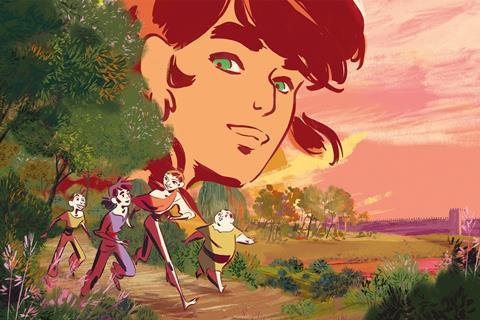
A visually stunning reimagining of Bizet’s Carmen, the third animated feature from Sébastien Laudenbach tells a parallel story to the tragic tale of the fiery gypsy and her scorned lover, the army lieutenant José. Laudenbach takes as his entry point the children’s chorus that opens the opera, telling a version of the story through the eyes of the urchins. The result is a Carmen made relatable and accessible to younger audiences, which also incorporates a feminist perspective. While some Bizet purists might rankle at the narrative segues and the stripped back approach to the music, it’s likely that viewers will be captivated by the film’s vital energy and its thrilling play of light and colour.
Alive with the sensation of constant movement and restlessness
Bizet’s opera, and the novella by Prosper Mérimée on which it was based, have both provided inspiration for numerous filmmakers. Previous versions of this classic tale include a 1915 silent version by Cecil B DeMille, a hip hop version starring Beyonce, a lavish 1984 film of the opera by Francesco Rosi and the South African Xhosa-language version by Mark Dornford-Hay, U-Carmen e Khayelitsha.
With its savage passions and knife-based violence, it is not a story that immediately lends itself to family entertainment. But then Laudenbach has a knack for deftly incorporating challenging themes into children’s films: his previous picture, Chicken For Linda!, which he co-directed with Chiara Malta, handled bereavement and grief with the lightest of touches. That film went on to earn several awards, including the Cristal top prize at Annecy and the César for best animation. Viva Carmen, which will screen in Annecy following its world premiere in Cannes Directors’ Fortnight, could match, or even surpass, Linda!’s warm reception with both awards juries and audiences.
The distinctively sparse ‘broken line’ approach to character design, which has been present in Laudenbach’s work since his 2016 debut The Girl Without Hands, is evident once again. Airy, alive with the sensation of constant movement and restlessness, it’s a graphic style that works wonderfully well in capturing the vibrant bustle of life on the teeming streets of 19th century Seville, and the slinky, flamenco-infused sensuality of Carmen (voiced by Camélia Jordana).
Elsewhere, in the backdrops and the lush, almost tropical, colour palette, the film has a distinctively rich visual approach that differs from the minimal breeziness of the previous films. Favouring throbbing, saturated magentas and lip-smacking tangerine hues contrasted with chocolate, violet and a dusky cyan, the film is a visual triumph. The heady sunlight of Andalucia is carved up by the tall tenement buildings and alleys of the city; the frame, like the story itself, is riven by light and shadows.
In this vivid world lives orphaned young adolescent Salvador (Anatomy Of A Fall star Milo Machado-Graner). He travels with Antonio (Paul Minthe) a blind knife-sharpener who has the gift of foresight. But when Antonio predicts the death of Carmen by the blade of the young soldier José, Salvador leaves his master’s service and partners with a motley street gang of children led by canny pickpocket Belén (Soumaye Bocoum). Both Antonio and Belén are determined to save Carmen in the only way they can think of – by stealing the knife that is destined to kill her.
The film’s approach to music is similar to that of the character design: Bizet’s opera is deconstructed, we hear tiny fragments of it but, like the elegant, minimal daubs of paint, it’s enough to evoke the spirit of the piece. And there are new musical works: the score is a collaboration between Amine Bouhafaand flamenco guitarist (and the director’s sister) Isabelle Laudenbach.
The picture diverges most from the source material at its climax which imagines a communal space for the women of the city and the orphans that roam its streets. Like the neighbourhood meal at the end of Chicken For Linda!, it’s a statement of hope and faith in community.
Production company: Folivari, La Garde Montante
International sales: Global Constellation, Leo Teste, sales@globalconstellation.eu
Producer: Damien Brunner, Sarah Delmas
Screenplay: Santiago Otheguy, Sebastien Laudenbach
Head of animation: Marjorie Caup
Production design: Élodie Rémy
Editing: Catherine Aladenise
Music: Amine Bouhafa, Isabelle Laudenbach
Main cast: Camélia Jordana, Milo Machado-Graner, Soumaye Bocoum, Carl Malapa, Gaëtan Dupont, Évan Paturel, Paul Minthe, Olga Milshtein, Nadège Beausson Diagne, Maxime Bailleul