











Mathilde Arcel puts in a terrific lead performance in the director’s follow-up to Long Story Short and Queen Of Hearts
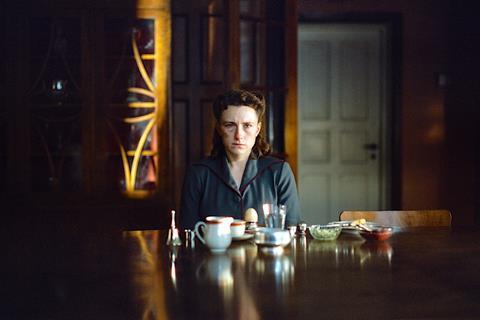
Dir. May el-Toukhy. Danish 2026. 126mins
This year’s Venice competition features only one film by a sole female director – but Danish selection Woman Unknown at least offers some corrective, being a feminist statement of considerable fury as well as harrowing but soberly managed emotional power. The setting is Denmark immediately after World War Two, the nation having been occupied by Nazi Germany during the conflict. Marie (Mathilde Arcel) is a young nanny and maid in the house of Christian (Carsten Bjørnlund), the widowed owner of a glove factory. Marie is also engaged to be married to Christian – although this fact barely raise her above strictly subordinate rank in the domestic regime.
Sombre elegance and slow-building complexity
This post-war historical drama is the third feature by May el-Toukhy, following Long Story Short (2015) and 2019’s Queen of Hearts, which was remade by Catherine Breillat as Last Summer (2023). With the film traveling to London, Toronto and likely others before a Danish release on February 4, el-Toukhy and terrific lead Arcel should expect much attention for a film that can surely expect some visibility in the awards season. The film’s meticulous execution, giving new energy to a traditional style of art cinema, could make for wider distribution.
The introverted, seemingly placid Marie has secrets – one of them known to Karl (Thorbjørn Hedegaard), a young man she once knew who insistently pursues her when he spots her on a bus. He blackmails her with his knowledge that she was one of Denmark’s so-called ‘horizontal collaborators’, women who slept with occupying soldiers. (In Marie’s case, this led to a pregnancy and difficult birth, which her son did not survive.) Such women were hunted down and brutally humiliated in the streets, beaten and their heads shaven – here the fate of two ‘unknown women’, as they are credited, one of them in a harrowing long take towards the end (full credit to Anne Mari Riga Kræmmer and Signe Mathilde Sørensen for utterly fearless performances in these sequences). Marie will do anything to save herself, including shifting the attention to a friendly bohemian neighbour (Sofia Nolsøe).
Marie, meanwhile, is very much a chattel in Christian’s house – a clotheshorse for the gloves he makes, and for his late wife’s wedding dress. Overall, she remains oppressed by the protocol of this airless bourgeois cage (with Marina Bouras playing the forbidding housekeeper, something of a Mrs Danvers figure).
Co-written by the director and regular collaborator Maren Louise Käehne (also a creator of Danish TV crime series Blackwater), Woman Unknown is all the more ferocious for its muted control, and for the almost casual way that it indicates that, while women were scapegoated as collaborators, much of Danish society happily got along with the occupying forces. It’s almost as inconsequential table talk that Christian’s dinner guests joke about how they emerged from the war intact by doing business with the enemy.
When Marie’s psyche finally explodes from the stress of guilt and secrecy – and subjection to Christian’s ever so well-mannered domination – it makes for a sequence of exceptionally disturbing impact; not least because Arcel’s performance has been so strictly internalised till then, giving Marie something of the unsettling glassiness of a Bresson character.
The film’s sombre elegance and slow-building complexity bear comparison with Claude Chabrol’s period dramas – e.g. Une Affaire de Femmes and the 30s-set Violette Noziére. As a story about women’s historic oppression, there are also echoes of another recent Danish film, Magnus van Horn’s more elaborately stylised The Girl With The Needle. But el-Toukhy’s formal severity is on its own very specific wavelength, with Jasper Spanning’s cinematography and Sabine Hviid’s production design emphasising the claustrophobic nature of Marie’s world, indoors and out. In rigorous control of her material, El-Toukhy makes one questionable decision in including flashbacks to violence during or after the war – not a little enigmatically, partly because of the use of superimpositions, an expressionistic effect that disrupts the film’s otherwise hyper-focused flow.
What never lapses, however, is Arcel’s performance, sometimes inscrutable in its enclosure, but often with Marie’s pain all too painfully readable. Arcel sensitively allows us to understand and empathise with a past and present transgressor, an anti-heroine all the more complex for El-Toukhy’s parsimony with conventional backstory detail. Hedegaard and Bjørnelund are also notable in portraying two contrasting faces of masculinity – one aggressively predatory, the other a quiet sophisticate, but icily, unforgivingly proprietorial.
Production company: Nordisk Film Production
International sales: Trustnordisk info@trustnordisk.com
Producer: Mikael Rieks
Screenplay: Maren Louise Käehne, May el-Toukhy
Cinematography: Jasper Spanning
Production design: Sabine Hviid
Editing: Rasmus Stensgaard Madsen
Music: Mikkel Hess
Main cast: Mathilde Arcel, Carsten Bjørnlund, Marina Bouras, Thorbjørn Hedegaard