'9 Temples To Heaven'

Source: Playtime

‘9 Temples To Heaven’

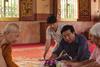
Thai filmmaker Sompot Chidgasornpongse drew heavily on personal experiences for his narrative feature debut 9 Temples To Heaven. The story charts the spiritual journey of a family of nine, who on hearing from a fortune teller that the 83-year-old grandma may not live past her next birthday, embark on a nine-temple trip within a single day.

Praying from one sacred temple to another is a widely practised merit-­making tradition. “Sometimes we visit just a few in a day, but nine is considered the luckiest number in Thai culture,” explains Sompot. “We would bring along offerings for the monks like toothbrushes, shampoo, shoes and food. The film is a family road trip with a touch of humour.”

Sompot has worked closely with Palme d’Or winner Apichatpong Weerasethakul as his assistant director for over two decades. Apichatpong produced his first documentary feature Railway Sleepers, which premiered in Busan’s documentary competition in 2016 and Berlinale’s Forum the following year, and now his first foray into fiction.

9 Temples To Heaven will premiere in Directors’ Fortnight, where it is the first Thai feature selected for the parallel section since 2007. The film was shot primarily in Samut Prakan, a historic coastal city where Sompot grew up and which served as a gateway to Bangkok during colonial times. The director and his location team scouted about 70 temples before selecting the 12 depicted onscreen, including Wat Bang Phli Yai Klang, which has the biggest reclining Buddha in Thailand.

Shooting road sequences and dealing with weather conditions became the main challenges, as filming took place during the rainy season from May to July 2025. “We had to wait for the rain to stop and the available light to come,” he recalls. “We couldn’t even shoot if the road was still wet from the rain.”

Sompot’s collaboration with Apichatpong dates back to 2003 with The Adventure Of Iron Pussy, on which he worked as an intern. He moved up to second assistant director for Tropical Malady (2004) and Syndromes And A Century (2006) before rising to first assistant director on Cemetery Of Splendour (2015) and more recently Memoria (2021), which played here in Competition. He has also worked on Apichatpong’s experimental and installation works, including the recent immersive virtual reality piece A Conversation With The Sun.

Similar trajectories

Like Apichatpong, Sompot is an architecture graduate. He missed working on 2010 Palme d’Or winner Uncle Boonmee Who Can Recall His Past Lives as he was studying for an MFA in film/video at the California Institute of the Arts (CalArts).

“I learnt from watching Apichatpong work,” says Sompot. “He is someone who is honest and sincere in his vision. He will continue to make it better until it lives up to his expectations.”

When it came to 9 Temples To Heaven, Apichatpong told Sompot to “make the film that I want to make. That gave me a lot of freedom.”

The Palme d’Or winning filmmaker read drafts of the script, offered feedback and visited the set twice to provide moral support. “He knew he would make me nervous if he was there all the time,” laughs Sompot. Producer Kissada Kamyoung was present throughout the shoot.

The Thailand-­Singapore-France-Norway collaboration is produced by Apichatpong’s Kick The Machine Films and At A Time Pictures from Sompot and Kissada, along with E&W Films, Petit Chaos and Needle In The Haystack. It has the support of the Thai Soft Power Grant, Singapore Film Commission, TFL Co-Production Fund and Sørfond. Paris-based Playtime handles international sales.

9 Temples was shot by French cinematographer Jonathan Ricquebourg, whose credits include Tran Anh Hung’s The Taste Of Things, winner of best director at Cannes in 2023. Further key crew include production designer Akekarat Homlaor, location sound recordist Chalermrat Kaweewattana and audio post sound designer Akritchalerm Kalayanamitr — all close collaborators of Apichatpong. First assistant director is Suteenit Kangvan, who was third assistant director on Cemetery Of Splendour.

The cast comprises non-­professional actors alongside performers who have had minor roles in series, short films or music videos.

“The film carries many aspects of Buddhism in a subtle, not provocative way,” says Sompot, who does not foresee any run-in with the local censors, who once disallowed some scenes of monks in Syndromes And A Century. “We were respectful during filming. They can give us a higher rating if they find it sensitive now that there’s a film rating system [which was introduced after Syndromes And A Century].”