








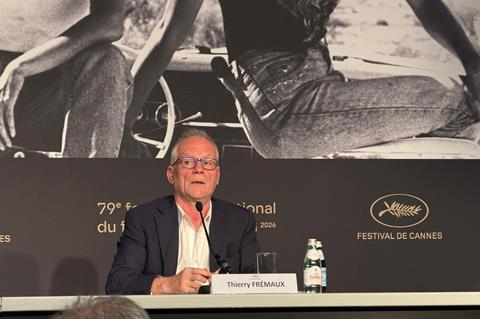
Cannes Film Festival general delegate Thierry Fremaux has defended Wim Wenders’ comments about politics and film that sparked controversy before this year’s Berlinale.
Speaking at his annual pre-festival press conference, Fremaux said Wenders “was the subject of some unfair commentary.”
“I understand what people wanted to say; but people didn’t want to understand what he actually stated,” said Fremaux, referencing comments at the opening press conference of this year’s Berlin Film Festival where jury president Wenders discussed the separation of film and politics.
“What he wanted to say is that, as president of the jury, politics is on the screen,” said Fremaux. “That’s what we see in Cannes.”
“I’m not going to put my function in the service of my opinions,” continued Fremaux. “I could talk about Bruce Springsteen, Olympique Lyonnais [Fremaux is a fan of the US singer and French football team], but these are personal. Cannes considers that political matters should be taken up by what the filmmakers say and do.”
Fremaux noted the festival’s lengthy political history; including the pre-Second World War discussions that led to its eventual founding in 1946, and the choice to award the 1981 Palme d’Or to Andrzej Wajda’s Man Of Iron, during the Polish Solidarnosc trade union movement.
But he also emphasised that political discussion should not be an imperative for participation in the event, and that the festival itself should steer clear of political demonstration.
“Neither the jury members or the president or organisers should have opinions other than on the films, which is our job,” said Fremaux. “You also have filmmakers who aren’t political – this needs to be respected as well.
“Some of these directors may be more engaged than others. You can ask the question – do they want to answer? One has to see. The world today, which is partly at war, is very fragile in terms of dialogue between nations. We don’t want to add further confusion and trouble.”
“One has to look at the gesture of artists as an artistic gesture, and not lend it more meaning than that. One should not lend it more meaning than the course of the two weeks here, and then we’ll see.” Fremaux did not say whether Cannes was providing any training to its press conference moderators in preparation for political questions.
Gender equality
The festival director was also questioned on the composition of this year’s lineup, including on the surge of Spanish films, the lack of US studio and Italian films, and the lower number of films directed by women.
On the latter point, Fremaux responded to the question by pulling some notes from his pocket and citing statistics to back up the festival’s commitment to gender equality.
“We have two women on the poster and people accuse us of feminist-washing,” said Fremaux, referring to the 2026 poster featuring an image of Geena Davis and Susan Sarandon in Ridley Scott’s Thelma And Louise. “We select films according to their merit. These films are coming up and being selected increasingly. We have four women newcomers, three of them French. People kept saying ‘it’s always the same people’ – that’s not true.”
He added that the late Agnes Varda, whose films appeared 12 times at the festival before her death in 2019, made him promise “never to choose a film simply because it was made by a woman.”
“So much the better if Berlin has achieved 50% [gender parity],” said Fremaux. “It is not our case.”
Fremaux also took on the topic of AI, which he compared to “an electric bike and a normal bike”.
“To ride an electric bike, you have to know how to ride a normal bike,” said the director. “To indulge in AI, you have to know about intelligence as well.”
He said that the increase in AI technologies may see a rise of films, and festivals, that eschew them entirely. “When did organic films cease to exist?” said Fremaux. “The last organic film was [Francis Ford Coppola’s] Apocalypse Now; the number of helicopters you see in the film was the number that was really there. There’s a big danger that these things will turn into a lie.”
“We stand on the side of all those whose jobs will be negatively impacted by AI,” said Fremaux. “I don’t use it personally. It shouldn’t prevent children from being intellectually curious; we haven’t reached that point yet.”
In the wide-ranging session, Fremaux also addressed the recent Oscars rule change, through which the main competition winners of six major festivals including Cannes will be eligible for the best international feature Oscar. He approved of the change, saying that “Hollywood is opening itself up to the world”, but added that he did not think it would affect how juries vote.
The 79th Cannes Film Festival will open tomorrow evening with the world premiere of Pierre Salvadori’s The Electric Kiss, out of competition.
The 22-strong Competition begins on Wednesday with Koji Fukada’s Naji Notes; while the festival will also host talks by Peter Jackson, Cate Blanchett and Tilda Swinton.





No comments yet