







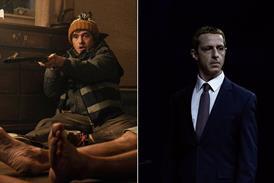


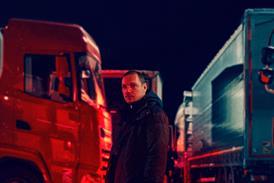


Minotaur marks the first feature by Andrey Zvyagintsev, the Oscar-winning Russian director of Loveless and Leviathan, since the Covid-period illness that almost killed him. He suffered an extreme reaction to Russia’s Sputnik vaccine and ended up in a coma for several weeks. Minotaur is also the first film he has made since moving to France from Moscow in 2023.
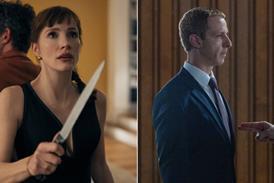
The film is a Russia-set remake of Claude Chabrol’s 1969 erotic thriller The Unfaithful Wife. Zvyagintsev worked with French powerhouse mk2 Films and shot in Latvia, the closest he, as an exile, could get to Russia. It is the story of a successful company director whose business and private life suddenly threatens to fall apart. The film has already sold to several territories including Mubi for the US, UK-Ireland and Latin America.
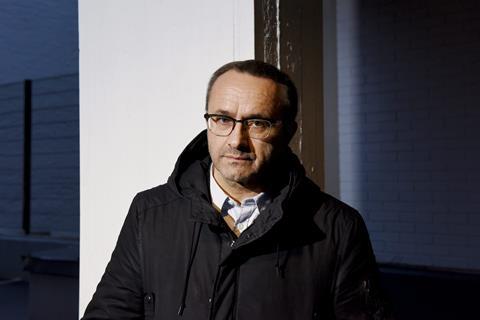
What was it like being back on set for the first time since your near fatal illness?
I feel very happy right now because for 40 days I was in a coma. It was very hard for me. I couldn’t do anything. I couldn’t move, I couldn’t walk, I couldn’t do anything with my hands. I was literally spoon-fed. For one year, I was in Germany, trying to recover. Once I recovered, I just felt happy to go back to work.
You’ve made your most recent films with Alexander Rodnyansky. Now you’re working with Charles Gillibert and Nathanaël Karmitz through mk2. What was that like and how was it shooting in Latvia?
Nathanaël Karmitz discovered my intention to do a remake of the Claude Chabrol film. That is why the main producer is French. In terms of the location, the movie is in [the] Russian language and we were showing Russia [on screen]. There was no solution we could use other than to shoot somewhere that, in terms of architecture and locations, looked like Russia. For us, Latvia was the only choice.
If you’re asking if anything happened between me and Rodnyansky, the answer is not at all. We are on very good terms. I am grateful to him because we did three fantastic films together: Elena, Leviathan and Loveless. I would be happy to do another project with him.
What are your feelings about being in exile?
It’s survivable [but] it’s a completely different level of life. But all the problems can be overcome. My main target is always to shoot a movie. This is how I live and this is why I live. Once the shooting starts, I am absolutely in my own place, I am like a fish in water. I realised that my motherland is where I’m shooting. It doesn’t matter where.
Why did you want to remake the Chabrol movie?
The main story of The Unfaithful Wife touched me a lot. The only thing in Chabrol’s movie that I was maybe not sure about was the office part. I found it a bit undercooked. When we started to write the script in the fall of 2022, that’s exactly when the draft mobilisation happened in Russia [after the full-scale invasion of Ukraine]. Basically, what happens in the office tells us about real life.
Does the businessman with the unfaithful wife stand for what is happening now in Russia?
The main character has ethical questions. But, of course, the movie has a political context because we are observing the situation six months after the Russian invasion of Ukraine. We are observing a country that is very silent, very ignorant about what is going on at its own border.
You’ve won prizes in Cannes before. What do you think your feelings will be when you walk up the red carpet this year?
It’s not about the red carpet, it’s about the whole event. There are thousands of films trying to be selected. When you realise it is your movie that has been selected, you feel special and you feel a winner. If you get anything above that, I consider it as a bonus. But you really win when you get into the Competition because that opens the door for your next movie. The jury can have different political views, different tastes, but it doesn’t matter — the point is to get into the Competition.





No comments yet