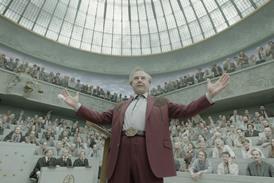
In Train Dreams, the Australian actor plays a man unlike most screen protagonists. “The film shows us how majestic, powerful and heroic normal life can be,” he tells Screen

Director of photography Adolpho Veloso and Joel Edgerton on location for ‘Train Dreams’

Source: Daniel Schaefer, BBP Train Dreams LLC

Director of photography Adolpho Veloso and Joel Edgerton on location for ‘Train Dreams’

“Sorry I got emotional,” says Joel Edgerton as he wraps up his conversation with Screen International. It is mid-November in London, and the Australian actor best known for playing stoic, often laconic tough guys has belied his prevalent on-screen image by shedding a few tears. It was not the expected response – not that there’s anything wrong with men crying, of course – but it says a lot about his personal investment in, and connection to, this latest role, one that has already earned him a slew of nominations including at the Critics’ Choice Awards, Independent Spirits and Golden Globes.

In Clint Bentley’s Malick-ian period drama Train Dreams – which premiered at the 2025 Sundance Film Festival and was acquired and released by Netflix – Edgerton plays Robert Grainier, a lumberjack and railway worker in Washington state at the turn of the 20th century. The story follows Robert throughout his life, but while he is plagued by guilt (after silently witnessing the murder of a Chinese co-worker) and struck by tragedy (losing his wife and daughter in a wildfire), he is by no means a traditional protagonist. Quiet and introverted, Robert does not so much drive the plot as get pulled along by it.

“Yeah, he’s just a ‘tagonist’,” chuckles Edgerton. “It’s not typical to make a film about a character who’s not at the steering wheel of life. Robert’s a passenger on the bus. I joked at a Q&A last night that he’s like an NPC [non-player character], you know, in the video-gaming world.”

So why play him, why even make a film about him? “Jokes aside, I think that while we go to the cinema to dream of being the people we’re not, we also like to see ourselves,” suggests Edgerton. “We tell stories to make sense of ourselves, and Train Dreams is a chance for the audience to see an ordinary person be celebrated by being the centre of a story. It changes our perception that ordinariness is insignificant. I think the film shows us how majestic, powerful and heroic normal life can be.”

Perfect timing

Train Dreams

Source: Sundance Film Festival

‘Train Dreams’

Edgerton first discovered Train Dreams when its source – Denis Johnson’s 2011 novella – was given to him as a wrap gift after shooting his second directorial effort, 2018’s Boy Erased. He was so impressed by the book’s “philosophical, almost religious rumination on an ordinary life in a western setting”, he hoped to adapt and direct it himself, only to find the rights were not available.

This, he insists, was a blessing in disguise. By the time Train Dreams serendipitously circled back to him years later, in the form of Bentley’s offer of the lead role, he had become a father to twins. “I thought, ‘Wow, this character is so much like me now – married, in love, nervous about being a new dad, constantly fretting about work, being far from home.’ And then… my deepest new fear was that anything…”

Here is where Edgerton becomes unexpectedly lachrymose. Following a difficult pregnancy, his twins, he explains, spent time in hospital after they were born. “It was all probably quite typical stuff,” he says, wiping his eyes, “but to me and my wife, it was like, ‘Are they even going to be here?’” So he felt Robert’s loss, he emphasises, “right inside my gut. It was a chance to do something a bit more close to me than I would typically look for.” The challenge being: “I’m far more emotional than Robert. So how do I push all of that inside and not let it out?”

Edgerton has previous experience playing a character who must convey so much to the audience without expressing it verbally or in obvious physical ways, namely as Richard Loving in Jeff Nichols’ 2017 drama Loving, about racism in 1960s Virginia. The actor does not resist the comparison, but he does draw a parallel from elsewhere in his career.

“When I write stories, it’s quite often about people making mistakes and trying to right their wrongs. The Gift [his 2015 feature debut as writer/­director] was that, except it was someone who refused to right their wrongs. In Boy Erased, I identified with Nicole Kidman’s character, who adheres to her husband’s ideology, then realises it’s damaging her son and rights the wrongs she’s made. I’m interested in the goodness of people and how they wrestle with that.”

Edgerton puts this tendency down to his upbringing. “I was raised Catholic, and I know guilt plays a big part in my life,” he says. “So when I read Train Dreams, one of the things that hooked me was Robert’s intense guilt at his complicity in the death of the Chinese worker, and the idea that that would follow him for the rest of his life. I believe the bad things we do will haunt us. So I try to be a good person. I struggle with it constantly in my own assessment of myself. It’s always about striving for this ideal version of myself.

“So, yeah, I do think I’m drawn to those characters. Though I’m also drawn to being a douchebag on screen,” he laughs. “I love that too!”

Edgerton is back on “douchebag” duties in next year’s Fangs, the feature debut of Melbourne-based filmmaker Lucy McKendrick, playing “a crazy, violent criminal”. This role, he explains, “has that same vibration that I had in movies like Black Mass or The Great Gatsby. I was tuning the equaliser of myself into more arrogant, dynamic, violent aspects, which I think we all have inside of us. You’ve just got to let some of it out or hold some of it back.”

He would also love to return to directing. “I wrote a few things during Covid,” he reveals, “and I’m trying to make a movie that’s tonally in the world of The Gift. That’s my speed – I call it suburban noir. My belief is that [other] people are the scariest things for people.

“I loved Weapons,” he continues. “It was unpredictable, structurally interesting, had amazing performances. I’m interested in exploring a few things that stemmed from Covid, but not to talk about Covid, just middle-class rage, basically. I’m hoping I get to do it next year. We’ve got partners and we’re working out where it’s going to live in terms of distribution, so we’re not off to the races yet. But we’ll make it happen.”

Edgerton does not wish “to downgrade acting or degrade it”. However, he says, “Directing is the best job in the world,” albeit a job that is both stressful and exposing. “As an actor, if the movie was good, you can go, ‘Yeah, that was me.’ And if the movie’s bad, you go, ‘Well, I did what I could…’ But a director can’t hide.”