





Balancing historical fidelity with a contemporary sensibility was vital to keep Hamnet relatable to modern audiences. Lukasz Zal (cinematography), Fiona Crombie (production design) and Malgosia Turzanska (costumes) explain all
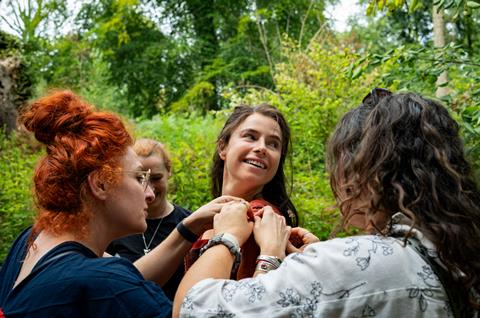
A big breakthrough in the creation of Chloé Zhao’s Hamnet came after almost a week of clambering around in the woods. The director and her team, including cinematographer Lukasz Zal and production designer Fiona Crombie, travelled to the Lydney Park estate in the Forest of Dean near the Welsh border, to scope out locations before production.
“Four or five of us, with a camera, spent four days just trying to find ways to shoot this forest, to get into this forest as a structure,” recalls Zal. At last, they found what they needed: an old, gnarled tree with a deep and mysterious gap among its roots unlocked the film’s central motif.
The void under that tree would be a key beat in the film’s opening moments, and would inform a dark doorway in the painted forest backcloth of the Globe theatre in the finale of the story of William Shakespeare (Paul Mescal) and wife Agnes (Jessie Buckley). It communicated Agnes’s deep alignment with nature, and the sense of loss she feels for her mother and, later, for her child. And it all came about when Zhao and her team allowed themselves time to explore.
“It was like, ‘Let’s each go out and work out where we would give birth,’” remembers Crombie. “That carried through the entire film – keeping our eyes open and, she [Zhao] would say, our hearts open, waiting to receive what came.”
The Focus Features-backed film, based on Maggie O’Farrell’s historical fiction bestseller and named for William Shakepeare’s only son, imagines the private family life of the playwright. Bringing it to the screen required Tudor period detail, but without the finery familiar from numerous films about the royalty and nobility of the time. It marries a respect for the known facts of Shakespeare’s life, but also a sense that this is ultimately about the book’s fictionalised conception of Will and Agnes.
To create that particular tone, Zhao needed heads of department who could marry historical fidelity with a contemporary sensibility, keeping the story’s emotion immediate and relatable. The search led her to three key collaborators.
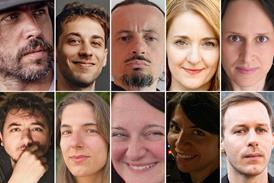
Director of photography Zal was Oscar and Bafta-nominated for Pawel Pawlikowski’s Ida in 2015 and Cold War in 2019, and was recognised by Bafta in 2024 for his cooly removed eye in Jonathan Glazer’s The Zone Of Interest. Production designer Crombie was Oscar and Bafta-nominated in 2019 for The Favourite, another historical drama with a contemporary touch, and is again in the running at both academies with Hamnet. And costume designer Malgosia Turzanska, also Oscar and Bafta nominated for Hamnet, helped create the worlds of The Green Knight (2021) and Train Dreams and was a contemporary of Zhao’s at New York University.
Power of communication
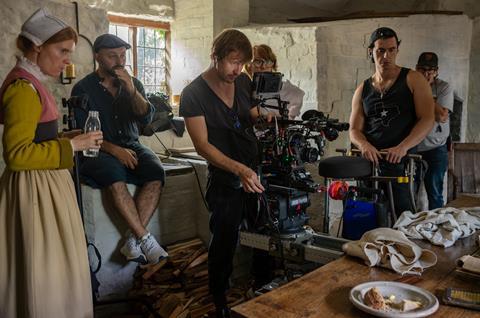
The three heads of department had never met, but developed a startling level of synchronicity ahead of the late-summer 2024 shoot. “The level of communication with Chloé and the people she surrounded herself with was unbelievable,” says Turzanska.
Early on, Zhao asked them to gather references for their work, and the results led to a surprise. “We shared images in our book by accident,” says Crombie. “I had absolutely no idea until Chloé sent me Malgosia and Lukasz’s [collections] that we had the same images. Not many; there was a handful. But the thing that was crazy was that they weren’t anything to do with the period. They were random. There was one of a bloodshot eyeball.”
“It’s a beautiful way of working,” says Zal. “We were exchanging ideas, and everything is growing and growing. Chloé is very smart in terms of managing people and inspiring people.”
After an initial meeting with Zhao, Zal read O’Farrell’s source novel while on the plane to a holiday. He spent his days surfing and musing on ways to interpret the tone. He wanted to communicate the novel’s omniscient narrator, but at the same time maintain a deep connection to the characters: “The sense that someone is observing from an objective perspective, but at the same time you feel the emotions of this person.”
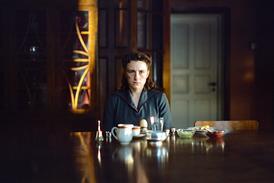
Zal chose to shoot digitally, both for a contemporary tone and because there would be night shoots in low light. He used an ARRI Alexa 35 for texture with Zeiss Super Speed lenses for day and Master Primes for night. “We didn’t want this film to be flashy,” he says. “We wanted very naturalistic, normal. We tried to be modest, not to go looking just for beauty or attraction. Our priority was to be honest and simple.”
Zal also tried not to rely heavily on close-ups. “I love to tell stories in a wide shot, because it can be a portrait of somebody but then you can also see the context. We wanted to build this film from tableaux, from fragments of reality, like a mosaic.”
That wider-angle approach chimed with some of the sources Turzanska found useful, particularly the work of Flemish artist Sebastiaen Vrancx (born 1573).
“He painted these large scenes filled with farmers and peasants and soldiers,” she explains. “The scenes are violent, but very dynamic. So you see the layers of the garments coming undone, sleeves rolled up, shirts untucked. That was inspiring. You can see the way things were put together and how they came apart, which you don’t see in portraits.”
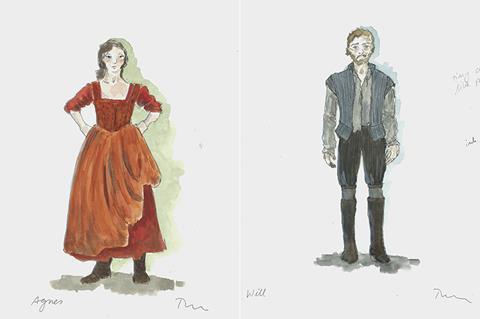
Turzanska felt it gave her permission, for example, to roll up Will’s sleeves and to repurpose the garments. Agnes wears the same dress, unlaced as far as possible, while heavily pregnant as she bids Will goodbye on his journey to London, and then laced up and brushed off when she goes to the city in the film’s closing scenes.
Turzanska also chose fabrics and colour based on the characters’ interests. Agnes wears a cloth made from bark in her opening scenes. It may not be period-appropriate, but signals her connection to the land, as does the berry red shade echoing the fruits she gathers to use as dye, food or medicine.
Will’s doublets (buttoned jackets) were coloured with the same iron-based ink used by the real Shakespeare when he wrote, creating a soft grey colour, while the small slashes in the garments reflect the endless blows of his abusive father. Those deepen and grow not just in deference to Tudor fashion but also following the loss of his child, when they become gaping wounds on his back, as if he has been whipped.
Crombie’s production designs likewise played with ideas of danger, and oppression. “Even when I was doing the early stages, just looking at the structure of the buildings, I saw immediately the potential for those buildings to feel like boxes, to be weighted and heavy, and to be about containment,” she says.
Crombie and Zhao initially discussed shooting the film entirely on location, but that proved impractical. First of all, such old buildings come with severe restrictions on their use – Will’s opening scene, tutoring Agnes’s younger brothers, was shot on a set painstakingly constructed inside an existing Tudor building, well away from the precious original walls. But worse, none offered the precise mix of elements they wanted.
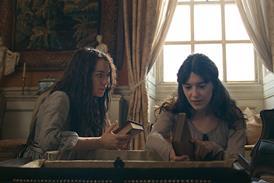
Ultimately, Crombie built the Shakespeares’ Henley Street family home at Elstree Studios, taking elements from all the period buildings she had visited: a twisting stair here, a buckling beam there, and a huge fireplace to anchor the main living space.
Form and function
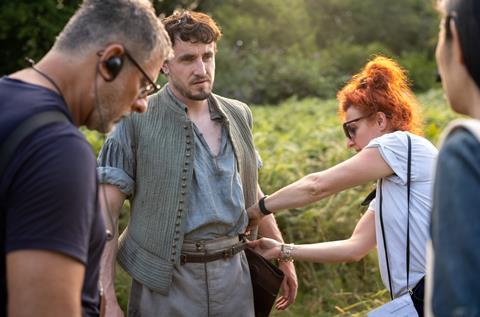
Crombie made the spaces feel as functional as possible, filled with the tools of a busy family, but also lived-in and sometimes makeshift. “We made a point of [having] window panes that had cracks in them, and bowls that had been repaired,” says the production designer. “All the fabrics were vintage, and were pieced together. Everything felt like it had a history.”
Sometimes that was a history of violence, with the long shadow of Will’s glove-maker father reflected in slight stains in the walls, where a glass might have been thrown, or where something had been dented or broken. Along with the hanging herbs of Agnes’s work and the children’s toys, the aim was to create a family home that felt lived-in but not idealised. “I’m so delighted that we built the house because it had so much heart,” says Crombie.
The aim was always to create a world that felt cohesive, which the characters could inhabit so casually and comfortably that a modern audience would not be alienated by the period setting and would feel the story’s full emotional impact.
That response has been felt in the eight Oscar and 11 Bafta nominations for Hamnet, plus box office of $42.4m at press time.
“I love this movie dearly, and the process of making it was like nothing I’ve ever experienced,” says Turzanska, who was grieving the loss of her father while working on the film. “I am thrilled that people seem to be responding to it and letting the movie take them to the painful places and then to the other side, which is the healing aspect of it.”
For Zal, it all comes back to Zhao’s immediate grasp of what works and what was needed – whether that was a particular lens or a hole under an old tree. “She is very intuitive,” he says of the director. “What I love is that she makes quick decisions. It’s a lot of instinct and a lot of feeling. She’s a witch, a bit.”
Stage hands: Hamlet at the Globe
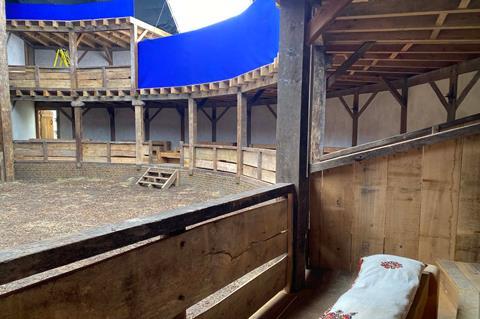
To build or not to build. That was the choice facing Hamnet’s production team when planning the film’s climactic scene, as Hamlet is performed on stage in London. There was a standing option: Shakespeare’s Globe theatre was re-established on London’s Southbank in 1997, only a few hundred metres from its original location. Recreated faithfully in timber and thatch, it has only a few modern tweaks, such as fire-retardant wood treatment and wider staircases in the entrances, few of which are visible inside. As part of Hamnet’s pre-production, director Chloé Zhao and her key creative team felt they had to tour the theatre to see if they could use it during the shoot.
Production designer Fiona Crombie had immediate misgivings. “This Globe we have today was too ornate,” she says. “It felt separate to our film and the kind of qualities we were going for. But I didn’t say anything; I was taking it all in and letting everyone have their [space].”
She was also conscious there would be challenges to shooting there – the Globe is a busy, working theatre that hosts daytime educational tours and workshops. The production would be limited in what they could do, but she would make it work if that’s what Zhao wanted.
After a few minutes, the director called Crombie aside and said, “I feel like it’s too big for us. We need ours to be smaller and more intimate. Also, ours needs to feel like the inside of a tree.”
Crombie knew immediately what the director meant. Their Globe had to reflect Agnes’s forest, because it was Will’s equivalent to her retreat. It needed to feel organic, rooted in the earth. “It has to link to their relationship and their history,” as Crombie puts it. The decision was made to build their own version, at a 70% scale.
Stolen promise
A considerable portion of the 20 tonnes of reclaimed oak that Crombie had sourced from France for the houses and structures of the film went to build the theatre, which began only a few weeks before the shoot. Art director Victoria Allwood led the work on the build and discovered something interesting during the research process.
“She said, ‘Fiona, I read that the wood from the first Globe was stolen or, we could say, reclaimed,’” remembers Crombie. “I was like, ‘That’s all we need to know.’ It wasn’t fresh. It came with scars, with history, like everything in this film.”
Crombie also talked to Paul Mescal about the space – in Hamnet, Shakespeare both directs his play Hamlet, and performs as the ghost of the prince’s dead father. “I should say how involved Paul was in directing that play. I had a conversation with him about the design, the backdrop, how that was going to work, and the tree we put on the stage. It was all about communication.”
For the finishing touches, Crombie co-ordinated with costume designer Malgosia Turzanska, who would handle the largest number of extras of any day on the shoot, and also the crucial question of how to dress the players, including Will’s ghost and Hamlet (Noah Jupe) himself.
“Fiona had the painted backdrop, and I painted the costumes of the players,” explains the costume designer. It was a non-period, deliberately theatrical flourish – real Elizabethan players wore essentially street clothes – but she wanted the sense of an artwork still being constructed, brushstroke by brushstroke.
Turzanska dressed Hamlet as a simplified memory of the departed Hamnet, in similar colours and shapes and with painted blond hair, but she struggled more with Will’s ghost costume. “I let it percolate for a while, because I had no idea what it was going to be,” she says. The solution was, inevitably, to bring it back to the soil. “I was connecting it again to nature, covering Paul in clay.” The result was both otherworldly and earthy, in keeping with Zhao’s organic approach to the film.




No comments yet