














Merch is a growing product category for cinema operators, as fans splash the cash for tie-ins. Screen talks to key players and digs into the market’s star performer: the collectible popcorn bucket.
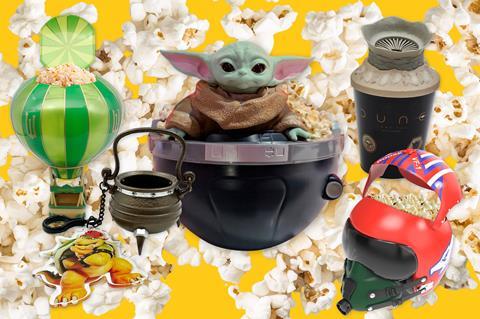
Earlier this year, Cineworld’s UK cinemas sold out of The Super Mario Galaxy Movie Yoshi character popcorn buckets, retailing at £34.99 ($47); the popcorn was an extra £5 ($6.70). Odeon promoted a £34.99 Popstar Collectors Michael combo, including fedora hat snack receptacle, and Vue trailed a Grogu popcorn container (£24.99/$34 without popcorn) weeks ahead of Star Wars: The Mandalorian And Grogu’s release.
Current and upcoming titles Supergirl, Paw Patrol: The Dino Movie, Jumanji: Open World, Resident Evil, Toy Story 5, Dune: Part Three, The Hunger Games: Sunrise On The Reaping and even The Odyssey will be accompanied by customised concession vessels (CCVs).
“Audiences increasingly want an experience,” says Tim Sparrow, director of retail at Cineworld. “Not having an offer when audiences expect one can be a disadvantage and might push them to a competitor.”
What began as a quirky concession stand upsell a decade ago has become a lucrative category of event souvenirs, as well as social media currency and, increasingly, a strategic battleground for cinemas chasing audience attention.
“North America is the most mature market, but Europe has significantly increased participation, more than doubling the amount of items purchased in the past 18 months,” reports Rod Mason, vice president of business development at Zinc Group, an Australia-based designer and manufacturer of movie tie-ins. “Southeast Asia is a significant contributor to the collectible market, but tends to focus more on beverage [cups] and other collectibles as popcorn is not so much of a staple.”
Across Europe in the territories where it operates (UK, Ireland, Netherlands, Germany, Italy, Denmark, Poland and Lithuania), Vue is seeing “consistent year-on-year increased demand” for merchandise tied to major releases, says group retail director David Pitron. He forecasts a strong 2026: “That’s partly because the slate is stronger and partly because we’re building our systems and forecasting better. We’re buying more, for more films and for products that go beyond food and beverage.”
Star performers

When Zinc entered the market in 2014, it initially found exhibitors in the US and Europe only willing to buy simple cups and buckets. “Anything more ambitious was a hard sell,” says Mason. “Theme parks and fast-food restaurants had proven that people would go out of their way to buy collectibles. Cinemas hadn’t embraced it yet.”
That changed in 2019 when Zinc launched an R2-D2 popcorn vessel with AMC for Star Wars: The Rise Of Skywalker. It sold in huge numbers at $50-$60 each. After the pandemic stalled the market, Zinc’s sandworm bucket design for Dune: Part Two went viral in 2023. The £20 ($27) item sold out, and still goes for 10 times that amount on secondary markets.
Tentpole releases with strong IP exhibit “significant demand”, says Mason, “particularly family animation or fandom-driven titles”. But IP alone is not enough. “You can’t assume that a superhero film will automatically sell well,” says Sparrow. Cineworld’s exclusive sale of £32.99 ($44) Red Hulk popcorn holders for Captain America: Brave New World underperformed.
On the other hand, fans “went berserk” for the chicken jockey popcorn container that partnered A Minecraft Movie. “We couldn’t get enough stock,” says Sparrow. “Every launch teaches us something new and raises new questions. The visual impact of the item, perceived value, price accessibility and the overall proposition all matter.”
Decisions on whether to buy into a product are taken six to nine months out from a film’s release, and the long lead time is one of the biggest challenges for exhibitors. “A lot can change in consumer sentiment and how the IP is received,” says Sparrow. “It injects risk. We use past learning and forecast carefully. Some outcomes are unexpectedly positive, like Minecraft’s chicken jockey. Others, like the Red Hulk bucket, don’t land.”
For Zinc, the process starts with the studios. “For big tentpoles, we secure rights 12 to 15 months ahead,” explains Mason. “And we meet regularly with exhibitors — they know their customers better than anyone so their input shapes the final product.”
For Minions & Monsters, Sparrow met with Zinc and Universal to talk about how to activate the film across the Cineworld estate and discuss merchandise. “It varies by title, distributor and IP,” he says. “Sometimes we can influence the design and development of items. Other times we’re more restricted.” Third-party IP involvement, as with Nintendo and Super Mario, adds complexity around approvals and rights.
When exhibitors can secure exclusive items, they often perform very well. “If you’re a highly engaged fan and you can only get something at Cineworld, that adds value,” says Sparrow. For major titles such as Dune, Zinc designs exclusive ranges for different chains within a territory. “We try to give each major exhibitor something unique,” says Mason.
When Zinc started, the business was “extremely price sensitive”, he says. Today, items routinely sell for the equivalent of $50 or more. French cinema chain Pathé retailed an Avatar: Fire And Ash dragon bucket for €75 ($87) in cinemas. “We are mindful of how often you can go back to the well,” says Mason. “People only have so much disposable income.”
“We are trying to balance creativity with commercial responsibility,” says Sparrow. “We don’t always know what competitors will do [on price] until we all go to market. Our understanding of how price affects consumer choice is still evolving.”
Studios earn royalties through licensing, manufacturers absorb production and shipping costs, and exhibitors set retail pricing. “It’s very fluid,” says Sparrow. “There’s no fixed-margin expectation.”
Nor is it clear whether collectibles drive ticket sales. “It’s hard to isolate causation,” admits Sparrow. “We do see significant engagement when merch is announced, especially on social media. We’re studying this but can’t yet prove it.”
Vue’s policy is to reserve collectibles only for customers buying tickets. “We don’t want collectors coming in just to buy merch without seeing the film,” says Pitron. “Part of building anticipation for the movie and the neighbourhood cinema experience is accessing merchandise that’s available for a relatively short period of time.”
Going immersive

The Dune bucket may have been iconic but it was essentially a fancy tin with a lid. Now there is a move to embrace technology and offer interactivity. LED lights illuminate some items — one popcorn vessel for Wicked: For Good lit up Elphaba on one side, Glinda on the other. RFID (radio frequency identification) and QR codes are being integrated into 2026 designs for in-cinema activations. “The more immersive and experiential you can make it, the better chance you have of capturing the imagination,” says Sparrow.
Social media amplifies the competition. “It all battles out on TikTok,” says Pitron. “People compare what’s available at Cineworld, Odeon or ourselves, and decide where they’re going based on the merch.”
As a rule, “anything the studio wants to promote significantly usually gets a collectible”, says Mason. Zinc has around 20 tie-ins for release in 2026 but exhibitors are selective in choosing which titles from Zinc, Goldenlink, SnapCo and other licence holders to buy into. Both Vue and Cineworld are planning to retail collectibles for 15-20 releases this year.
“It gets crowded, quickly,” says Sparrow. “We look at audience overlap. Will the same people buy merch twice in one month? Which title will capture the imagination more?”
Certain features, think The Drama, are considered “a stretch” for a credible novelty tie-in, while others “make sense”, says Mason. This includes Amazon MGM Studios’ October release of erotic thriller Verity, based on a Colleen Hoover bestseller. The upcoming 25th anniversary re-release of Harry Potter And The Philosopher’s Stone presents another opportunity; likewise May’s re-release of Top Gun, for which Vue offered £24.99 ($34) Goose and Maverick popcorn holders in the shape of pilot helmets.
“We’re not chasing everything,” says Pitron. “We’re trying to make sure we’re getting the meaningful, larger releases across the different categories. That’s the first filter.” The second filter is relevance for the target audience. “If you offered something for Downton Abbey, that’s probably not the right fit in terms of customer profile.” That said, the range of genres where merchandise works is broadening, including event cinema titles (such as BTS: The Return), as is the type of merchandise available (blankets for The Super Mario Galaxy Movie).
Some IP may be strong enough to sustain ‘always on’ merchandise, independent of release windows — much like Harry Potter retail stores. Cineworld already offers online fulfilment and is considering an expansion of the platform. However, Sparrow says: “Selling too much online doesn’t necessarily enrich the cinemagoing experience, which is our mission. If merch isn’t contributing to that experience, we should ask why we’re doing it.”
The category has grown so quickly that exhibitors are scrambling to display merchandise properly in cinemas. “Currently we’re using existing impulse stands, but space is limited,” says Pitron. Merchandise will feature in flagship YourWay stores open at five Vue sites across the UK and one in Amsterdam.
In North America and Europe, Zinc identifies deeper penetration into the mid-tier and independent chains, “well beyond the national chains”, says Mason. “Everyone realises there is a market, and that 100% of the revenue generated remains in the organisation. We think the market may level off slightly, but with the right item film connection, it will remain very popular.”






No comments yet