












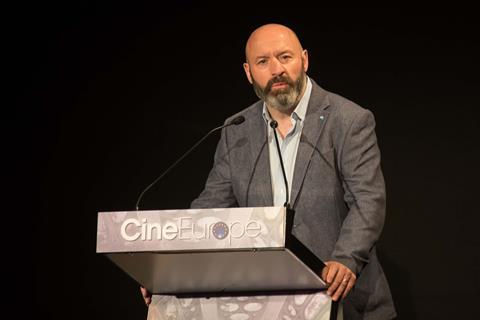
This year’s CineEurope in Barcelona will be the last Phil Clapp attends in his capacity as president of the International Union of Cinemas (UNIC). The organisation elected Jaime Tarrazón as his successor on June 23, with Clapp bowing out after a 13-year stint.
Clapp also received UNIC’s honorary achievement award at the convention, following in the footsteps of exhibition industry luminaries such as Vue International’s Steve Knibbs and Picturehouse Cinemas’ Clare Binns.
A former civil servant, Clapp became chief executive of the UK Cinema Association (then called the Cinema Exhibitors Association) in 2007, and was subsequently introduced to UNIC. At the time, it was headquartered in Paris, employed no full-time executive team, and — in Clapp’s estimation — lacked structure and capacity for effective action.
“I came in from the government policy side, so I had seen the way different parts of the film sector, and also the telecoms companies and ISPs [internet service providers] were lobbying government,” he recalls. “It struck me that UNIC was being left at the starting line in terms of engagement with key policy makers and influencers.”
What then emerged was a “loose coalition of the willing” which “began lobbying for consideration of a fundamental change to the structure of UNIC,” explains Clapp.
Moving UNIC’s head office to Brussels in 2012, the creation of a full-time team led by inaugural CEO Jan Runge, and a new UNIC board structure capable of greater agility were the key reforms. Clapp joined the board and became its president in 2013, and Laura Houlgatte succeeded Runge as Unic’s CEO in 2017.
In 2011, UNIC — having previously tried without great success to launch its own annual European trade convention — teamed with Film Expo Group’s flourishing Cinema Expo event to jointly create CineEurope. It is a partnership that endures, giving a sustained profile to UNIC as well as vital income. Ahead of this year’s CineEurope (June 22-26), Clapp spoke to Screen about what he believes to be Unic’s greatest lobbying achievements and his future plans.
What are you most proud of during your tenure as president of UNIC, and the previous years when you were at the vanguard of reform?
The development of UNIC from a supportive network to a very effective lobby organisation at the heart of Europe. The proof of the pudding is the extent to which the European Commission and commissioners see UNIC as the key voice of exhibition. We should be collectively proud of taking a deep breath and moving from Paris to Brussels, which was no small undertaking, and required certain people to step back from national pride. Now we have a very effective, influential, knowledgeable and high-profile lobbying outfit, in a way that would have been beyond our wildest dreams 14, 15 years ago.
One of my observations of UNIC when I first arrived was, we would have a very good dinner, we’d also have a meeting and discuss a whole range of things, but no one was tasked to actually do anything about it. Meanwhile, the ISPs and the telcos are at the table in Brussels, affecting policy. Having a nice dinner in Paris is not quite the same. It’s kind of asymmetric warfare.
Is there anything you wish you’d done differently?
Probably done it [all] sooner. There was a lot of discussion, most of which I think was necessary in order to bring the broadest possible coalition with us, but we probably lost a couple of years in those negotiations.
UNIC members comprise the cinema trade bodies of countries large and small, plus big exhibition chains and smaller operators. How have you navigated the competing interests and egos?
I think we respect the specificities of different territories. We absolutely respect that France has a regulated release window. Italy, Spain and Germany have a regulated window in some smaller respects. We don’t seek to drag people into conversations they’re not comfortable having. There are a number of UNIC territories, in particular the emerging markets, where the head of the cinema trade body is themselves an exhibitor. We seek to be responsive when they approach us but also sensitive to the other day-to-day pressures they inevitably face.
The first Cinema Expo International was back in 1992. Why did it take UNIC so long to get involved?
When I first joined UNIC, the prevailing wisdom was that Cinema Expo was an American convention that did not reflect European values. That struck me and others as a misreading of the position and a missed opportunity. And it was absolutely not the view of the major European cinema operators — they did attend Cinema Expo and saw value in it.
Predating my arrival, UNIC took the decision to run its own convention in Brussels, which didn’t work for a variety of logistical and financial reasons. But it was useful because it strengthened the hand of those of us who wanted to go smoke the pipe of peace with the Film Expo Group and make clear to them that there was mutual interest here.
We went to speak to [Film Expo Group’s then president] Bob Sunshine, who was very gracious. The event was renamed CineEurope, became the official convention of UNIC, and moved to Barcelona. It’s public knowledge that we have a profit share, which added rocket fuel to what we were trying to do with the reform of UNIC. I think the failed convention was a necessary step for us to prove that UNIC is not an organisation that can run a convention of that scale.
Is it still providing rocket fuel?
Our revenue has taken a hit in the last few years because of admissions, but also, more importantly, costs. One discussion we’re having in the organisation is we live a kind of hand-to-mouth existence, and the money coming in from CineEurope has reduced. We recognise that being partly dependent on the convention is a risk, and we’re having a live discussion about how we broaden our funding base. That’s still ongoing, so there are no clear conclusions.
Some of the things we hear from exhibitors are: ’I go to CinemaCon in April, I don’t need to go to CineEurope because it’s going to be similar content. And they used to show more completed films, and get more talent attending than has recently been the case’.
We’re always very mindful of the potential overlap between CinemaCon and CineEurope, and we keep in close contact with [CinemaCon managing director] Mitch [Neuhauser] and the two Matts [Pollock and Shapiro, associate managing director and director of operations, respectively] about what’s going to be in their sessions. In recent years, the overlap in audiences between the two events has declined. Because of costs, in part. It’s also undeniable that many people are more reluctant to travel to the US. Where we’ve benefited, and this is none of our doing, is that major films are completed much closer to release — so for the big summer films, even content in the reel is often not as developed as you might think [in April]. We benefit from that additional nine weeks.
The point about talent is well taken. If you’re in Vegas, LA is a 45-minute flight. Unless we have people filming in Europe, we’ll always be the poor relation when it comes to talent.
Do the studios pay for stage time?
The studios pay for tech time. They don’t pay a participation fee.
What prompted the decision to step down from the UNIC presidency after 13 years?
I’m conscious that the UNIC statutes ordinarily limit any one person serving as president for more than two terms of two years. While I’ve been hugely grateful for colleagues’ support in allowing me to stay on for considerably longer than that, I do think it’s time for fresh energy at the top of the organisation.
Congratulations on your honorary achievement award. What celebrations are planned?
Thank you. I’m quite cynical by nature, and “Trade body gives trade body head an award” is not necessarily a headline I’d be chasing. But I will say this, the spirit in which it’s offered, but also knowing most, if not all, the other people who come before me with the award, it’s incredibly touching. I’m incredibly honoured.
While I hope to have some time to celebrate, I’m also conscious that CineEurope coincides with the culmination of a long-running UK legal dispute over music rights, where I am sure to represent the UKCA in the High Court that week. I’ll be at CineEurope on Monday and Tuesday, fly back to London on Tuesday night, appear in court on Wednesday, and then fly back to Barcelona for the last day.






No comments yet