









Rebecca Miller’s five-part documentary Mr. Scorsese gets to the spiritual heart of the legendary filmmaker’s prodigious output and religious upbringing.
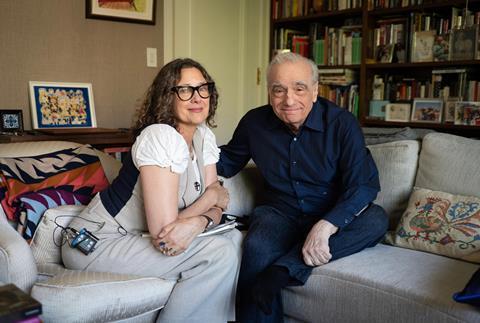
Mr. Scorsese was conceived as a one-off documentary about the maker of Raging Bull, Taxi Driver, Goodfellas and other landmark US films of the past half-century. But it soon outgrew that format, thanks to the way its director chose to view the life and work of its subject Martin Scorsese.
“I wanted to take a kind of cubist approach and look at him from many different angles, including personal, his family, him as a filmmaker and, of course, putting him in historical perspective,” says Rebecca Miller, herself an acclaimed writer/director and novelist, best known for 2002 Sundance grand jury prize winner Personal Velocity.
Expanding first to two parts, then three, the Apple TV portrait ended up as five one-hour episodes anchored by footage from the 20 hours of interviews Miller shot with Scorsese and peppered with input from collaborators including Robert De Niro, Leonardo DiCaprio, Jodie Foster and longtime editor Thelma Schoonmaker, as well as Scorsese’s wives (former and current), children and boyhood friends.
There is also material from Scorsese’s archives – home movies, childhood artwork and revealing outtakes from projects such as the troubled The King Of Comedy and magnum opus Raging Bull – as well as deep background on almost all his major features.
That the portrait might require an extended running time dawned on Miller when she first interviewed Scorsese, at the start of the pandemic, about his childhood in New York’s Little Italy, and his brushes with the kind of low-level organised crime that features in some of his best-loved films.
“Those interviews were very long and didn’t go very far in his life,” Miller recalls. “It became clear that the process was going to take a while, because I was going deep and because he’s very discursive in the way he answers. Part of it was how rich his childhood was, and how important it is in terms of understanding his work.”
The early interview sessions also showed Scorsese’s openness to the process. “Some of these interviews lasted four or five hours,” says Miller, “and I was very surprised sometimes by his answers and where he was willing to go.”
Helping paint the picture of Scorsese’s early days are some of his old neighbourhood friends, among them Salvatore ‘Sally Gaga’ Uricola, one of the models for De Niro’s rebellious Johnny Boy character in Mean Streets. Summoned to Miller’s set by an on-camera phone call from his brother Robert, the funny but slightly reluctant Sally Gaga personifies the world of Scorsese’s early crime classic.
“It was the strangest serendipity,” says Miller of the impromptu interview. “I don’t think he would have done it if we’d asked him in advance. But what was good is that it was a very genuine conversation. His ambivalence about having basically seen himself in Mean Streets was very profound. And when he says he left in the middle and went to see Doctor Zhivago… I just loved that.”
Spiritual life
Another aspect of Scorsese’s world that Miller wanted to cover was the filmmaker’s religious faith. More than any other major director, Scorsese – who briefly attended a preparatory seminary in New York before turning his attention to cinema – has made faith a key theme in features such as Mean Streets, the hugely controversial The Last Temptation Of Christ and the latter-day standout Silence.
“My initial portal really was faith,” Miller relates of her interest in Scorsese, “and his ongoing relationship with Catholicism. The struggle to figure out what his faith was. Understanding the apparent conundrum between his faith and this fascination with violence and people who are really on the edge.
“I had a sense that his spiritual life was extremely important in understanding him and his films, and I didn’t think that had been completely explored.”
Miller and Scorsese had been friendly since meeting on the set of 2002’s Gangs Of New York, which starred Miller’s husband Daniel Day-Lewis (also interviewed). But making the series revealed to Miller previously unknown struggles in the life of her subject, a filmmaker who has been battered by the commercial film industry almost as often as he has been lauded.
“What I find so touching is how completely he threw himself into his life, both as a man and as a filmmaker,” she explains. “He risked everything, every time. I didn’t know the level of failure he felt he’d had, the times when he was in what we call ‘director’s jail’, when he was left for dead on the side of the road by Hollywood. I found it fascinating how he used his understanding of men of power, that he had from living in the neighbourhood, to talk to some of these people he had to deal with in our own gangster environment of making films.”
Since finishing her five years of work on Mr. Scorsese, Miller, whose only previous documentary had been Arthur Miller: Writer, a 2017 HBO film about her famous father, has been recognised with the Directors Guild of America’s award for directorial achievement in a documentary series. And she has almost finished writing what will be her first narrative feature since the 2023 Berlinale premiere She Came To Me (shot while Scorsese was away on the Covid-restricted set of Killers Of The Flower Moon). Currently titled Moonsong: A Life In Seven Verses, the new film will feature Julianne Moore in one of the lead roles, reports Miller, and is being prepared to begin filming next spring.
Thirty-five years into her own career as a writer/director, Miller has had “a few of my own lessons” about the vicissitudes of the business. Chronicling Scorsese’s highs and lows in Hollywood, however, has strengthened her resolve to make films in her own voice, even if, like many of his classics, they have been written by others.
“What I’m always looking for as an artist is a sense of freedom,” asserts Miller. “But [making Mr. Scorsese] expanded that and made me feel even more ‘no surrender’ about it all. It made me feel more emboldened to chase my personal voice.”



No comments yet