










Historical drama ’Nuremberg’ spotlights the relationship between Nazi Reichsmarschall Hermann Göring and the psychiatrist tasked with assessing his fitness for trial.
When James Vanderbilt first read an outline for the book that would inspire his second film as a director, he was so sure of its potential he used his own money to option it. “Nobody should do that,” he says. “It’s a terrible idea. But I just had a feeling about it and felt I could do it justice.”
The book that fired Vanderbilt’s imagination was The Nazi And The Psychiatrist, Jack El-Hai’s 2013 volume about Hermann Göring, former Reichsmarschall of a defeated Nazi Germany, and Lt Col Douglas M Kelley, the US army psychiatrist brought in to evaluate his ability to stand trial for war crimes. Having grown up hearing stories of the war from both of his grandfathers, Vanderbilt – a member of the famous American dynasty – had long felt a connection to a historical era he “could reach out and touch”.
His writing credits include Zodiac, White House Down and The Amazing Spider-Man, while his work as a producer includes entries in the Scream franchise plus Ready Or Not and its upcoming sequel. As the versatile talent started work on the script for what would become Nuremberg, he knew it would need to detail how the prosecutions of Göring and other members of the Nazi high command came to be held in the titular city in the aftermath of the Second World War.
“The issue with this film was that the structure kept getting bigger,” says Vanderbilt of the project, the genesis of which pre-dates the production and release of his debut feature as director, 2015’s Truth.
“I thought my movie was over here in a cell, but it’s over there in a courtroom as well. So much of adaptation is about subtraction; a lot of this was figuring out the parameters. I tried to give myself very specific guardrails.”
Justice Robert H Jackson, Supreme Court associate and one of the main figures involved in the establishment of the international military tribunal, proved crucial to the film’s evolving narrative. As did Sgt Howie Triest, the young US soldier who served as Kelley’s interpreter. “Jack’s book is wonderful, but it’s very much focused on Göring and Kelley. I realised that would be the spine of the film, but it was going to be something larger.”
Thanks in part to Truth – which detailed CBS News’ flawed investigation into George W Bush’s military record – and Vanderbilt’s other commitments as a writer and producer, it was not until 2016 that the Nuremberg project was in a position to attract financing and talent.
“We got it into Russell Crowe’s hands, and he signed on to play Göring in 2019,” recalls Vanderbilt. “He was the first person to say, ‘Yes’, and he stuck with it for the next five years. There were a lot of times he could have said, ‘I’m going to find the door.’ But it was a part he wanted to play, and he was ready to go to the dark places he needed to.”
The script also caught the eye of Bluestone Entertainment CEO Richard Saperstein, who approached Vanderbilt in 2022 with a tempting proposition. “Richard was working in Budapest, which was emerging as a huge film hub. He called me and said, ‘I think I have a way to make this if you can shoot it here.’”
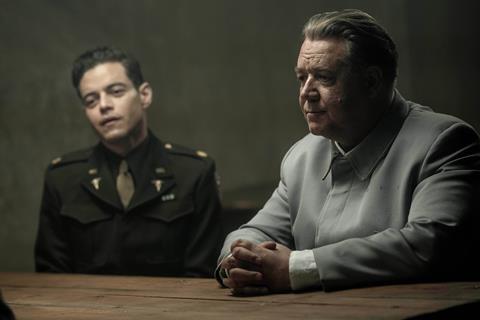
With further financial input secured from Walden Media, Vanderbilt was able to round out his ensemble. It was a job made easier by another best actor Oscar winner showing an interest. “Rami Malek had read the script independently and raised his hand as we were starting to look for our Kelley,” reveals Vanderbilt. “Usually, when you’re that level, you’re not reading scripts unless there’s a million-dollar offer on the table. But Rami isn’t that kind of actor.”
With much of the film revolving around Göring and Kelley’s wary, bargaining interplay, Vanderbilt was confident his leads’ contrasting energies would generate something noteworthy. “I loved putting Russell and Rami together because they vibrate at such different frequencies,” he says. “So much of casting is like cooking – if all the ingredients taste the same, the dish is not going to be very interesting.”
Michael Shannon’s “honest and stoic” quality made him right for the role of Jackson, while Vanderbilt – with the assistance of casting director John Papsidera – identified the UK’s Leo Woodall as his ideal Triest. “I watched Leo get famous as we shot the movie,” Vanderbilt says of the actor, whose One Day series dropped on Netflix during Nuremberg’s 2024 shoot. “It was so fun to watch Russell and Rami take him under their wing and be excited by a younger generation of talent.”
A monologue towards the end of the film reveals Triest to have a personal connection to the trials, a scene Vanderbilt knew would ask much of whoever came to play him. “It had to be someone who could absolutely park that scene,” he says. “We read a hundred different people and Leo kept coming back; he’s an amazing young actor and he fought for it.”
Moments of horror
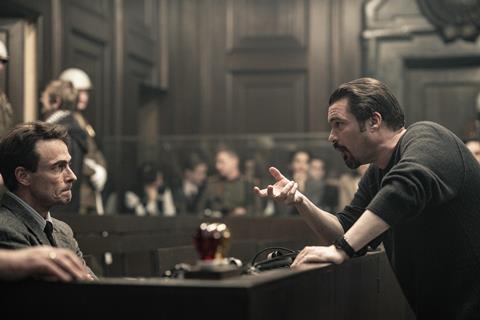
During the trials of 1945 and 1946, footage from the Nazi concentration camps liberated by the Allies was presented in evidence. It was a moment Vanderbilt was determined to recreate in his film, as truthfully as possible. “The amount of footage was always a conversation, but we held the line with that, because it was really important for the story,” he says. “Once you see that footage, you can’t unring that bell, and it’s the moment the whole movie turns.”
Before shooting, Vanderbilt asked his actors not to watch or revisit the footage in question so he could record their honest reactions. “I don’t want to say there was no acting required, but what you’re seeing is their experience of it for the first time through the lens of their characters,” he continues. “It was a hard day but they’re powerful images, and I felt it was important to honour that.”
With filming in Hungary completed in May 2024 and a final cut locked by December of that year, this year’s Toronto International Film Festival was chosen as Nuremberg’s most suitable launch venue. The response was positive, with an extended standing ovation at its premiere that marked something of a departure for a traditionally restrained audience.
Additional showings at San Sebastian, Zurich and other autumn festivals preceded a North American release in November through Sony Pictures Classics that generated a respectable $12.5m at press time. A same-month release in the UK and Ireland by Studiocanal on behalf of Sky Cinema added $3.5m (£2.6m), and Sky will stream to its subscribers from January.
After taking 10 years to realise his second directorial feature, Vanderbilt assures Screen International his third will not take another decade to materialise. Beyond confirming reports he is writing a film for Paramount – “possibly in the science-fiction genre” – the ebullient and loquacious director is uncharacteristically reticent.
“I feel like we’re living in darker times so I wanted to write something hopeful,” he says of a film he will also direct that will be “fictional and not historical”.
“At the end of the day, it’s all about telling a good story and keeping people engaged.”






No comments yet