



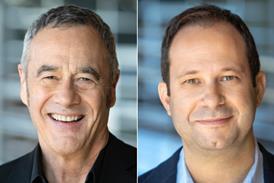














More than half a century after a historic trial helped pave the way for legal abortion in France, filmmakers Lauriane Escaffre and Yvo Muller revisit the case through the eyes of influential French lawyer Gisèle Halim.
Women On Trial (L’Affaire Marie-Claire) is making its US premiere at The American French Film Festival (TAFFF) on November 6.
The drama, which premiered in Cannes’ Special Screenings section, follows Halimi - played by Charlotte Gainsbourg - and her defence of 16-year-old Marie-Claire Chevalier (Saül Benchetrit), prosecuted for undergoing an abortion after being raped, her mother Michèle (Cécile de France) and three women accused of helping her.
The groundbreaking 1972 Bobigny trial became a turning point in the fight to legalise abortion in France, which was finally achieved in 1975.
Produced by Quad, with Gaumont handling international sales and the November 4 French release, the film has sold to several territories, including the US, where Menemsha Films has acquired distribution rights.
For Muller, who began developing the project with Escaffre in 2022, the story felt increasingly urgent. “We thought we were telling a historical story, but realised it was still very much a contemporary one,” he says, pointing to the reversal of Roe v. Wade in the US that year.
Courtroom thriller

Rather than a conventional biopic, the duo set out to turn the historic case into a gripping courtroom thriller.
“The biggest challenge was keeping audiences on the edge of their seats when there are no major revelations and we know how the story ends,” says Muller.
They drew on a rare published transcript of the original proceedings — French trials generally cannot be recorded — preserving Halimi’s closing argument and numerous witness statements verbatim while dramatising other events. The transcript had initially been published without authorisation by feminist organisation Choisir la cause des femmes.
“The trial allowed us to reconstruct the historical events,” says Escaffre. “Even if we know the outcome, we can’t help but wonder how Gisèle, Michèle and Marie-Claire Chevalier are going to pull it off.”
They also filmed in the original Bobigny courtroom.
“There was something quite magical about having the actors standing in the same room as the people they were portraying more than 50 years earlier,” Muller recalls.
Method acting
Gainsbourg was their first choice to play Halimi. “We needed someone who could capture both her strength and determination as a formidable, sometimes intimidating fighter, and the sensitivity and vulnerability beneath that exterior,” says Muller.
Gainsbourg signed on in January 2025, leaving just two-and-a-half months to prepare before filming began. She undertook extensive research, immersing herself in recordings of Halimi’s voice and personal writings.
The actress also wore clothes that had belonged to Halimi, sourced through a collaboration with Yves Saint Laurent, as well as her lawyer’s gown, lent by Halimi’s son.
Both directors also took supporting roles in the film. “You have to split yourself in two,” says Escaffre. “Directing means serving the whole team, while acting demands complete focus on just your character.”
Beyond the courtroom and the cinema
The film marks a departure for Escaffre and Muller, whose César-winning short Pile Poil and feature debut Maria Into Life explored female emancipation through comedy.
“There’s a common thread running through all our films: female characters who break out of the mould and refuse to follow the paths laid out for them,” says Escaffre, who also wanted to highlight the class inequalities underpinning the case.
“Gisèle Halimi herself said the law was not only misogynistic and unjust, but also deeply discriminatory,” says the director, who recalls a memorable Montélimar screening attended by around 1,200 young people.
“They were shocked and outraged by what they had discovered and identified deeply with Marie-Claire,” she says. “It was one of the very few times I’ve cried at a premiere.”
Above all, she hopes audiences will take away Halimi’s central message. “Never resign yourself to injustice. Things can change, and it’s always worth fighting against injustice.”
The filmmakers are particularly interested in the film’s US reception at TAFFF amid renewed battles over reproductive rights.
“We’ve met people who told us they were opposed to abortion before seeing the film and that watching it changed their perspective,” says Escaffre. “Perhaps little miracles can happen.”






No comments yet