








The ‘Loveless’ and ‘Leviathan’ director’s Cannes Competition title intertwines personal and national crisis
Dir: Andrey Zvyagintsev. France/Latvia/Germany. 2026. 140mins
Exiled Russian director Andrey Zvyagintsev returns to Cannes Competition with a steely and immaculately composed remake of Claude Chabrol’s 1969 classic The Unfaithful Wife, about a man who correctly suspects his wife is having an affair. Minotaur sees Zvyagintsev set his own deliciously ink-black stamp on Chabrol’s erotic thriller; indeed, for the majority of its runtime, Zvyagintsev deliberately flattens both the eroticism and the thrills – a carefully judged gambit that allows scenes of nudity and murder to land with greater force when they finally arrive.
Zvyagintsev sets his own deliciously ink-black stamp on Chabrol’s erotic thriller
Having spent 40 days in an induced coma in 2019 followed by a challenging recovery period, the man behind Loveless (the Jury Prize winner at Cannes in 2017) and Leviathan (winner of Cannes’ Best Screenplay prize in 2014) is now firmly in the running for his first Palme d’Or win. Whether or not that proves to be the case, Minotaur should have a healthy life following its Cannes Competition premiere; it has already sold to multiple territories including Mubi for the US, UK/Ireland and Latin America.
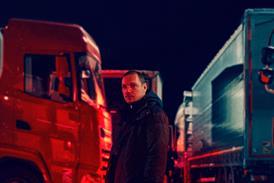
Minotaur makes a persuasive case for the oft-derided practice of remaking films – the new cultural and political context for these characters brings a bracing new life to the bare bones of the plot. The year is 2022, and unhappily married Gleb (Dmitriy Mazurov) is a wealthy Russian businessman tasked with adding 14 of his workers’ names to a list of men to be drafted into the war in Ukraine. While initially hesitant, once this ethically distasteful task collides with a moral problem closer to home, he swiftly finds his scruples vanishing.
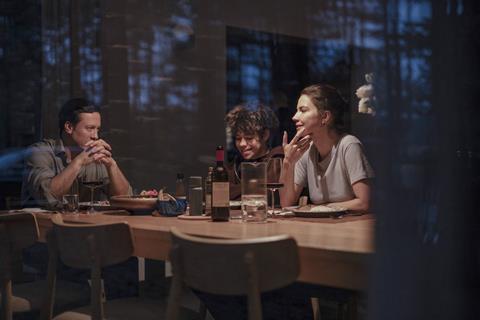
Iris Lebedeva does lovely and often very subtle work as Gleb’s wife Galina, in a potentially unsympathetic role. She is aided by the sly wit of the production design: the large, over-determined, uncluttered house in the provinces that she shares with Gleb is furnished in supposedly tasteful muted blue-grey tones, and decorated with the kind of art you see in nice, anonymous hotels. In contrast, the cramped and messy home of her lover is a monument to art as process rather than product: the space is warm, alive and imperfect, and Galina’s entire way of being shifts as she enters the tiny flat.
Minotaur demands some patience from audiences. Zvyagintsev and his regular cinematographer Mikhail Krichman (who has shot all his features) set out to meticulously establish this world and these characters before anything much happens to them. By inhabiting Gleb and Galina’s dead marriage right alongside them, the stultifying sense of this life is fully baked in by the time the key act of violence transpires. Mazurov’s performance in particular is a massive gamble, albeit one that pays off: for a good hour or so, he is a closed book, a man of flattened affect, going through the motions, without much to recommend him. Outrageously, his humanising event is murder – for the first time, he is truly animated, sweating and panicking, and it becomes perversely easier to empathise with him simply because he suddenly seems more alive.
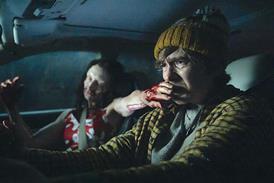
Zvyagintsev’s films are generally characterised by a thread of bone dry humour, and there’s one scene in particular here where it almost feels like he’s creating a very dark tribute to a much earlier period in film than Minotaur’s 1960s source material: that of the great silent comedies. As Gleb attempts to erase the evidence of his crime of passion, his inept clean-up plays out at length in real time and with all the clumsiness to be expected from someone who has never committed a murder before. There’s an echo of Chaplin or Keaton to this frazzled guy frantically scrabbling to grab more and more kitchen roll, or trailing a dripping towel across the Soviet-era apartment’s shabby-chic parquet, and a groan from the not-quite corpse plays as pure farce. However, Zvyagintsev never indulges in the Tarantino-esque impulse to render death itself comic: instead, the mundane practical frustrations here add to the overall horror of the situation.
The film’s final flourish is open to interpretation: footage of the rolling Mediterranean sky, seen from an airplane. Fluffy white clouds float across a seascape which we know must be azure blue, but the sequence is shot in black and white, giving the greyscale clouds the appearance of billowing explosions. Are we witnessing a return to the nearly monochrome colour scheme of Galina and Gleb’s stultifying dream home, or a visual echo of the conflict engulfing Ukraine? This is a Zvyagintsev film, where the personal is always political – so perhaps it’s both.
Production company: MK Productions, CG Cinéma, Razor Film Produktion, Forma Pro Films, Arte France Cinéma, LEAF Entertainment
International sales: Mk2 intlsales@mk2.com
Producer: Charles Gillibert, Nathanaël Karmitz, Marco Perego
Screenplay: Andrey Zvyagintsev, Simon Liashenko
Cinematography: Mikhail Krichman
Music: Evgueni Galperine, Sacha Galperine
Sound: Andrey Dergachev
Cast: Dmitriy Mazurov, Iris Lebedeva, Juris Zagars, Anatoliy Beliy, Vladimir Friedman, Varvara Shmykova, and Stacy Tolstoy