











An improvised family navigates uncertainty in Tiago Guedes’s three-hour Cannes Premiere title
Dir: Tiago Guedes. Portugal/France. 2026. 200mins
Near the end of Aqui, the film’s young protagonist makes a request of his father, who’s tempted to write a book about him: “You must promise not to understand me.” Indeed, the mysteries of raising a child lie at the heart of Portuguese director Tiago Guedes’ lengthy, challenging adaptation of J.M. Coetzee’s so-called ‘Jesus trilogy’ that spans more than three hours and consistently leaves the audience trying to decipher its riddles. For audiences willing to make peace with the picture’s overt preciousness and inconsistent storytelling, Aqui offers substantial rewards, including several striking set pieces.
Conjuring an enigmatic tone, Guedes immerses the viewer in the strangeness of Coetzee’s vision
Guedes returns to Cannes four years after 2022’s Remains Of The Wind with a film that occupies an uneasy alternate reality in which an adult man and a boy who are strangers to one another fall into a traditional father-and-son dynamic. Starring Manolo Solo as the father and Patricia Lopez Arnaiz as the woman who will become the boy’s de facto mother, Aqui could struggle to find theatrical distribution because of its demanding runtime, but its festival prospects should prove stronger.
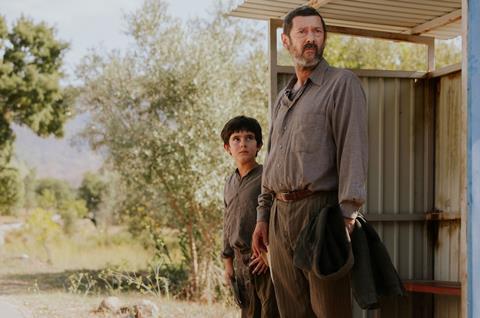
Simon (Solo) and six-year-old David (Alex Pelaez) arrive in the nondescript town of Novilla, having no memory of their lives before meeting just a week earlier. Simon knows he is not David’s father, but he is convinced that he can figure out who his mother is just by looking at her. Soon afterwards, he encounters Ines (Lopez Arnaiz), suggesting she help care for the child. Ines initially resists, but soon the threesome become an unlikely family unit.
Conjuring a tone that’s meant to be enigmatic, if not downright baffling, Guedes immerses the viewer in the strangeness of Coetzee’s vision. Much about Aqui remains unexplained, including why the adults decide to become David’s guardians and the governing rules of this odd dystopian environment. (For instance, it’s never entirely clear what time period we are in, or which part of the planet.) Colourful side characters enter the story, such as Sergi Lopez’s ill-tempered dockworker, only to leave just as quickly, and the picture’s aspect ratio changes during the final third. This narrative and aesthetic unpredictability may frustrate some viewers, but also strengthens Aqui’s sense of heightened reality – making it impossible to know exactly where the script, co-written by Guedes, will go next.
In due course Simon and Ines, who never develop anything resembling a romantic relationship, learn that David is talented, prompting them to enrol him in a dance academy. This puts them on a collision course with quirky, possibly unstable, instructor Dimitri (Daniel Elias), but it also yields some beguiling dance sequences, choreographed by Sofia Dias and Vitor Roriz, that tap into Aqui’s larger theme of a world intent on suppressing children’s unbridled potential. As the young David, Pelaez adeptly hints at something unknowable behind those big, bright eyes. Fittingly for a film in which weird occurrences are commonplace, David will ask his father at one point, “Am I a ghost?”; the intensity of his expression makes the question seem reasonable.
Similarly, Solo and Lopez Arnaiz play their characters in a kind of waking daze as they gradually accept their parental roles, becoming symbols for every father and mother overwhelmed by the demands of child-rearing. By design, Aqui’s protagonists are shapeless because of their lack of memory, but the adult actors tap into something almost primal as Simon and Ines adapt to being David’s guardians, which becomes increasingly difficult once David grows more stubborn in his pursuit of finding out who he was before he met them.
The picture’s meandering narrative occasionally grows repetitive, as Guedes labours Coetzee’s metaphor for David as a Christ-like innocent under threat from a callous society. But it also allows generous screen time for Simon, Ines and David to negotiate their fragile coexistence, including a leap forward in time as an older David (Hugo Encuentra) seeks greater independence.
Even when the plotting falters, cinematographer Daniela Cajias provides a steady stream of sun-soaked, intentionally sterile images meant to evoke the anxiety of raising children in a society facing an uncertain future. The longer you spend in Aqui, the less it seems disorientingly dystopian and, instead, a sad commentary on the unsettling childhood our sons and daughters are living in right now.
Production company: Leopardo Filmes
International sales: Films Boutique, contact@filmsboutique.com
Producer: Paulo Branco
Screenplay: Tiago Guedes, Luis Araujo, based on the “Jesus Trilogy” by J.M. Coetzee
Cinematography: Daniela Cajias
Production design: Meral Aktan
Editing: Jackie Bastide, Tiago Augusto
Main cast: Manolo Solo, Patricia Lopez Arnaiz, Alex Pelaez, Hugo Encuentra, Daniel Elias, Lambert Wilson, Sergi Lopez, Camille Decourtye