








Lauriane Escaffre and Yvo Muller revisit the historic Bobigny case through the eyes of lawyer and activist Gisele Halimi
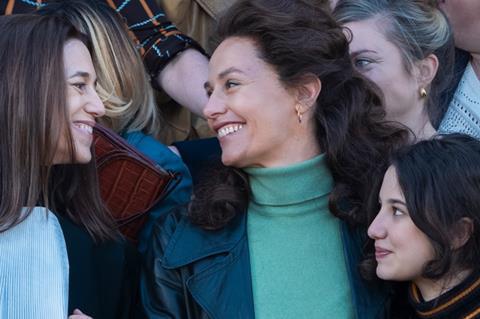
Dirs/scr: Lauriane Escaffre, Yvo Muller. France. 2026. 102mins
“Can’t you be a normal woman?” asks Fritna (Farida Ouchani) the mother of Gisele Halimi (Charlotte Gainsbourg), summing up in a sentence the ingrained everyday sexism the real-life Tunisian-French lawyer was up against when she took on the case of Marie-Claire in 1972 in Bobigny, outside Paris. Writer/directors Lauriane Escaffre and Yvo Muller chart what would become the groundbreaking trial of 16-year-old Marie-Claire Chevalier (Saul Benchetrit), her mother Michele (Cecile de France) and two other women for helping the teenager have an abortion after she was raped. This pacy retelling, which keeps its focus on Halimi, interweaves the trial itself with the run-up to it and events outside the courtroom to solid effect, although the fact that the outcome of the case is known from the outset inevitably blunts some of the dramatic tension.
The presence of Anglo-French star Gainsbourg should also help raise its profile abroad
Women On Trial is the second feature collaboration between Escaffre and Muller after Maria Into Life (2022). It premieres as a Cannes Special Screening, and will be released by Gaumont in France on November 4. A tour of the festival circuit seems likely and it could catch the attention of audiences further afield who responded to recent French legal dramas such as Anatomy Of A Fall and The Girl With A Bracelet. The presence of Anglo-French star Gainsbourg should also help raise its profile abroad.
Gainsbourg delivers a performance marked by dogged determination as Halimi, insisting to the women from the start that they must not apologise for their actions. The lawyer sees an opportunity in this case – not just to defend these women, but to take on the law that criminalises abortion. In between watching various people take the stand, including a small but stand-out turn from Florence Loiret Caille as Micheline Bambuck, the abortionist who is wracked by nerves, the writer/directors – who also appear in smaller roles – focus on Halimi’s home life. There, in contrast to her mother, her sympathetic husband (Gregory Gadebois) offers unwavering support. We also see Halimi attempting to raise the profile of the case through the media, and rallying activists including Simone de Beauvoir (Marianne Basler), a key ally in France’s feminist movement.
The man’s world of the period is evident almost everywhere Halimi turns, from male editors and reporters to the judges at the trial. This patriarchal bias is baked in from the start as we learn it was Marie-Claire’s own rapist who denounced her to the authorities, while facing no consequences himself. In another shocking moment, a doctor notes that when he performs curettage procedures on women suffering complications from backstreet abortions, he is ordered not to use anaesthetic “so they remember”.
Cinematographer Jean-Francois Hensgens (a regular collaborator with Joachim Lafosse) creates a visual distinction between the court and domestic spaces. He employs harsher, cool light as the women take the stand, emphasising the stark scrutiny they are under. A warmer palette comes to life in Halimi’s home, with night scenes marked by pockets of lamplight. The distinction between the two realms is also underlined by Stéphane Taillasson’s production design, which uses blues in the courtroom and warmer greens and ochres in Halimi’s orbit. Emmanuelle Youchnovski’s costumes dovetail with this approach, with orange becoming a key colour for Halimi and the wardrobe generally evoking the period without veering into caricature.
The focus on Halimi does mean that Marie-Claire’s mother and, particularly, the teenager herself, take something of a back seat. But as an exploration of Halimi’s courage and talent in a world where small battles for equality were being fought every day, it makes a cast iron case.
Production companies: ADNP Quad Films, Gaumont, France 3 Cinéma
International sales: Gaumont, communication@gaumont.com
Producers: Foucauld Barré, Nicolas Duval-Adassovsky
Cinematography: Jean-Francois Hensgens
Production design: Stephane Taillasson
Editing: Valerie Deseine
Music: Philippe Rombi
Main cast: Charlotte Gainsbourg, Cecile De France, Gregory Gadebois, Saul Benchetrit, Lauriane Escaffre, Yvo Muller, Sarah Suco, Florence Loiret-Caille