















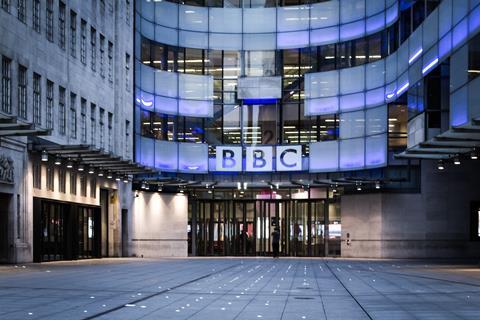
Banijay UK and Pact support the introduction of a household levy to replace the BBC’s licence fee funding.
In their respective submissions to the culture, media and sport committee (CMSC), the trade body and super-indie argued that the current licence fee model is outdated, and argued against alternative funding options such as advertising and subscription models.
In its strongly worded submission, Banijay UK emphasized the status quo is “not an option” and that a settlement that maintained the licence fee would mean a real terms decline in funding, due to inflation.
“If we do not seize this moment to make a radical intervention to address the funding challenge and ensure the BBC’s long-term sustainability, the future of the entire UK television industry is at risk,” it warned.
A universal household levy would be a more stable and progressive solution, it wrote, suggesting that its cost to the public could be tied to council tax bands.
Pact made a similar argument in its support for a universal household levy and said that such a model would better ensure predictable support for UK content.
“If we limit ourselves to minor adjustments to the current licence fee, we are effectively choosing a course of managed decline,” Pact wrote. “To remain competitive against global players with vastly greater resources, and to maintain the UK’s position as a world leader in content production, the UK needs a BBC with the scale and certainty to act as a genuinely strong partner.”
Both Banijay and Pact argued against an advertising model for the BBC, with the former stating it would be “catastrophic” for other UK broadcasters and damage the “already fragile” advertising market, as well as reducing overall spend in UK content.
Pact argued a subscription service would “undermine” the BBC’s universality by excluding lower income audiences, as well as pushing commissioning decisions in favour of commercial criteria rather than public value merit.
Closer PSB collaboration
Both Pact and Banijay supported the idea of the BBC working more closely with other PSBs, with Pact suggesting sharing tech resources, and Banijay preferring a “best in class” BVoD platform.
Pact said the BBC must “move beyond siloed operations” by sharing its technological “backbone” with other PSBs and seeking to collaborate with them on infrastructure technology. It argues that each PSB currently maintaining their own backend systems is costly and yields a “limited” return on investment.
However, the trade body added that any partnership must be one based on equality between the partners.
“This principle should guide discussions on shared technology, ensuring that the BBC’s public investment can be leveraged in a way that supports and, where appropriate, subsidises the wider PSB ecosystem,” it continued.
“This could lead to positive impacts such as a reduction in in-house costs and uphold healthy competition. With constraints on the market such as inflating production costs, the money saved from sharing this technology could be put towards fostering UK creativity and IP through shared resources.
“As this is the BBC’s technology, this would only solidify their position as a leader amongst other PSBs while simultaneously taking pressure off the BBC’s own budgets.”
Banijay highlighted that streamers cumulatively spent circa £850m in 2024, which was greater than Channel 4’s content spend of £643m in the same year, but flagged that “no single streamer spends as much as the BBC”.
Creating a single easy-to-access BVoD platform that offers the full range of British PSB content would create a “super UK creative ecology” that could take on the tech giants, Banijay said.
It added: “A combined PSB digital platform could also be a place where a hybrid ad model could work. Advertising would continue to fund the commercial channels, buoyed by an increased consolidated reach, but the BBC would remain publicly funded.”
Ultimately, the UK PSBs are at a moment of “extreme jeopardy”, warned Banijay, as a result of unprecedented viewer fragmentation.
It continued: “Powerful US businesses, with no imperative to tell UK stories, continue to reshape the industry. More people are relying on social media for their news where misinformation is rife, and now more than ever it is vital that the BBC, as one of the most trusted and reliable institutions in the country, is fit for the future and able to compete in the modern broadcasting environment.”
This story first appeared on Screen’s sister site Broadcast






No comments yet