







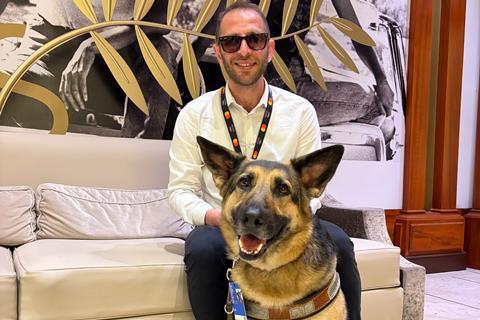
Bahman Yazdan Panah is like many independent filmmakers at Cannes except for one fundamental difference. He is blind.
While many struggle to weave their way through the dense crowds and barriers of the Croisette and Marche du Film, the young producer/director must navigate Cannes using his guide dog Tess alongside assistant (and fellow producer) Elnour Torabi.
“Tess helps a lot because everyone is interested in her and her market badge,” says Yazdan Panah of his four-year-old German Shepherd. “It’s great at starting conversations because people want to pet her and ask questions, which is when I can introduce myself and my project.”
The Kurdish Iranian filmmaker, now based in Paris, is at the market with his second feature as a director, Marie-Renée. The documentary follows a 73-year-old blind woman who devotes her energy to rebuilding a school for visually impaired children in Gabon, Africa.
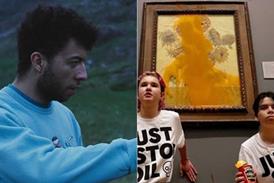
It follows his 2025 debut, Out Of Frame, a self-portrait that traced his journey hitchhiking alone through eight countries across Europe despite being blind. He captured 60 hours of footage using a GoPro, attached to his head or chest, in addition to his phone. It world premiered at IDFA.
Directing the film was a defiant move for the lifelong traveller, who began to lose his sight in 2020 and was blind two years later. “When I became blind, one of my big challenges was mobility,” he recalls. “My family hadn’t seen me blind so I set myself the challenge of hitchhiking back to them to get their reaction.”
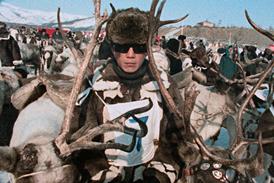
Born in the Kurdistan part of Iran, he worked as a marketing and communications consultant before leaving in 2019, feeling his Kurdish culture was being repressed. He eventually reached Paris as a political refugee and reunited with childhood friend Hazhar Ramezani, who turned a camera on Yazdan Panah and filmed for four years as his eyesight began to fail. The resulting film was titled Bahman, which became the first feature of Yazdan Panah’s own production company, Vision Réalité.
During that time, he also learned French and English. Tess also understands four languages, knowing around 50 commands in French while also being able to “speak” English, Kurdish and Farsi.
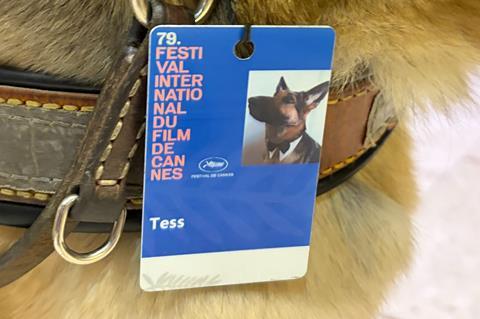
“This is my second time in Cannes as I came in 2024 to learn how film markets worked,” he says. “I’m looking for international co-producers partners and finance but one of the biggest challenges I face is a lack of confidence from people who think it’s a risk to invest in a film directed by a blind person.”
Unlike his debut feature, he is working with a cinematographer on his second doc. Filming has already taken place in France ahead of a planned shoot in Gabon. “If all goes well, I’ll go to Africa for the first time to film,” says Yazdan Panah.
While his time at the market has been productive, taking nearly 20 meetings including “very positive” one with Creative Media Europe, his festival experience has included disappointment.
The filmmaker has attended screenings of opening title Electric Venus, James Gray’s Paper Tiger, Iranian documentary Rehearsals For A Revolution and Asghar Fahadi’s Parallel Tales. But Cannes does not offer the option of audio description for visually impaired audience members.
“Maybe Cannes thinks there are not enough blind people to see films here,” says Yazdan Panah. “At screenings, Elnour describes everything for me on screen and I know it’s not easy for her. The Berlinale has introduced audio description for a selection of its titles, even if they are in German.”
It is a cause championed by his company CineBlind, which was founded as a platform for promoting and producing inclusive cinema. “I would also like to see the introduction of SDH (subtitles for the deaf and hard of hearing),” he adds. “Cinema should be for everyone.”

No comments yet