



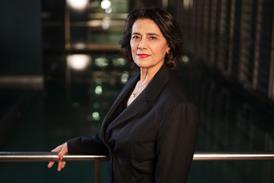
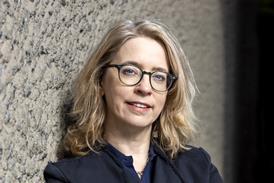




Acclaimed French documentary director Claire Simon has an unusual but not very lucrative way to ensure her fans can watch her old films – she makes them available on her website. Anyone can request to view them and she’ll forward the password.
“I do that every day. I’m not a big company… you just have to write me,” said Simon, explaining how as an independent documentary maker, she has ensured her back catalogue always remains in circulation.
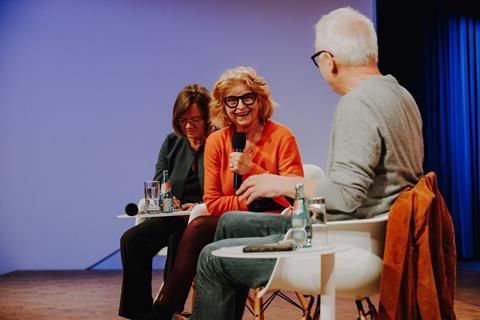
The 70-year-old director was speaking at DOK Leipzig this week where her latest feature doc, Writing Life: Annie Ernaux Through The Eyes Of High School Students, opened the festival, having previously world premiered in the Giornate degli Autori sidebar at Venice.
The documentary explores how modern French teenagers respond to the work of Ernaux who, in 2022, became the first French woman to be awarded the Nobel Prize for Literature.
Simon also took part in a wide-ranging public talk at DOK Leipzig moderated by festival director Christoph Terhechte, who calls her “one of the world’s leading documentarists.”
That may be a lofty claim about a documentary maker who isn’t a household name but Simon fully justifies it. Her works have been feted everywhere from Cannes, where her 2024 feature Elementary received a special screening last year, to the Berlinale, where Our Body premiered in the Forum in 2023. Simon has already been the subject of several career retrospectives. Born in the UK but raised in the south of France, she has been making films for half a century, sometimes venturing into fiction but racking up a hugely impressive list of documentary credits.
On stage, she held forth on everything from why she prefers documentary to fiction, how she makes her films on the hoof (“I never plan”) and the magic of listening.
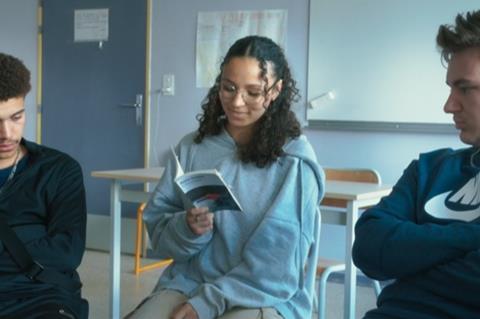
One of the inspirations for Writing Life was a memory she had of the French author Marguerite Duras meeting girls from a French high school. “They were so moved to read Duras and Duras was nearly crying,” recalled Simon.
Simon herself makes both documentaries and fiction films, but much prefers the former. “When I do a fiction, it’s because the people are dead or I can’t get the story in documentary [form].”
She gave the example of her 2008 fiction film, God’s Offices, about a family-planning clinic. Unable to shoot inside the clinic, she recorded interviews and then had actresses playing the family guidance counsellors. “You can’t film in a family-planning [clinic]. Girls and women go there because it is anonymous.”
Writing Life was shot at different schools in France, with students from a wide range of backgrounds. But they all interpret Ernaux’s writing in perceptive and sensitive fashion, said Simon. “The first place I shot, which is not in the film, was a technical high school, only boys, ultra-right wing…but they loved Annie Ernaux!”
The director paid tribute to “courageous” teachers in schools in deprived areas who championed literature and supported the documentary.
“Each place was another story and it was completely random,” she remembered. “If you plan something, it doesn’t work…if you go somewhere to find something you already know, this is TV reportage. Documentary is completely different.”
She also spoke of her intuitive approach to documentary making. “What happens to me very often in a documentary is that I change the topic when I film,” she explained.
Simon believes firmly in the role that luck plays in the best documentaries. “If you’re open, things happen to you,” she observed. “It’s very important that you are open.”
The French director also talked about why it pays to listen. “If you listen to the other person, it’s like going to the movies or reading a book; you forget about yourself. You’re relieved. You’re not thinking anymore about who am I. You are entering the story of the other and it’s wonderful. So please try the experience of listening.”
As for the teenagers in the Annie Ernaux doc and younger kids in her 2024 documentary, Elementary, she believes they’re continually underestimated by society.
Elementary is set in an inner city primary school where 99% of the pupils are children of immigrants. Riots took place while she was filming because a young boy had been killed by the police but the school itself proved an oasis of calm. “The children of the suburbs, Black, Arab, Georgian, Russian, Chinese – they wanted to learn, they were quiet, they wanted to read.”
Terhechte told Simon that certain critics accuse her of being “too positive” in her films but she quickly brushed off that accusation. “I still have hope in the future – I am sorry!”


No comments yet