








Filmmaker Elisabeth Rasmussen joins musician Jon Larsen on his 10 year search for valuable micrometeorites
Dir: Elisabeth Rasmussen. Norway, Denmark. 2026. 101mins
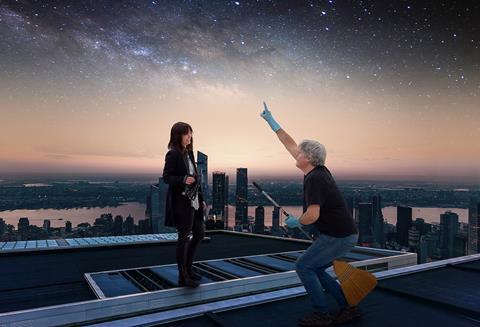
Science, myth, music, art and philosophy all orbit around Jon Larsen, the magnetic heart of Elisabeth Rasmussen’s absorbing, informative documentary, which follows his hunt for stardust over 10 years. Armed only with a broom, a magnet, a handful of bags, and dogged determination, Larsen looks in everyday places (like roof gutters) for microscopic cosmic dust, known as micrometeorites, which date back to the inception of our solar system and can offer clues to life on Earth. Unsurprisingly, Larsen’s approach is not taken seriously by the scientific establishment, which spends billions on trying to collect this valuable dust.
Larsen’s enthusiasm is infectious
Rasmussen has been drawn to outsiders before, previously making punk profile The Heart Of Bruno Wizard. She’s hit the jackpot with Larsen, an affable and charismatic fellow Norwegian. who dreamed of being an artist before becoming a successful jazz musician and producer, and who has maintained a love of amateur geology since childhood. Larsen’s enthusiasm is infectious, and is already proving popular with festival programmers; the film screens at CPH:DOX immediately after its world premiere in Thessaloniki Documentary Film Festival’s Newcomers Competition. Rasmussen marries astrophysics to offbeat charm in ways that are likely to ensure good audience word of mouth wherever it plays, and could help We Are Stardust attract a specialist distributor.
Rather than starting immediately with hard science, Rasmussen lures in viewers by drawing on her own Sámi heritage and framing Larsen’s journey with the Sámi myth about the universe being founded by a cosmic reindeer, Gabba, descending from the heavens. These sorts of existential ideas are folded together with more concrete science, all well illustrated in accessible layman’s terms using VFX from London-based Little Shadow.
The time that Rasmussen has invested in this project shows in terms of the depth of her approach, which allows a biography of Larsen to gradually build as she follows him working at his hobby in his spare time, collecting and then carefully sifting his samples. Sweet scenes with his elderly mum – who recalls moving his childhood rock collection to the basement because she was concerned it would break through his bedroom floor – indicate that his love of citizen science is a lifelong obsession.
As Larsen’s hunt continues, he forms an alliance with Norwegian mineralogist Jan Braly Kihle, who has the pioneering photographic equipment to capture the potential micrometeorites on camera. (In a mark of a film that is as much about luck and personality as it is about science, Braly Khile’s involvement comes via his love of Larsen’s music.) As Larsen becomes convinced he has found what he was looking for – beautifully cinematic tiny objects that, when blown up on the big screen, look like ornate blown glass works of art – the question becomes whether he can convince anyone in the scientific establishment to even look at the evidence, let alone accept it.
Rasmussen encourages the viewer to join Larsen in his passion, mixing observational footage with well-thought-out explanatory sequences with veteran scientists, including Donald Brownlee. She also weaves in her own brush with death – which she documented more fully in her short film Phoenix – in a way that adds to the film’s existential underpinning and uniquely personal punch. A suitably complex score from Danish composer Philip Owusu, alive to the jazz background of Larsen, adds to the sense of scale and wonder.
Production companies: Wonderline Productions
International sales: Wonderline Productions, elisabeth@wonderline.no
Producers: Benedikte Bredesen, Jamie Hever, Ulrik Gutkin
Cinematography: Jannicke Mikkelsen, Jason Leeds
Editing: Ash Jenkins, Phil Jandaly, Heli Kota
Music: Philip Owusu