



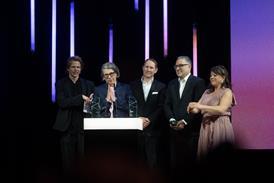


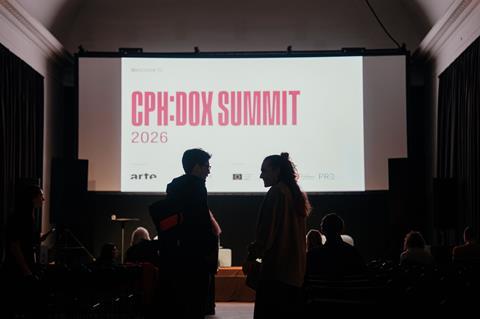
Harnessing social media to grow audiences for feature documentaries, to woo or not to woo tech billionaires and the future of public interest media were among the wide-ranging topics discussed at the lively second annual CPH:DOX Summit at the Copenhagen International Documentary Festival in Denmark on March 16.
Titled, ‘Media Sovereignty: Rethink, Envision, Redefine’, the Summit was held in association in Arte.
Many independent documentary filmmakers are operating amid real and existential crises. This was underlined by the absence of Beirut-based Jad Abi-Khalil, executive director of cultural non-profit organisation AFLAMUNA, who was unable to travel to Copenhagen due to the US and Israel war with Iran and Lebanon.
Abi-Khalil was due to participate in a panel called ‘The Act of Building: New Infrastructure for Information Ecosystems Under Siege’.
“We’re very sad [Abi-Khalil] wasn’t able to join us, because he has an immense amount of experience and expertise working across the MENA region, not least in how to use physical infrastructure in society, to bring people together around documentary film and to bring people together across different divides and communities,” explained panel moderator Sameer Padania, a UK- based independent researcher and strategist.
Abi-Khalil’s spot was filled by German writer and entrepreneur Aya Jaff, author of the non-fiction book ‘Broligarchie’, whose resume boasts stints as a coder for a Silicon Valley tech executive.
Jaff, who said she had experienced firsthand a complete lack of interest among the billionaire community in anything other than expanding their personal wealth, dismissed any hope this community could be harnessed to support the documentary sector.
However, the UK’s Bill Thompson, head of public value research at the BBC, said he believed there were better options than valiantly seeking philanthropic instincts among billionaires. Namely, creating the conditions that proved documentaries could be a good investment.
“If we sorted out problems with digital infrastructure, it’d be easy to persuade funders that the documentaries would reach a sufficient audience to justify the investment and find financing,” he suggested.
Bente Roalsvig, deputy director of Norway’s Fritt Ord Foundation, made the point that in-person, human-to-human interaction can be the main ingredient for documentarians and journalists. Filmmakers making contentious projects often require a haven away from prying eyes and ears. Her foundation has a physical space in Oslo for that.
Summit host, Beadie Finzi, co-director of the UK branch of non-profit film foundation Doc Society, which has outposts across Europe, East Africa, the Americas and Australia, asked Anthropic’s Claude AI chatbot to describe the state of public interest media in the year 2030.
Among the bullet-point predictions suggested by Claude was that by 2030, public service broadcasting will exist as commissioning entities rather than broadcasters; The information environment is flooded with synthetic material, and everyone else is swimming in content that may or may not be real.
“We have to reinvent ourselves as broadcasters, as producers, filmmakers, founders, in order to resist the rise of technology,” said Boris Razon, editorial director of Arte France.
Razon was talking on a panel called, ‘To be seen or not to be seen, that is the question: the strategies we will need to connect, engage and inspire citizens in 2030’ discussion. “The only way to do it is to be flexible, resilient and create flexible alliances.”
Lea Fels, partner and co-owner of Amsterdam- based SVDOCS, is working on a project called Bugs detailing the story of young Russians who have recently been exiled in Europe following the country’s invasion of Ukraine. She said by deploying social media – whether that’s TikTok clips or YouTube trails – audiences will grow, particularly for youth-led films.
“I realised that I knew this story [of social media] from [the success of] amazing documentaries such as Navalny and Mr Nobody Against Putin,” said Fels. “But the audience for those films is 40-plus.”
Imagine the audience that could be found with a story about young people, said Fels. Her as-yet-untitled project is a coming-of-age story, not just a story about underground activism.
“No one is coming to save us. We have to build our own life rafts,” underlined UK investigative journalist Carole Cadwalladr, on the panel with Fels and Razon.
“Think about who your audience is and what audience you’re trying to serve, even before you decide what stories you are telling,” added Felipe Estefan, the Colombian-born US-based CEO of documentary financier Curiosity Capital.




No comments yet