







Jackson’s nephew Jafaar Jackson stars as The King Of Pop, alongside Colman Domingo and Nia Long
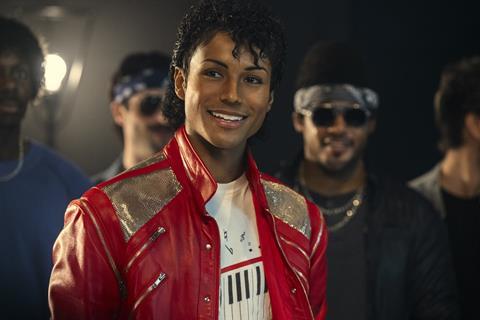
Dir: Antoine Fuqua. UK/US. 2026. 127mins
Michael Jackson left behind a complicated legacy, thrilling millions of fans with his mastery of pop music while simultaneously receiving criticism for his eccentric behaviour and facing accusations of child sexual abuse. Perhaps not surprisingly, the biopic Michael – which is backed by the late singer’s estate – would prefer audiences focus on his artistic achievements, celebrating a prodigy who stepped out on his own to enjoy even greater success as a solo artist in adulthood. But although the film’s musical performances galvanise, director Antoine Fuqua reduces The King Of Pop to a blandly inspirational cipher.
Disconnected from reality
Opening in the UK and US on April 24, Michael hopes to emulate the commercial fortunes of 2018’s award-winning Queen blockbuster Bohemian Rhapsody ($911 million worldwide), which was also produced by Graham King. Jackson is played primarily by his 29-year-old nephew Jaafar, with Colman Domingo portraying the singer’s physically abusive father Joseph. The picture boasts plenty of Jackson’s hits, both as a solo artist and with his childhood group The Jackson 5, and his fans will savour the glossy treatment. But Michael might court controversy for sidestepping its subject’s history of alleged child molestation.
John Logan’s screenplay traces Jackson’s life from his early years growing up in Gary, Indiana in the 1960s to the triumphs of Thriller and Bad two decades later. Juliano Valdi plays the singer as a boy as he quickly becomes the main attraction of The Jackson 5, his chart-topping band with his older brothers. But his domineering manager father Joseph (Domingo) pushes his sons relentlessly, intimidating them through verbal abuse and, sometimes, by whipping them with a belt. As Michael fast-forwards to the late 1970s, Jackson (now played by Jaafar) dreams of breaking free of Joseph to become an artist on his own terms. But Joseph isn’t about to let his cash cow go so easily.
Both Valdi and Jaafar Jackson credibly capture Michael’s high voice and joyful demeanour. (They are also quite good at conveying the singer’s incredible dance moves, although it’s Michael’s original vocals we hear throughout the film.) But the effect is little more than mimicry, summoning a decent impression of Michael Jackson without offering much insight into the human being behind the image.
To be fair to the actors, though, Michael’s overriding strategy is to put its subject on a pedestal, never examining or interrogating him in any meaningful way. The singer’s bizarre quirks — his penchant for adopting wild animals, his tendency to behave in an adolescent manner even in adulthood — are presented with affection and utter incuriosity. Most music biopics are fawning, but Michael is notably defensive in its careful massaging of Jackson’s potentially disturbing personality traits. It’s telling that, other than Joseph, who is treated as the film’s despicable villain, everyone in Michael’s orbit is besotted with him and convinced of his genius. The result is a strangely frictionless narrative in which the audience simply waits for Michael to summon the courage to emancipate himself from his dad.
Fuqua struggles to transcend genre cliches, most prominently the hamfisted foreshadowing of key incidents in Jackson’s life and career. Michael constantly reminds us of his childlike whimsy by showing him reading Peter Pan and waxing eloquent about his hero Charlie Chaplin. Sometimes, however, these stabs at character development prove terribly uncomfortable, such as in the multiple scenes concerning Jackson befriending children — an unpleasant reminder of the sexual-assault accusations levelled against him, which he denied. Later, when Fuqua pivots to Michael’s escalating conflict with his father, Domingo’s fiery but one-note performance quickly grows tiresome.
Anytime Michael puts Jackson in the recording booth or on stage, the proceedings possess a little more crackle. There’s an undeniable electricity to Jafaar Jackson’s renditions of ‘Don’t Stop ‘Til You Get Enough,’ ‘Beat It’ and ‘Bad’ thanks to the undiminished power of those pop songs. Fuqua and cinematographer Dion Beebe adroitly re-create iconic performances and music videos, inviting fans to relish the nostalgic rush of seeing Michael Jackson in his prime.
But even those rousing sequences may leave some viewers with a bad taste in their mouth. Many will, understandably, object to this hagiographical film because it refuses to address the serious accusations that profoundly shifted some fans’ feelings about Jackson. But in a sense, Michael does acknowledge those accusations through the shameless way it strenuously insists that this saintly superstar was an exceptional artist, a loving son to his long-suffering mother Katherine (a wasted Nia Long), and a bighearted humanitarian. By denying any contradictory views of its subject, Michael seems disconnected from reality — a problem the massively famous and troubled Jackson would himself come to embody.
Production companies: GK Films, Optimum
US distribution: Lionsgate / International distribution: Universal Pictures
Producers: Graham King, John Branca, John McClain
Screenplay: John Logan
Cinematography: Dion Beebe
Production design: Barbara Ling
Editing: John Ottman, Harry Yoon, Conrad Buff, Tom Cross
Main cast: Jaafar Jackson, Nia Long, Juliano Valdi, KeiLyn Durrel Jones, Laura Harrier, Jessica Sula, Miles Teller, Colman Domingo