













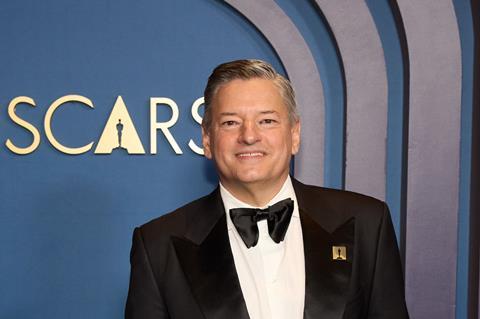
Ted Sarandos pushed back against antitrust concerns and allegations of wokeism in a testy US Congressional hearing into Netflix’s proposed $82.7bn acquisition of Warner Bros’ streaming and studios business on Tuesday (February 3).
Testifying in front of Republican and Democratic senators in Washington DC., the co-CEO reiterated that Netflix would preserve the 45-day exclusive theatrical window should the merger go through. He touted the company’s job-creation record in the US, and its plans to continue making film and series in the country.
Sarandos came under fire from Republican senators on the sub-committee on antitrust, competition policy, and consumer rights over the potential impact of the merger on jobs, customer choice, and industry competition, and fielded accusations that Netflix was a woke platform.
While senators cannot approve or block the deal, they gather information and can be influental. The at times intense questioning during the two-hour hearing suggests a challenging time ahead as the transaction comes under review from the US Department of Justice and European regulatory bodies.
Asked by Republican Senator Ted Cruz (Texas) if he thought monopolies were a good thing, the Netflix co-CEO was clear. “No sir they are not,” he said. ”We are nowhere near a monopoly. We are 9% [of total US television] viewership and would rise to 10% [were the Warner Bros deal to go through].”
When Cruz pressed WBD chief revenue and strategy officer Bruce Campbell, who also testified on Tuesday, on the implications of a combined subscriber base of more than 100m – Netflix commands approximately 86m members in the US, and HBO Max approximately 50m – the WBD executive noted an overlap of roughly 80% of HBO Max members who also subscribed to Netflix.
Sarandos continued, “We’re buying a company that has assets that we do not, and we will keep investing in Warner Bros. We will preserve one of the five majors studios in Hollywood. We will support theatres by releasing those movies with traditional 45-day windows and we will keep growing the American entertainment industry.”
Sarandos said Netflix productions have created more than 155,000 American jobs, contributed $225bn to US economy, and filmed in all 50 states, adding that the company was currently investing $1bn to transform a former military base in New Jersey into a production facility.
Netflix is by far the market leader in terms of US subscriber levels and Sarandos and his co-CEO Greg Peters are hoping to stay on the right side of a monopoly debate as the merger goes through the regulatory process by presenting themselves as relative minnows compared to YouTube.
Sarandos played that card during the hearing. He cited YouTube as one of several “deep-pocketed tech companies who are trying to run away with the television business”, noting the Google-owned platform was the number one viewing site in the US. “YouTube is not just cat videos anymore – YouTube is TV.”
He continued, “This deal keeps one of the most iconic Hollywood studios healthy and competitive. Warner Bros and Netflix together will create more value for consumers, more opportunities for the creative community, and more American jobs.”
Politics, culture wars writ large
Politics was writ large over the hearing. When Republican senator Josh Hawley (Missouri) claimed that ”almost half” of the platform’s children’s programming promoted transgender ideology, Sarandos said the assertion was inaccurate, adding: ”Netflix has no political agenda of any kind […] We feature a wide variety of stories and programmes to meet a wide variety of people’s tastes.”
Hawley also sought commitments around production, labour, and other areas. Sarandos said US production will increase – Netflix said in January that it forecasts a $20bn content spend on production and acquisitions in 2026 – and added that the streamer currently employs around 10,000 US-based employees, while the number of production roles was “fluid”.
Sarandos said the streamer would continue to use union labour on its US productions, and would preserve the exclusive theatrical window. He stalled when asked if he would “fairly [compensate] workers in the industry with residual payments”, by which Hawley may in fact have mean back-ends, which the streamer does not do, favouring up-front compensation. ”This is a very complicated answer,” Sarandos said, ”because we pre-pay [..] This is not a yes or no answer […] Starting in the next few days we’re sitting down with the unions [for contract renewal talks]”.
Republican Senator Eric Schmitt (Missouri) said that 99% of Netflix staff had donated to the Democrat Party and questioned why anyone would approve the deal when Netflix content was “over-sexualised for kids” and said, without citing the source, that over 41% of G-rated children’s content on the platform contained LGBTQIA themes. “The overwhelming majority of your stuff right now is overwhelmingly woke,” Schmitt said, “and it’s not reflective of what the American people want to see.”
Sarandos, who said he was unaware of the statistic, noted, “We have a great deal of programming on Netflix – left, right and centre. We have state-of-the art tools for parents to manage what their kids see on Netflix.”
Asked by Democrat Senator Cory Booker (New Jersey) about his meetings with president Donald Trump and whether it was appropriate for the president to be involved in the merger review, Sarandos said the Department of Justice will decide. He added that when he and Trump met last December they discussed so-called “runaway production” and tariffs and did not specifically talk about the deal.
Booker referenced reports that Trump acquired as much as $2m in Netflix and Warner Bros Discovery stock a couple of weeks after the companies announced their deal on December 5.
“I’m hearing from parties who are expressing fear […] about what our society is spiralling towards,” Booker said, “as wealth becomes more concentrated and corporate power and their ability to sway the decisions of politicians becomes greater and greater.”





No comments yet