











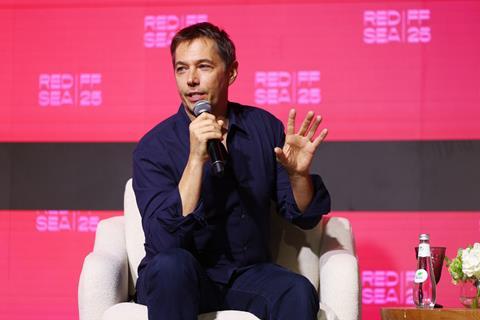
US director Sean Baker has said “filmmakers need to put their foot down” and that “theatrical windows should be expanded” when asked about Netflix’s proposed acquisition of Warner Bros during a wide-ranging discussion at Red Sea International Film Festival.
The Oscar-winning director of Anora, who presides over the jury at this year’s RSIFF, was applauded several times during the in-conversation event as he rallied to protect cinemas and the importance of film.
“I cannot comment on what’s going to happen with the whole Netflix-WB thing. I don’t know the details yet and I don’t know any of us should actually be commenting until we know exactly how it’s going to play out,” he said.
“But I do have to say that we should not be reducing theatrical windows, we should be expanding them. We really should be.
“What’s wrong with keeping something in a place where it’s like, ‘This is the only way you can see the film. This is how the filmmaker wants you to see this film, and everybody else who doesn’t want to, they can wait for it.’”
The filmmaker, who told Screen earlier this week that he plans to go into hard prep on his next production in January, said: “My next film, I’m going to get a 100-day theatrical window. That’s a little bit over three months and I think that’s a good place at this moment.
“When you have day-and-date and going directly to streaming, it diminishes the importance of a film. The theatrical experience elevates the importance. The way you present it to the world is a very important thing.”
The conversation was led by Fionnuala Halligan, Red Sea’s new director of international programmes, who said: “People don’t get enough time to know [a film] is on.”
“Yes, and that’s sadly happened a lot to me just recently,” Baker responded. “Films I’ve wanted to see on the big screen, I only had a week to do that. I didn’t even know.”
The filmmaker, known as a staunch advocate of cinema and celluloid, also expressed optimism as he increasingly sees young people heading to theatres.
“I am hopeful because Anora’s biggest audience was Gen Z, which I never would have expected,” said Baker. “I was told Gen Z aren’t going to the movies anymore and that’s not true. In LA, when I go to see movies, it’s usually Gen Z and I love the fact that younger people are seeing the value in a communal experience, and also one in which their focus is entirely on the film and not being distracted by everything else in the room, your phone or whatever.
“We have to support [cinema]. Audiences have to be reminded that they will lose their theatres if they don’t attend.”
Reflecting on Oscar wins
It has been nine months since Baker became the first person to win four Oscars on the same night for the same film with Anora – a fact that only recently began to sink in.
“In the last month, I’ve had time to really start thinking about it, because within 36 hours of the Oscars [we] were on our way to Tokyo, because the movie was opening there,” he recalled.
Immediately after that, he began working on Left-Handed Girl, a Taiwan-set drama directed by his long-time collaborator Shih-Ching Tsou, on which he was co-writer, producer and editor. That film also premiered at Cannes in Critics’ Week and was acquired by Netflix. It is Taiwan’s entry to the upcoming Oscars.
“It’s just recently that I’ve been able to reflect and it’s a beautiful thing,” he added. “We’re very happy with what happened with Anora because we never expected it. We went in thinking it was going to be the most divisive film.”
Anora premiered in Competition at Cannes in 2024, where it won the top prize. “Honestly, when the Palme d’Or happened, it was my dream come true… and I thought that was it. That was the win,” said Baker. “But as we were flying back from France, my phone started blowing up, and people were texting me, saying, ‘Get ready for the next six to eight months of your life. It’s going to be crazy.’ It’s like, we have to go on an Oscar run now? I almost had a nervous breakdown on the plane, because I thought that was going to be it. So it’s been quite a journey with this movie and a very incredible outcome.”
For his next project, Baker said it “will probably be around the size of Anora, staying in the same wheelhouse in terms of story and content”.
Asked how the Oscar might have changed opportunities for the staunch independent filmmaker, Baker said: “Well, the opportunities are there. Whether we’ll take them or not is the question because I’ve been in this world for so long and we got to a place with Anora where I was working with such an incredible team and the outcome was incredible. So why not try to repeat that?
“So I’m not going to go for the $150m studio thing. I’m just not. I am going to stay in this world. We like to make films independently.”
During the Q&A section of the event, the filmmaker was asked about the marketing budget of Anora by Sudanese filmmaker Mohamed Kordofani, who was among the audience. The director, whose debut feature Goodbye Julia played in Un Certain Regard at Cannes and won the Freedom Award, said: “I understand Anora was a $6m film with $18m for the marketing. How did this budget come about? It took me five years to collect $1m to make my film, and it went to Cannes and won an award. We then were submitted for the Oscar for best international film but had zero budget.”
Baker confessed that he was not aware of the marketing budget until the day after the Oscars when it was revealed on a podcast by Tom Quinn, president of the film’s distributor Neon. “I was just as surprised,” the US filmmaker added. “But it’s all good. I mean, it worked.”





No comments yet